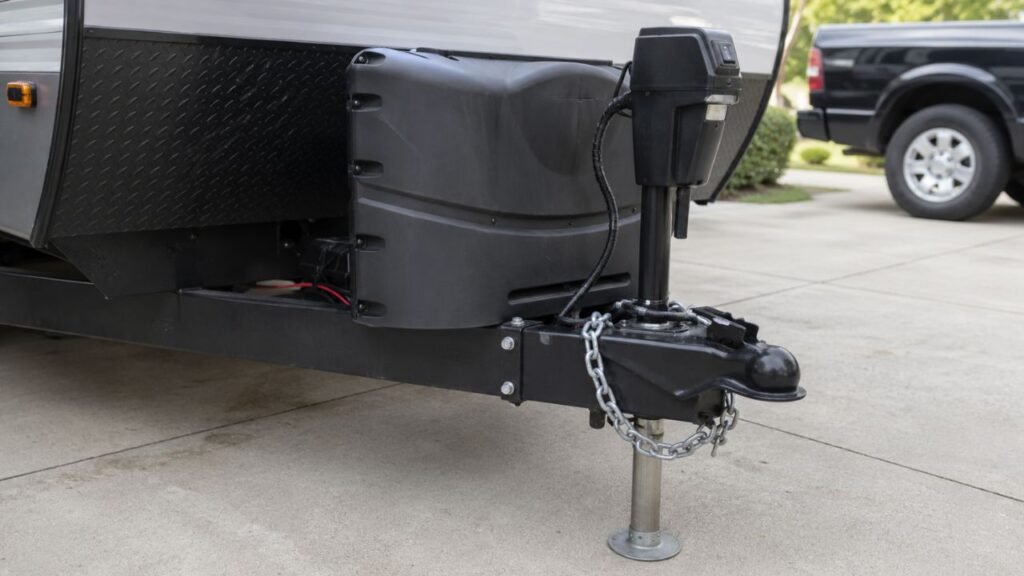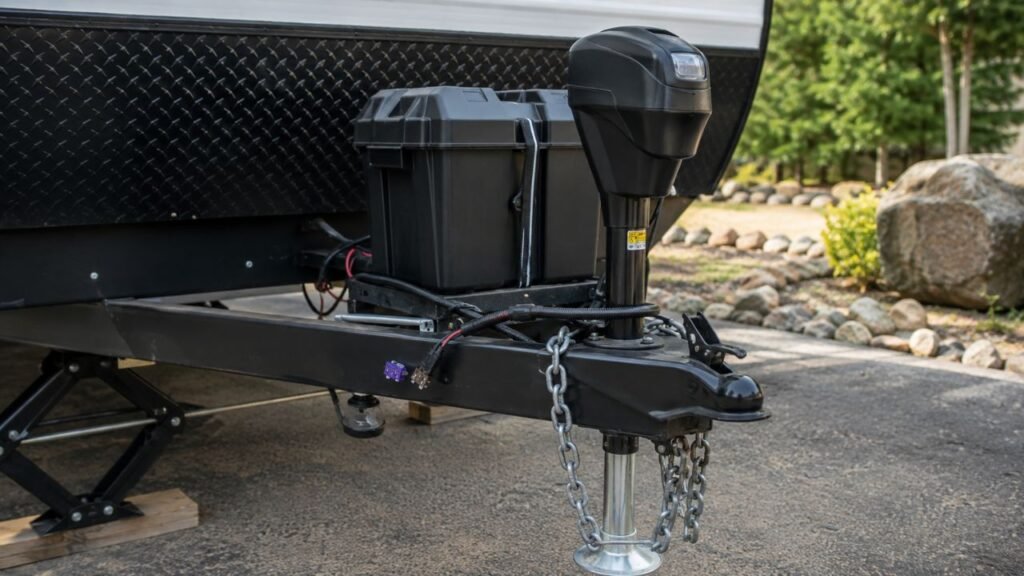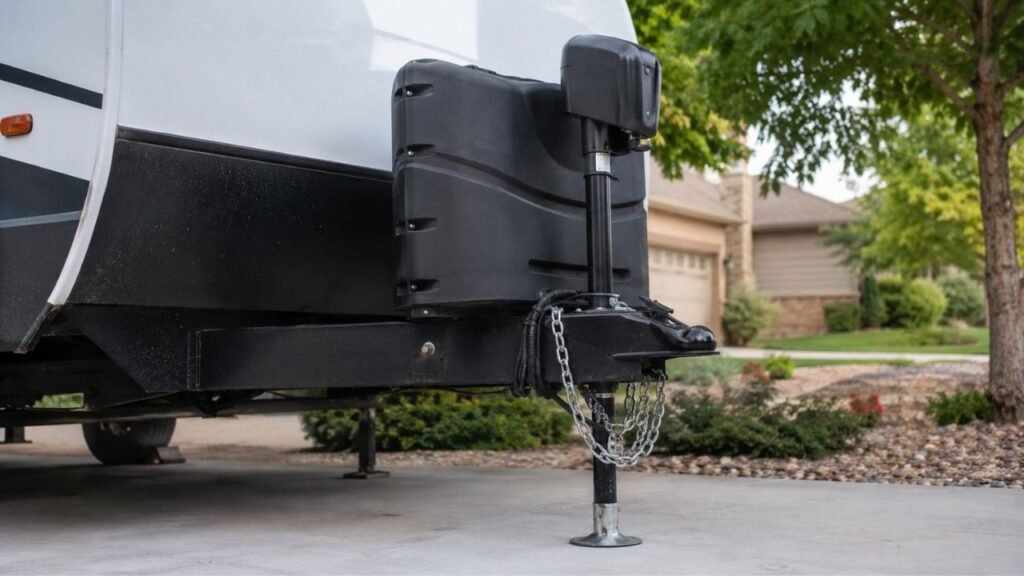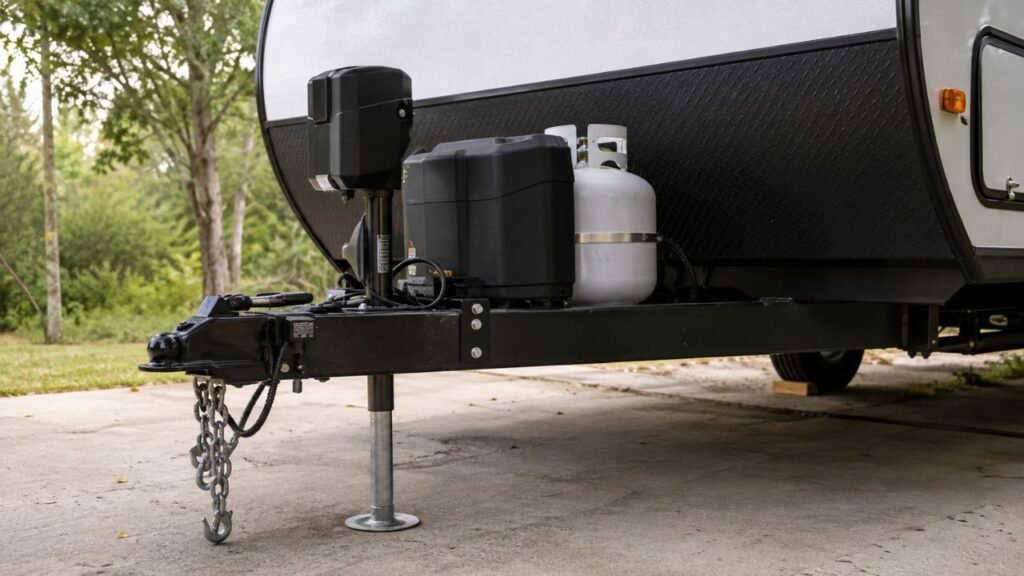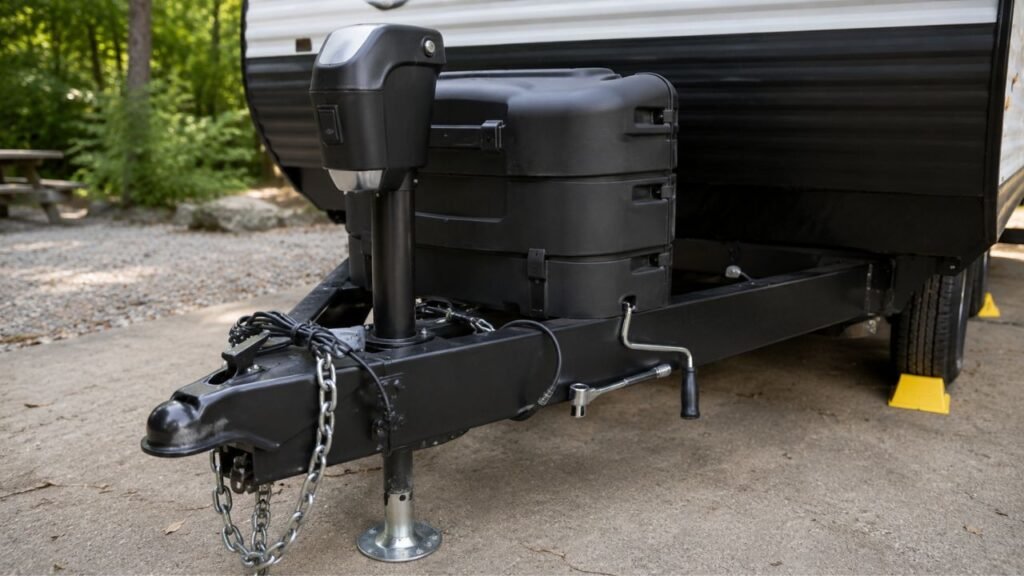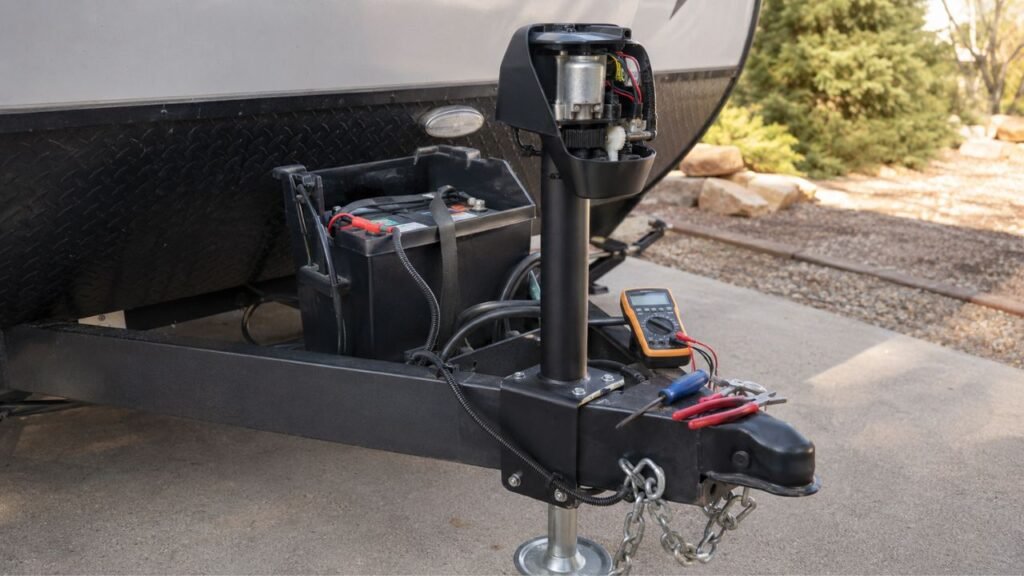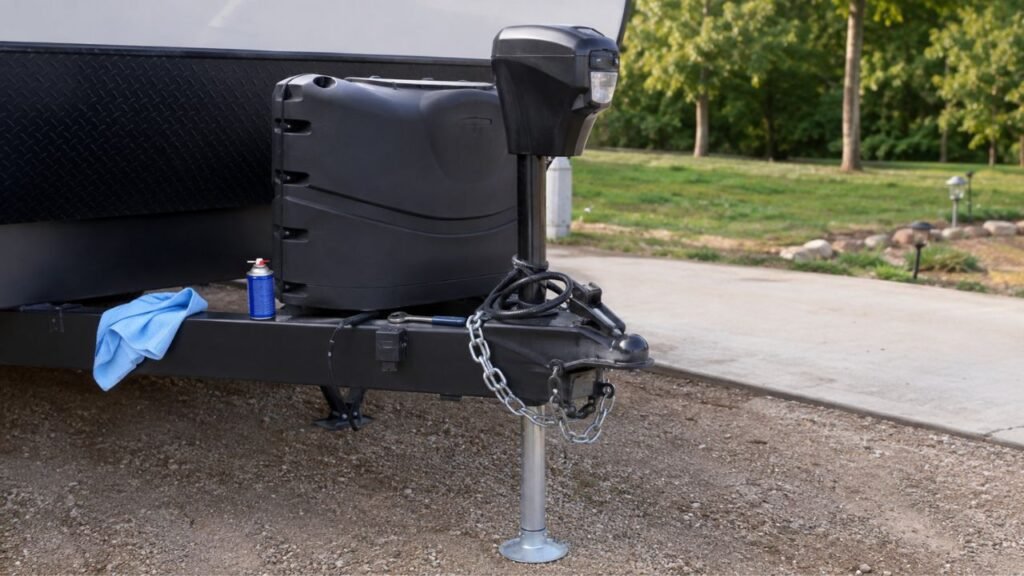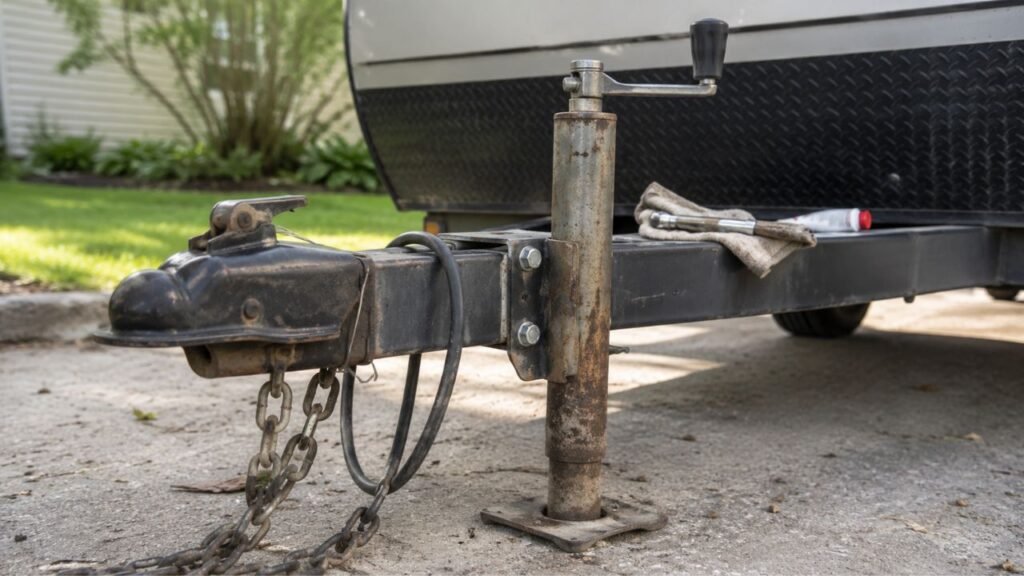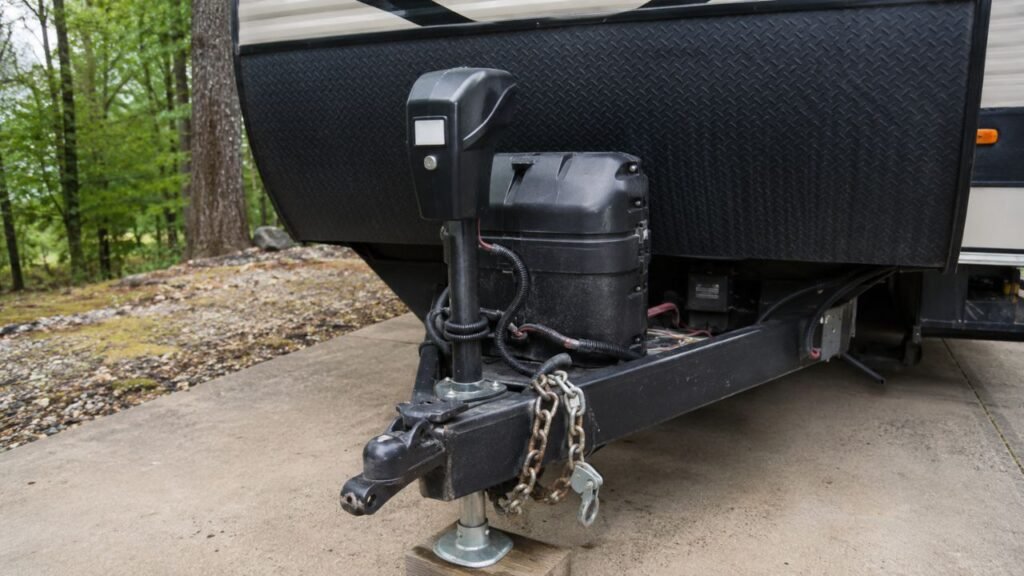
An electric trailer jack usually stops working because of a weak or disconnected 12V battery, blown fuse or circuit breaker, poor ground, damaged wiring, faulty switch, overloaded motor, or mechanical binding. Start with the battery, fuse, and ground before assuming the jack motor itself has failed.
Below, I’ll help you troubleshoot the problem from the easiest checks to the more serious mechanical issues. We’ll also cover what different noises mean, how to manually operate the jack, and when replacement makes more sense than repair.
Key Takeaways
- Start by checking the trailer’s 12V battery, fuse, and ground connection.
- A working jack light does not guarantee enough battery power for the motor.
- Clicking, humming, grinding, and slow movement can point to different problems.
- Test battery voltage while trying to operate the jack whenever possible.
- Never replace a blown fuse with one rated higher than the jack manufacturer specifies.
- The manual override can help determine whether the problem is electrical or mechanical.
- Stop using the jack if it binds, slips, grinds heavily, or has a visibly bent tube.
Quick Electric Trailer Jack Troubleshooting Guide
Your jack’s behavior often gives you the first clue about what’s wrong. Use this table to narrow down the problem before taking anything apart.
| What the Jack Is Doing | Likely Cause | What to Check First | What to Do Next |
| Completely dead | Battery, fuse, wiring, ground | Battery and fuse | Trace 12V power to jack |
| Light works, jack doesn’t | Weak battery, bad connection, switch | Battery under load | Check voltage and ground |
| Clicks but won’t move | Low voltage, poor connection, binding | Battery and manual override | Test electrical and mechanical sides |
| Hums but won’t move | Overload, jammed mechanism | Manual override | Check for binding |
| Works only one direction | Switch or wiring problem | Extend/retract switch | Test switch circuit |
| Moves very slowly | Weak battery, resistance, heavy load | Battery voltage | Clean connections and inspect load |
| Works with truck connected | Weak trailer battery | Trailer battery | Check battery charging system |
| Stops after a few seconds | Overload, heat protection, binding | Load and jack movement | Let cool and inspect |
| Keeps blowing fuse | Low voltage, short, overload | Wiring and battery | Find cause before replacing fuse |
| Grinds or skips | Gear or internal damage | Manual operation | Stop using and inspect |
Make the Trailer Safe Before Troubleshooting
Before checking wiring or manually operating the jack, make sure the trailer cannot roll or suddenly drop. A few simple precautions can prevent a small electrical problem from becoming a much bigger one.
- Park on firm, reasonably level ground.
- Chock the trailer wheels securely.
- Keep the tow vehicle connected when it makes the situation safer.
- Never crawl under a trailer supported only by the tongue jack.
- Use properly rated supports if the tongue must remain raised.
- Disconnect jack power before opening electrical connections.
- Keep your hands away from exposed gears or moving components.
- Stop pressing the switch if the motor is grinding or obviously stalled.
- Follow your jack manufacturer’s instructions before disassembly.
Once the trailer is stable, you can troubleshoot without rushing.
How to Troubleshoot an Electric Trailer Jack Step by Step
The easiest way to diagnose an electric trailer jack is to work from the power source toward the motor. Start with simple external checks before removing covers or replacing expensive parts.
1. Make Sure the Battery Disconnect Is On
This sounds obvious, but it catches people surprisingly often.
Many travel trailers have a battery disconnect switch that isolates much of the 12V electrical system during storage. If the disconnect has been turned off, the jack may receive no usable battery power.
Check whether your other 12V equipment works.
If several battery-powered accessories are dead at the same time, the problem is probably farther upstream than the jack.
2. Check the Trailer Battery
A weak battery is one of the first things I would check.
Look at both battery terminals and make sure they are tight. Corrosion around the posts, loose cable ends, or a partially disconnected negative cable can prevent the jack motor from receiving enough current.
If you have a multimeter, measure the battery voltage.
A fully charged 12V lead-acid battery at rest is usually around 12.6 to 12.8 volts. A reading around 12.2 volts indicates a significantly discharged battery, while something close to 12 volts or below deserves immediate attention.
Lithium batteries behave differently, so follow the voltage information provided by your battery manufacturer.
Also remember that resting voltage doesn’t tell the entire story.
3. Test Battery Voltage While Operating the Jack
This is one of the most useful tests you can perform.
Connect your multimeter to the battery and watch the reading while someone briefly presses the jack switch.
A battery might show decent voltage while sitting unused, then drop sharply when the motor demands current.
That’s why you may still have working trailer lights while the electric jack refuses to lift anything. The lights require much less power than the jack motor.
If voltage falls dramatically when the switch is pressed, investigate the battery before replacing the jack.
4. Inspect the Inline Fuse or Circuit Breaker
Follow the jack’s positive wire toward the trailer battery.
Many electric tongue jacks have an inline fuse holder or small breaker somewhere along this power wire.
Open the holder and inspect the fuse.
A broken internal element usually means the fuse has blown, but don’t rely only on appearance if you have a meter available. Some damaged fuses can be difficult to identify visually.
Also inspect the holder itself.
Look for:
- Corrosion
- Loose contacts
- Melted plastic
- Heat discoloration
- Water intrusion
- Damaged terminals
If the fuse is blown, replace it only with the type and amperage specified for your jack.
Don’t assume every electric trailer jack uses the same fuse rating.
And never install a larger fuse just because the correct one keeps blowing. That can allow wiring to overheat before the fuse protects the circuit.
5. Check the Jack Ground
A poor ground can make an otherwise healthy electric jack appear completely dead.
Some jacks ground through their mounting bolts and trailer frame. Others use a dedicated negative wire.
If yours grounds through the mounting hardware, inspect the area around the jack flange and mounting bolts.
Rust, thick paint, corrosion, or loose hardware can interfere with electrical contact.
You want a clean and secure metal-to-metal connection wherever the manufacturer expects the jack to ground.
If your jack uses a separate ground wire, follow that wire back toward the battery or grounding point. Check for loose terminals, corrosion, or damaged wire.
Don’t automatically start scraping paint from the trailer until you know how your particular jack is designed to ground.
6. Inspect the Power Wire and Connections
Once the battery, fuse, and ground look good, follow the wiring.
Pay special attention to areas where wires pass around the A-frame or close to metal edges.
Look for:
- Cracked insulation
- Frayed wire
- Pinched sections
- Loose ring terminals
- Corroded connectors
- Damaged fuse holders
- Heat-damaged terminals
- Wires rubbing against the trailer frame
- Loose connectors inside the jack housing
A wire may look connected while having significant resistance inside a corroded terminal.
That’s another reason voltage testing under load is so useful.
7. Try the Jack With the Tow Vehicle Connected
If your trailer and tow vehicle are configured to provide charging power through the 7-way connector, connecting the truck can sometimes help with diagnosis.
Suppose the jack is dead when running only from the trailer battery but begins working after the truck is connected.
That strongly suggests you should investigate the trailer battery or charging circuit.
Possible causes include:
- Discharged trailer battery
- Weak or failing battery
- Loose battery cable
- Battery disconnect issue
- Charging system problem
- Poor battery connection
However, don’t assume every tow vehicle can provide enough current through the trailer connector to operate every jack.
Use this as a diagnostic clue rather than a universal operating method.
8. Check the Extend/Retract Switch
The rocker or toggle switch can eventually wear out.
A switch problem becomes more likely when the jack works in one direction but not the other.
For example, it might retract normally but refuse to extend.
You may also notice that moving or wiggling the switch briefly brings the jack back to life.
Before blaming the switch, confirm that good voltage is reaching the jack.
If incoming power and ground are good but one switch direction consistently does nothing, the switch or its internal wiring deserves closer inspection.
9. Check for Overload or Travel-Limit Problems
Electric trailer jacks are designed to operate within a certain lifting capacity and travel range.
Problems can occur when the jack is:
- Fully extended
- Fully retracted
- Carrying too much tongue weight
- Being forced against its mechanical stop
- Trying to lift while side-loaded
- Working against a jammed or damaged component
If the jack suddenly stops at the very top or bottom of its travel, don’t keep holding the switch.
Release it and try moving slightly in the opposite direction.
If that works, the jack may simply have reached its travel limit.
10. Let an Overheated Jack Cool
Some electric jacks can temporarily stop operating when the motor becomes too hot or overloaded.
You might notice that the jack quits, then starts working again after sitting for a while.
That doesn’t necessarily mean the problem has disappeared.
Repeated overheating can indicate:
- Excessive tongue load
- Low battery voltage
- Corroded electrical connections
- Mechanical binding
- Too many long operating cycles
Let the motor cool, then investigate why it was working so hard.
11. Check for Mechanical Binding
If the electrical side seems healthy, inspect the moving parts.
Look closely at the inner and outer jack tubes.
Check for:
- Bent tubing
- Heavy rust
- Dirt buildup
- Impact damage
- Misalignment
- Side loading
- Damaged foot plate
- Bent drop leg
- Unusual resistance
A bent tube can put enormous strain on the motor.
If the jack looks visibly damaged, continuing to run the motor may turn a repairable issue into a complete gearbox or motor failure.
What Different Electric Trailer Jack Symptoms Tell You
The sound and behavior of the jack can tell you almost as much as a meter. Here’s how I would interpret several common symptoms.
Electric Trailer Jack Light Works but the Motor Doesn’t
This often confuses trailer owners.
The light may illuminate normally, making you think the jack has plenty of electrical power.
But the LED requires very little current compared with the motor.
A weak battery or high-resistance connection may provide enough electricity for the light while failing as soon as the motor tries to lift the trailer.
Check battery voltage under load, ground connections, and the power wiring before replacing the motor.
Electric Trailer Jack Clicks but Won’t Move
A click usually means something is receiving at least some power.
However, the motor may not be receiving enough current to turn.
Check:
- Battery condition
- Battery terminals
- Ground
- Fuse or breaker
- Voltage reaching the jack
If voltage is good, try the manual override.
A jack that cannot be manually moved may have a mechanical problem rather than an electrical one.
Electric Trailer Jack Works Down but Not Up
Raising the trailer usually requires more effort than lowering it.
That’s why a weak battery or poor connection may first show up when you’re trying to lift the tongue.
However, one-way operation can also indicate a damaged extend/retract switch.
Start by testing battery voltage while lifting.
If voltage remains healthy and the jack works strongly in one direction, inspect the switch and related wiring.
Electric Trailer Jack Works Only When Plugged Into the Truck
This often points back to the trailer’s battery.
Your tow vehicle may be adding charging voltage to the trailer electrical system, allowing the jack to operate.
Check the trailer battery for:
- Low charge
- Internal failure
- Loose terminals
- Battery disconnect problems
- Charging-system problems
Don’t replace the jack until you’ve ruled these out.
Electric Trailer Jack Stops After a Few Seconds
A jack that starts normally and quickly shuts down may be experiencing excessive load or motor heat.
Mechanical resistance is another possibility.
If the jack repeatedly stops in the same physical position, inspect the jack tube and internal mechanism more closely.
If it stops after long use but works again after cooling, overheating or overload becomes more likely.
Electric Trailer Jack Hums or Grinds but Doesn’t Move
A humming motor usually means the motor is trying to turn.
That moves mechanical binding, overload, or internal drive problems higher on the list.
Grinding, popping, or skipping sounds are more concerning.
They can indicate damaged gears or other internal components.
Don’t repeatedly hold the switch hoping it will work through the problem. Stop and inspect the jack before additional damage occurs.
Why Does My Electric Trailer Jack Keep Blowing Fuses?
One blown fuse may simply be an isolated electrical event. A jack that repeatedly blows the correct fuse is telling you something is wrong, so replacing fuse after fuse is not the solution.
Low Battery Voltage
It seems strange, but low voltage can contribute to high-current problems.
When an electric motor struggles because voltage is too low, it may draw excessive current while trying to do the same work.
That can cause the fuse to open.
Charge and test the battery before assuming you need a larger electrical repair.
Excessive Tongue Weight or Mechanical Binding
The harder the motor has to work, the more current it may require.
A jack struggling with excessive load, bent tubing, heavy corrosion, or internal mechanical resistance can repeatedly overload the circuit.
Confirm that your loaded tongue weight is within the jack’s rated capacity.
Damaged or Shorted Wiring
Inspect the positive wire carefully.
A section of insulation rubbing against the trailer’s A-frame may eventually expose the conductor.
Moisture inside a connector or fuse holder can also create electrical problems.
Pay particular attention to wiring near sharp metal edges and moving components.
Failing Motor or Internal Jack Damage
If the battery, fuse rating, wiring, load, and mechanical movement all check out, the motor itself may be failing.
Internal gearbox damage can also increase resistance enough to overload the motor.
At that point, repair or replacement becomes more realistic.
Whatever you do, never install a higher-rated fuse to stop the correct fuse from blowing.
How Do I Manually Raise or Lower an Electric Trailer Jack?
Most electric tongue jacks include some type of manual override so you aren’t stranded if the battery or motor fails. The exact procedure varies, so keep your jack manual in the trailer whenever possible.
- Chock the trailer wheels securely.
- Make sure the trailer is stable.
- Turn off or disconnect jack power if your instructions require it.
- Locate the manual-override cover on top of the jack.
- Remove the protective cap.
- Insert the supplied crank or correct-size socket.
- Turn slowly in the specified direction.
- Watch the jack leg as it moves.
- Stop if the jack becomes unusually difficult to turn.
- Reinstall the weatherproof cover when finished.
Don’t assume that every electric jack uses the same socket size or rotates the same way.
Check the instructions for your particular model.
What Does the Manual Override Test Tell You?
Besides getting you hitched or unhitched, the manual crank is a useful troubleshooting tool. How the jack feels when you turn it can help separate an electrical failure from a mechanical one.
| What Happens Manually | What It May Mean |
| Jack turns smoothly | Electrical problem more likely |
| Very hard to turn | Binding, rust, bent tube, or internal resistance |
| Shaft turns but jack doesn’t move | Gear or drive failure |
| Jack jams at the same location | Tube, screw, gear, or alignment problem |
| Jack cannot be turned | Serious mechanical seizure |
| Grinding or skipping occurs | Internal gear damage possible |
If the jack moves easily by hand but won’t move electrically, focus your troubleshooting on the battery, fuse, wiring, switch, and motor.
If it is extremely difficult to move manually, don’t force the motor to do the same job.
Can Shore Power Make an Electric Trailer Jack Work?
An electric tongue jack normally operates from the trailer’s 12V DC system.
Shore power may indirectly help if your trailer’s converter or charger is supplying the 12V system and charging the battery.
But how this behaves depends on the trailer’s electrical design.
If the jack works while connected to shore power but fails when disconnected, I would investigate the trailer battery first.
The battery may be discharged, weak, disconnected, or unable to support the jack under load.
Can a 7-Pin Trailer Plug Power an Electric Jack?
Sometimes, but don’t treat that as guaranteed.
Many tow vehicles provide a 12V charging circuit through the 7-way trailer connector. Depending on the vehicle and trailer wiring, that extra power may allow the electric jack to operate.
If your jack suddenly works after connecting the truck, that’s useful information.
It suggests the trailer battery or its connections deserve attention.
However, the charging circuit in the tow vehicle may not be intended to supply the jack’s full operating current by itself.
When Is the Electric Trailer Jack Actually Bad?
After checking the external electrical system, you may eventually find that the jack itself is the problem.
Possible signs include:
- Correct voltage reaches the jack under load.
- Ground connection tests good.
- Fuse or breaker remains functional.
- Switch output appears normal.
- Motor still won’t operate.
- Jack is extremely difficult to move manually.
- Internal gears grind, skip, or pop.
- Manual shaft turns without moving the jack leg.
- Jack slips while supporting tongue weight.
- Jack tube is visibly bent.
- Motor housing has severe water damage.
Don’t replace the jack simply because it stopped moving once.
Battery and connection problems are much easier and cheaper to fix.
But if the jack slips under load or has structural damage, safety matters more than squeezing additional life out of it.
Should You Repair or Replace the Electric Trailer Jack?
Some electric jack problems are inexpensive to fix, while others make replacement the more sensible choice. Look at both the damage and the jack’s overall condition before spending money on parts.
Repair May Make Sense When
Repair is often reasonable when the problem is limited to:
- Corroded battery connections
- Damaged fuse holder
- Loose electrical terminal
- Poor ground
- External wiring damage
- Replaceable switch
- Replaceable weather seal or cover
- Minor serviceable components
If the mechanical assembly is still strong and replacement parts are available, there’s usually no reason to throw away the whole jack.
Replacement May Make More Sense When
Consider replacing the jack when you find:
- Bent jack tube
- Serious gearbox damage
- Jack slipping under load
- Severe internal corrosion
- Major water intrusion
- Damaged motor plus damaged gears
- Structural mounting damage
- Jack that is undersized for your trailer
- Repair parts that are unavailable or unusually expensive
A trailer tongue jack carries a significant load.
When structural reliability becomes questionable, replacement is usually the safer choice.
How to Prevent Electric Trailer Jack Problems
A little maintenance can prevent many of the failures that leave trailer owners stuck at campsites or in driveways.
- Keep the trailer battery properly charged.
- Inspect battery terminals before longer trips.
- Keep electrical connections clean and tight.
- Inspect the jack’s power wire for rubbing or damage.
- Keep the manual-override cover installed.
- Protect the jack head from unnecessary water exposure.
- Don’t hold the switch against the travel limit.
- Stay within the jack’s rated capacity.
- Keep exposed jack tubing reasonably clean.
- Lubricate only where your jack manufacturer recommends.
- Carry the correct manual crank.
- Keep the correct replacement fuse in your trailer tool kit.
I especially recommend making sure you can find the manual crank before every major trip.
The middle of a rainy campsite is not the ideal place to discover that it’s sitting in your garage.
Final Words
If your electric trailer jack is not working, troubleshoot it in this order: battery, fuse or breaker, ground, wiring, switch, motor, and mechanical components. That sequence helps you rule out the most common and inexpensive problems before replacing anything major.
Most dead-jack situations come down to the 12V power supply or a poor electrical connection. But grinding, slipping, severe binding, or visible bending deserves more caution. If the jack cannot safely support and move the trailer tongue, stop using it until the underlying problem is repaired.
Related FAQs
Why Is My Electric Trailer Jack Completely Dead?
A completely dead jack usually points to lost 12V power. Check the trailer battery, battery disconnect, inline fuse or breaker, positive wire, and ground connection before assuming the motor has failed.
Why Does My Trailer Jack Light Work but the Jack Won’t Move?
The light requires very little current, while the motor needs much more. A weak battery, voltage drop, bad ground, damaged wiring, switch problem, or motor failure can therefore stop the jack even though its light still works.
Why Does My Electric Trailer Jack Click but Not Move?
Clicking often means some electrical power is reaching the jack, but the motor may not have enough current to turn. Check battery voltage under load, connections, ground, and then test whether the jack moves with the manual override.
Where Is the Fuse for My Electric Trailer Jack?
The fuse is commonly located in an inline holder along the positive wire between the jack and trailer battery, although placement varies. Follow the jack’s power wire toward the battery if you cannot immediately see it.
What Size Fuse Does an Electric Trailer Jack Use?
Fuse size depends on the jack model. Some use 30-amp protection, but you should always use the exact fuse type and amperage specified by your jack manufacturer rather than assuming all electric tongue jacks are the same.
Can a Bad Ground Stop an Electric Trailer Jack From Working?
Yes. A poor ground can completely stop the motor or cause slow and intermittent operation. Check the jack’s dedicated negative wire or its frame-ground connection, depending on how your particular model is designed.
Why Does My Electric Trailer Jack Only Work With the Truck Connected?
This usually suggests the trailer battery is weak, discharged, disconnected, or poorly connected. The tow vehicle may be adding enough charging voltage through the trailer connector to temporarily make the jack operate.
Why Does My Electric Trailer Jack Work in Only One Direction?
A jack that extends but won’t retract, or retracts but won’t extend, may have a faulty rocker switch or internal wiring problem. Low voltage can also show up more strongly while lifting because raising the trailer requires more motor effort.
Why Is My Electric Trailer Jack Moving Slowly?
Slow movement can come from a weak battery, voltage drop, corroded connections, excessive tongue weight, cold conditions, or mechanical resistance inside the jack. Check electrical voltage under load before assuming the motor is worn out.
Why Does My Electric Trailer Jack Keep Blowing Fuses?
Repeated fuse failure can result from low battery voltage, damaged wiring, a short circuit, excessive load, mechanical binding, or a failing motor. Find the cause rather than installing a fuse with a higher amperage rating.
Can I Manually Crank an Electric Trailer Jack?
Most electric tongue jacks include a manual override for power failures. Use the supplied crank or the socket size specified by the manufacturer, and stop if the mechanism feels unusually difficult to turn.
How Do I Know if My Electric Trailer Jack Motor Is Bad?
Motor failure becomes more likely when proper voltage reaches the jack, the ground and fuse are good, the switch is functioning, and the jack moves freely by hand but still won’t operate electrically.

Ryan Mitchell writes for readers who prefer independent travel and practical outdoor motorhome living. His how-to guides and reviews focus on simplicity, durability, and real value. He brings a calm, hands-on perspective to every topic.