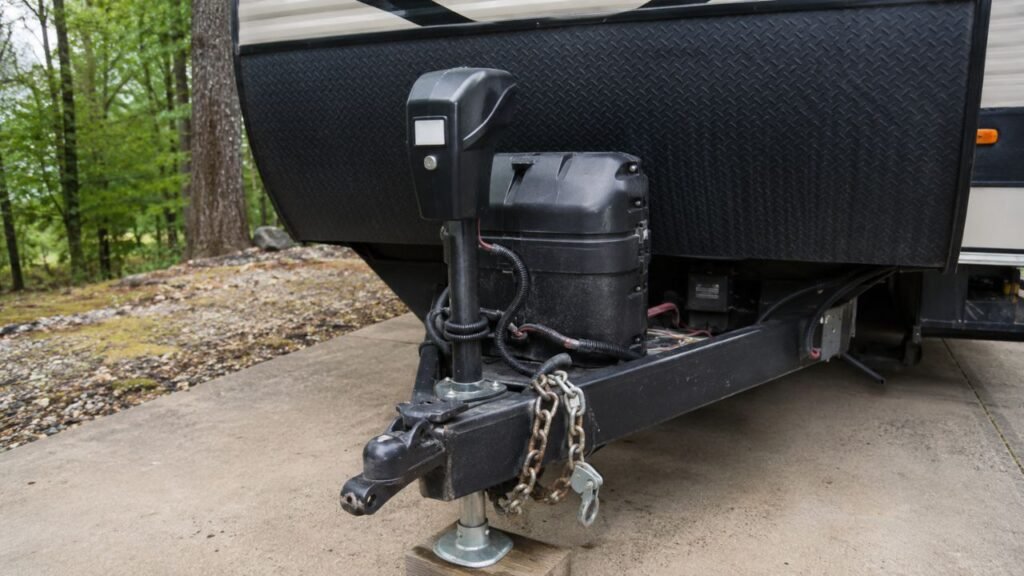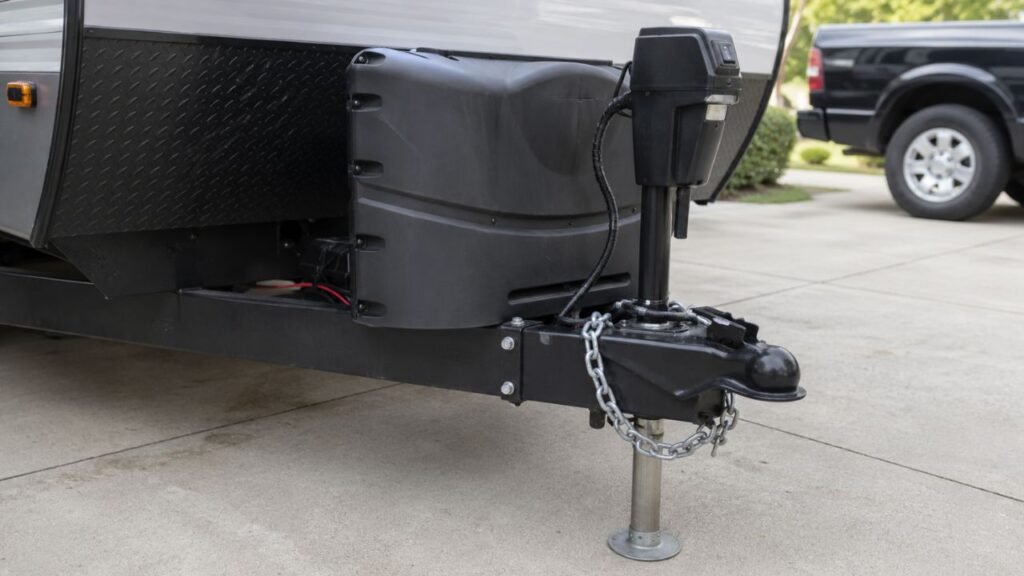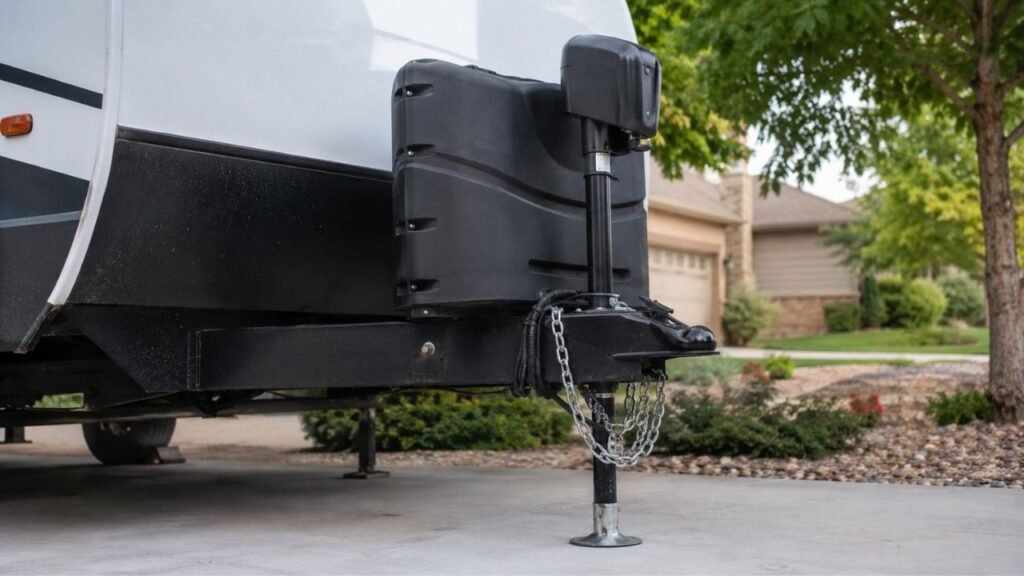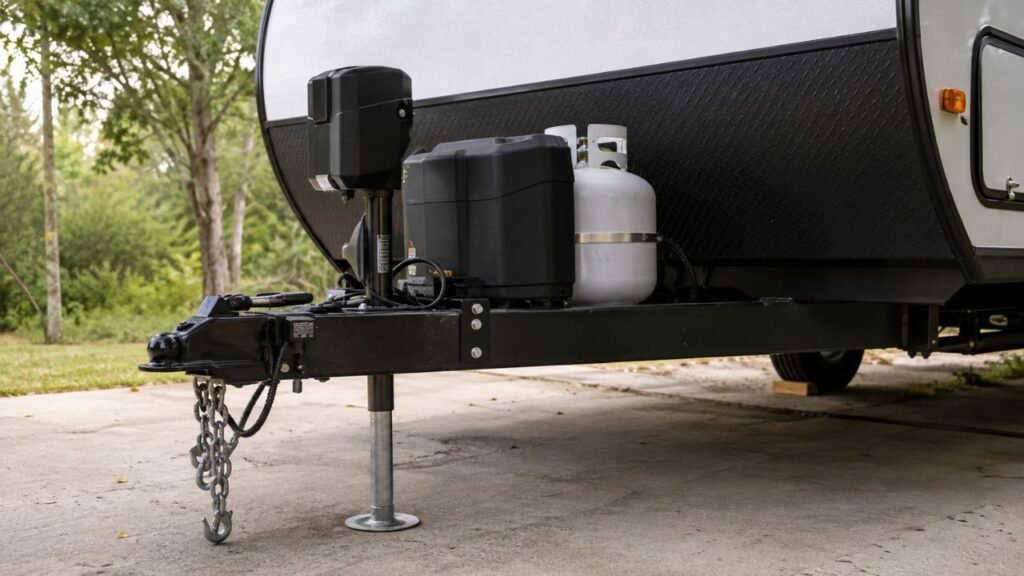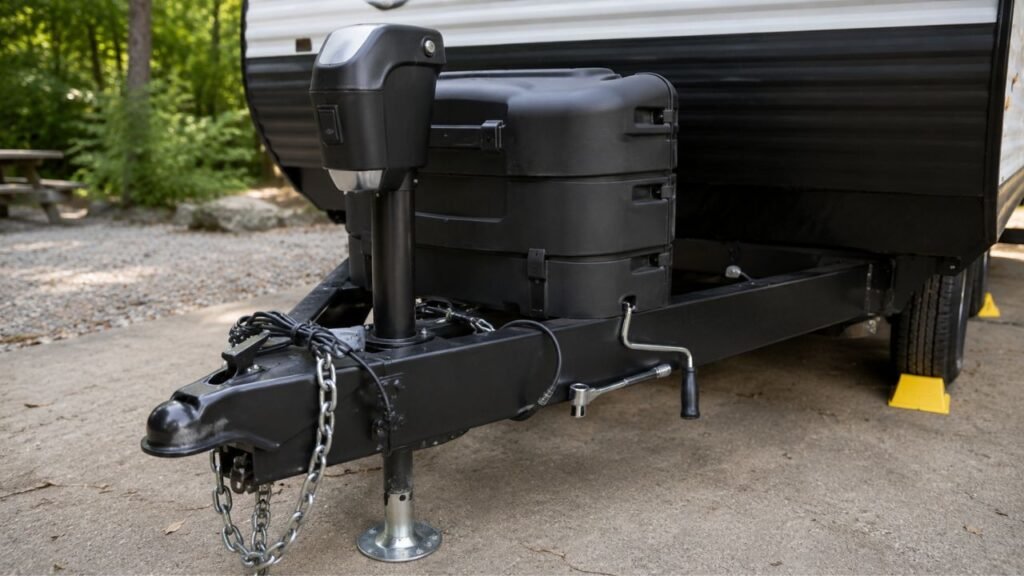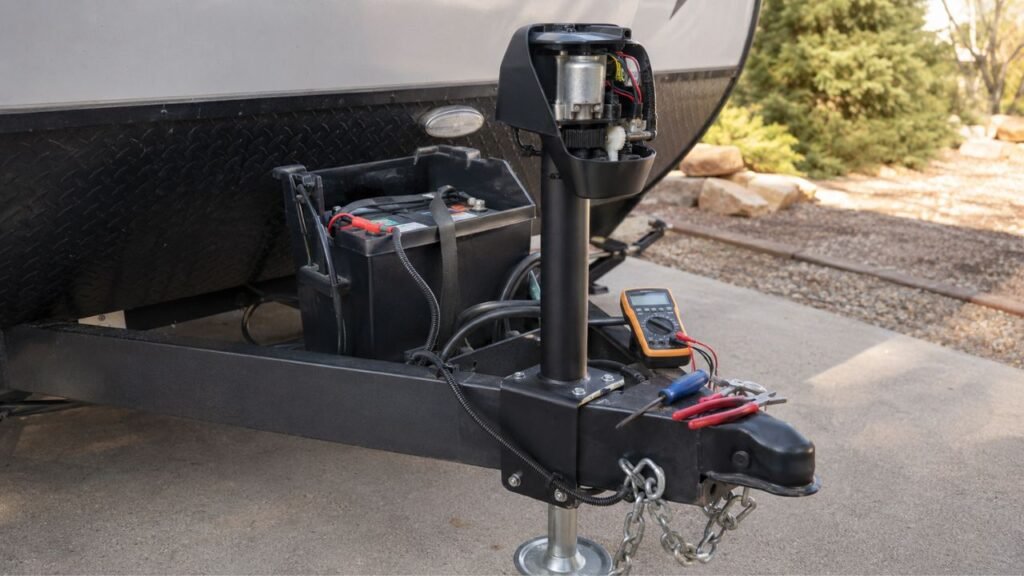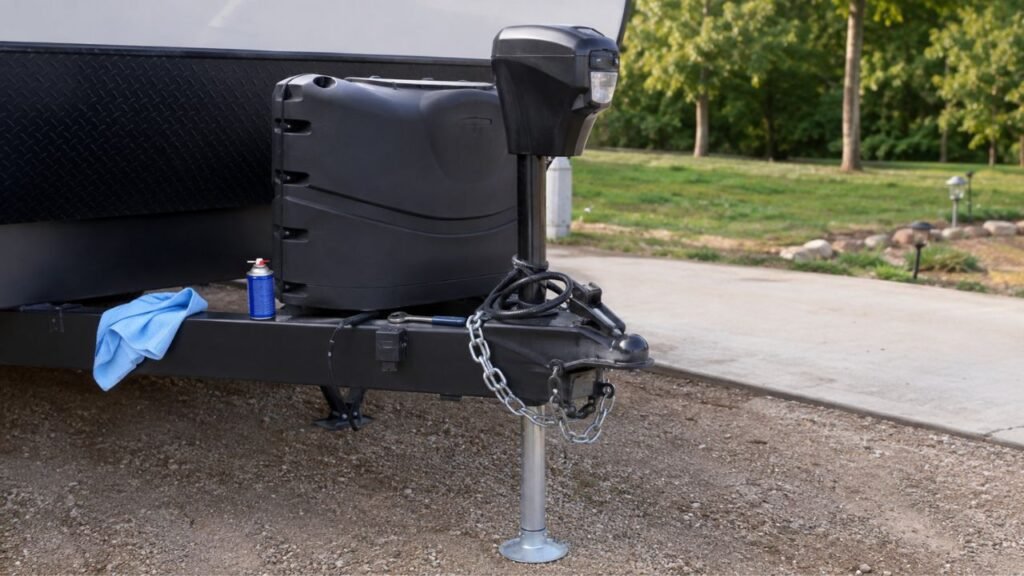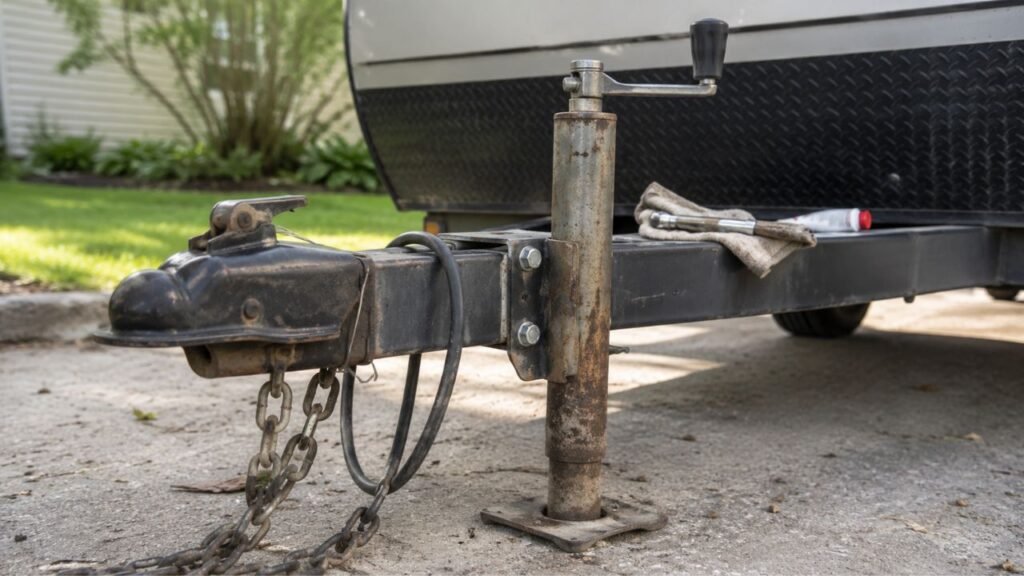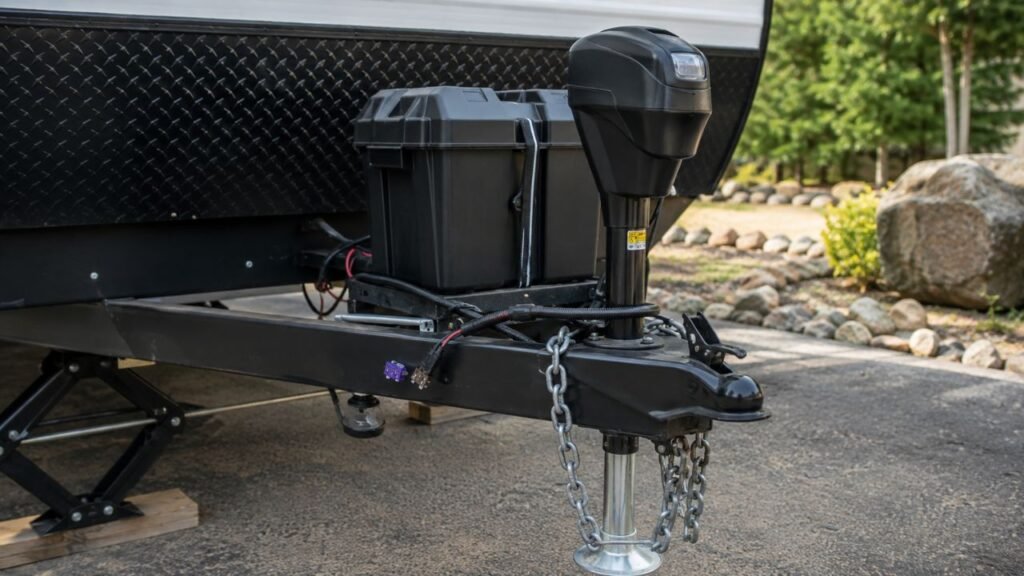
An electric trailer jack usually keeps blowing fuses because the motor is drawing excessive current or the circuit has an electrical fault. Common causes include hitting the jack’s travel limit, low battery voltage, poor connections, mechanical binding, damaged wiring, excessive tongue load, or a failing motor.
If your fuse keeps popping, replacing it repeatedly will not solve the problem. Below, I’ll help you narrow down the cause based on when the fuse blows, then walk you through the checks you can safely make yourself.
Key Takeaways
- A repeatedly blown fuse usually indicates excessive current or an electrical fault.
- Stop holding the switch once the jack reaches its travel limit.
- Check battery condition and electrical connections before blaming the motor.
- Rust, corrosion, or paint can interfere with some jack grounding systems.
- A stiff manual crank can point toward mechanical binding.
- Never install a larger fuse unless your jack manufacturer specifies it.
- Fuse failure only under load often points toward voltage, binding, or overload.
What Does It Mean When an Electric Trailer Jack Blows a Fuse?
A blown fuse is usually doing exactly what it was designed to do. It interrupts the circuit when electrical current rises beyond the protected circuit’s safe range.
That does not necessarily mean your jack is ruined.
You might occasionally blow a fuse by accidentally holding the switch after the jack reaches its limit. However, if the correct fuse repeatedly blows during normal operation, something needs attention.
The real goal is not finding a fuse that survives longer. You need to determine why the jack circuit is becoming overloaded.
Repeated fuse failure usually comes from one of three areas:
- Electrical supply or wiring problems
- Excessive mechanical resistance
- Excessive load or an internal jack problem
Knowing exactly when the fuse fails can make diagnosis much easier.
When Does the Fuse Blow? This Can Point to the Cause
Pay attention to what the jack is doing immediately before the fuse fails. That small detail can dramatically narrow your troubleshooting.
| When the Fuse Blows | Possible Cause | What to Check First |
| At full retraction | Jack reaches travel limit | Stop before the limit and check jack operation |
| At full extension | End-of-travel resistance | Retract slightly and test again |
| Immediately after pressing switch | Shorted wire or internal electrical fault | Inspect wiring and fuse holder |
| Only while lifting trailer | High load, weak battery, binding | Battery, tongue load, mechanical resistance |
| After several seconds | Voltage drop, heat, mechanical drag | Connections, battery, motor condition |
| Only in one direction | Switch, wiring, internal mechanism | Directional switch and jack mechanism |
| After rain or washing | Moisture or corrosion | Jack head, switch, connections |
| Randomly | Loose connection or damaged fuse holder | Terminals, ground, fuse holder |
This symptom-based approach can save you considerable troubleshooting time.
7 Common Reasons Your Electric Trailer Jack Keeps Blowing Fuses
Most repeated fuse failures come from electrical resistance, excessive mechanical load, or the jack being operated beyond its normal limits. Start with the simplest possibilities before assuming the motor has failed.
1. You’re Running the Jack Into Its Travel Limit
This is one of the easiest ways to overload an electric tongue jack.
When the jack reaches full extension or retraction, it cannot continue moving. If the motor keeps receiving power, resistance rises dramatically.
Depending on the jack design, you may hear:
- The motor suddenly change pitch
- The motor noticeably slow down
- Clicking or clutch noise
- A strained motor sound
- The fuse suddenly pop
Some jacks include clutches, limit protection, or internal breakers. Others depend more heavily on the operator stopping at the correct point.
Don’t keep holding the switch once movement stops.
If your fuse usually blows when the jack is completely retracted, this should be one of your first suspects.
2. Your Trailer Battery Is Weak or Voltage Is Dropping
Your electric jack needs a healthy 12-volt electrical supply to operate properly.
A battery can appear normal while sitting unused but struggle once the jack motor places it under load. Poor terminals and undersized or damaged connections can create similar symptoms.
Look for:
- A partially discharged battery
- Old or failing battery
- Loose battery terminals
- Corroded terminals
- Poor cable connections
- Significant voltage drop while operating
Don’t judge the battery only by what it reads while resting.
If possible, measure the voltage while somebody briefly operates the jack. A large voltage drop under load deserves further investigation.
Some jack manufacturers specifically warn that inadequate supply voltage can contribute to premature fuse failure.
3. The Jack Has a Poor Ground or Corroded Connection
A poor electrical connection can create trouble even when your battery is healthy.
Some electric tongue jacks ground through their mounting hardware and trailer frame. Others use a dedicated ground wire.
Check your exact jack before changing anything.
For frame-grounded jacks, problems may include:
- Rust around mounting bolts
- Heavy paint beneath the mounting flange
- Corroded mounting surfaces
- Loose jack mounting bolts
- Dirty hardware
For jacks using dedicated ground wiring, inspect the ground terminal, wire, connector, and frame connection.
You want clean, secure electrical connections with no obvious corrosion.
If the mounting area is supposed to provide the ground, clean metal-to-metal contact becomes especially important.
4. The Power Wire or Fuse Holder Is Damaged
Sometimes the problem isn’t inside the jack at all.
The positive power wire typically runs through an inline fuse before reaching the jack. Damage anywhere along this path can create intermittent or immediate fuse problems.
Inspect the entire accessible wire carefully.
Watch for:
- Chafed insulation
- Pinched wires
- Melted insulation
- Loose crimp connections
- Corroded terminals
- Heat-damaged fuse holders
- Loose fuse blades
- Water inside electrical connections
Pay special attention where wiring passes around the trailer A-frame.
Repeated vibration can eventually rub insulation through.
If the fuse blows immediately when you press the switch, even without lifting much weight, damaged wiring or an electrical fault should move higher on your list.
5. The Jack Screw, Leg, or Gears Are Binding
Your motor has to work much harder when the jack mechanism cannot move freely.
Possible causes include:
- Dry internal components
- Dirt around the jack tube
- Corrosion
- Bent inner tube
- Damaged gears
- Side loading
- Worn screw mechanism
- Poor maintenance
One useful clue is the manual override.
After safely securing the trailer, try operating the jack manually according to the manufacturer’s instructions.
It should require some effort because you’re moving a loaded mechanical system. However, it should not feel severely jammed or unusually difficult.
If manual operation is extremely stiff, the problem may be mechanical rather than purely electrical.
Don’t randomly pack grease into a sealed jack head.
Use the lubrication method recommended for your exact jack model.
6. The Tongue Weight Is Too High for the Jack
Every electric trailer jack has a maximum lifting capacity.
If your tongue load exceeds that rating, the motor may become overloaded while lifting.
This can happen even if the jack worked properly before.
Changes around the front of the trailer can increase tongue weight, including:
- Additional batteries
- Larger propane tanks
- Storage boxes
- Cargo placed toward the front
- Heavy accessories mounted near the tongue
Weight-distribution hitch hookup procedures can also temporarily place additional force on the jack.
Don’t compare the jack’s rating only with your trailer’s total GVWR. What matters is the load the jack actually has to lift during operation.
If the fuse only blows while lifting the trailer but not when moving the jack unloaded, load-related problems deserve close attention.
7. The Motor, Switch, or Gearbox Is Starting to Fail
Sometimes the jack itself is simply wearing out.
Electric motors and internal components can develop problems after years of use, water exposure, corrosion, or repeated overloading.
Warning signs may include:
- Motor becoming noticeably slower
- Unusual grinding sounds
- Intermittent operation
- Motor getting excessively hot
- Burning electrical smell
- Jack stopping unpredictably
- Repeated fuse failure with good voltage
- Water or corrosion inside the jack head
You should not immediately replace the entire jack because one fuse blew.
However, if the battery, wiring, ground, capacity, and mechanical movement all check out, an internal failure becomes much more likely.
How to Troubleshoot an Electric Trailer Jack That Keeps Blowing Fuses
Troubleshooting works best when you move from simple checks toward more advanced testing. Avoid replacing several parts at once because that makes the real problem harder to identify.
Step 1: Secure the Trailer Before Testing
Safety comes first whenever you’re working around the tongue jack.
Park on firm, level ground when possible.
Chock the trailer wheels securely before testing anything.
Never crawl beneath a trailer supported only by the tongue jack. If you need to remove or unload the jack, use properly rated support equipment.
Step 2: Verify the Correct Fuse Rating and Type
Before installing another fuse, confirm what belongs there.
Look for:
- Jack model number
- Manufacturer label
- Owner’s manual
- Fuse amperage requirement
- Required fuse style
A 30-amp fuse is common on several electric tongue jack models, but that does not make 30 amps universal.
Your jack may require something different.
More importantly, never replace the specified fuse with a higher-amperage fuse just because the correct one keeps blowing.
That may allow wiring or internal components to overheat before circuit protection opens.
Step 3: Fully Charge and Test the Battery
Start with a properly charged battery.
Clean and tighten the battery terminals before testing again.
If you have a multimeter, measure battery voltage at rest. Then watch what happens when the jack operates briefly.
A battery that looks acceptable unloaded may drop considerably once the motor starts working.
If voltage collapses significantly, investigate:
- Battery condition
- Battery charge level
- Terminal connections
- Cable condition
- Excessive resistance
This is particularly important if your jack works better while connected to an external charging source.
Step 4: Inspect the Jack’s Ground Connection
Determine how your particular jack receives its ground.
If it uses the mounting flange, inspect the jack mounting area carefully.
Rust, dirt, heavy paint, and loose hardware can interfere with the connection.
Clean corrosion where appropriate and reinstall the jack according to the manufacturer’s instructions.
If your jack has a separate ground wire, inspect that connection instead.
Don’t assume every power tongue jack grounds the same way.
Step 5: Inspect the Positive Power Wire and Fuse Holder
Follow the positive cable from the battery toward the jack.
Look closely at every accessible connection.
Check for:
- Loose terminals
- Corrosion
- Burned connectors
- Melted fuse holders
- Worn insulation
- Crushed cable
- Exposed copper
- Loose fuse contacts
A fuse holder that looks slightly discolored or melted deserves attention.
Heat can damage its contacts and make the connection unreliable.
Step 6: Move the Jack Away From Its Travel Limit
Did the fuse blow when the jack was fully raised or lowered?
If so, use the manual override procedure to move the jack slightly away from that position.
Install the manufacturer’s specified replacement fuse.
Then test the jack without running it back into the mechanical limit.
If it suddenly works normally, your problem may have been caused by stalling the motor at end-of-travel.
Step 7: Test the Jack With the Manual Override
The manual crank is useful for more than emergencies.
It can also help separate mechanical problems from electrical ones.
If the jack turns reasonably smoothly by hand, focus more closely on:
- Battery supply
- Wiring
- Ground
- Switch
- Motor
If it feels extremely difficult to crank, inspect for mechanical resistance.
Possible causes include bent components, dry mechanisms, damaged gears, or internal binding.
Never force a completely jammed jack.
Step 8: Check for Mechanical Binding and Lubrication Problems
Inspect the visible jack components carefully.
Look for:
- Rust
- Dirt buildup
- Bent inner tube
- Damaged foot
- Side loading
- Obvious deformation
Maintain the jack using the lubrication procedure specified by its manufacturer.
Some models require occasional cleaning and lubrication of their inner tube or screw mechanism. Others have components that should not be opened by the owner.
More grease is not always better.
Step 9: Check Whether the Jack Is Being Overloaded
Confirm your jack’s lifting capacity.
Then consider whether your trailer setup has changed.
You may have recently added:
- A second battery
- Larger propane cylinders
- Tool storage
- Generator equipment
- Heavy front cargo
Also make sure the jack is operating vertically without unnecessary side force.
If the problem happens only while the trailer’s weight is on the jack, this test becomes particularly important.
Step 10: Measure Voltage Drop and Current Draw
If the easy checks don’t find anything, electrical measurements can reveal problems that visual inspections miss.
A technician can compare battery voltage with voltage reaching the jack while the motor operates.
A significant difference points toward resistance somewhere between the battery and motor.
This resistance might come from:
- Poor terminals
- Long or damaged wiring
- Bad ground
- Corroded connections
- Faulty fuse holder
A DC clamp meter can also measure motor current.
There isn’t one universal amperage reading for every trailer jack, so compare current draw with your manufacturer’s specifications when available.
Abnormally high current with proper voltage can point toward mechanical binding or internal motor problems.
Why Does My Trailer Jack Blow the Fuse Only When Lifting?
If the jack moves normally without much load but blows the fuse while raising your trailer, focus on problems that appear under increased demand.
A weak battery may struggle only when the motor needs maximum power. Poor wiring connections can also create a larger voltage drop under heavy load.
Mechanical binding becomes another possibility.
The jack may move freely when unloaded but require excessive force once significant tongue weight is applied.
Also verify that the jack’s lifting capacity is suitable for your trailer’s actual tongue load.
If all those checks pass, the motor itself may be losing efficiency.
Why Does the Fuse Blow When the Jack Is Fully Retracted?
A fuse that consistently blows at full retraction often points toward end-of-travel operation.
When the leg reaches its stopping point, the mechanism cannot continue moving. Continuing to hold the switch may stall the motor or activate the jack’s overload protection.
The exact behavior depends on the jack design.
Some models have clutches or internal protection systems. Others can place more responsibility on the operator.
Watch for the jack slowing down or changing sound as it approaches full travel.
Release the switch instead of holding it against the stop.
Your fuse should never become your normal method for telling you the jack has reached its limit.
Can a Bad Ground Cause a Trailer Jack to Blow Fuses?
A poor ground can contribute to electric trailer jack problems, especially when it creates excessive electrical resistance and voltage drop.
The important part is identifying how your jack is actually grounded.
Some power tongue jacks use the trailer frame through their mounting hardware. These installations may require clean metal-to-metal contact around the mounting area.
Other models use a dedicated ground conductor.
Inspect the connection type your manufacturer specifies before removing paint, adding wires, or changing the original installation.
Can a Weak Battery Make an Electric Trailer Jack Blow a Fuse?
Yes, inadequate battery voltage can contribute to fuse problems on electric trailer jacks, and some manufacturers specifically warn about operating their jacks with low voltage.
However, don’t assume a battery is healthy simply because it shows voltage while resting.
A weak battery may experience significant voltage sag once the motor begins lifting the trailer.
Dirty or loose battery terminals can create similar symptoms.
Charge the battery fully, clean its connections, and check voltage while the jack operates.
Should I Put a Bigger Fuse in My Electric Trailer Jack?
No. You should not install a larger fuse simply because the correct fuse keeps blowing.
The fuse protects the circuit from excessive current.
Increasing its amperage may allow wires, connectors, switches, or the motor to overheat before the fuse opens.
Instead, verify the exact fuse amperage and type required by your jack manufacturer.
If the specified fuse continues blowing, troubleshoot the reason.
A repeated blown fuse is a warning sign, not an invitation to increase the fuse rating.
Can I Replace the Fuse With an Auto-Reset Circuit Breaker?
You should only replace a fuse with a resettable circuit breaker when the jack or wiring manufacturer approves that configuration.
Some electric jacks already contain internal overload protection or resettable breakers.
Installing another breaker does not solve an overload.
If the motor is binding, wiring is damaged, or the jack is overloaded, a resetting breaker simply allows the same problem to happen repeatedly.
Any replacement protection device must match the circuit’s required rating and design.
When in doubt, stay with the original manufacturer-specified protection.
When Does a Blowing Fuse Mean the Trailer Jack Is Bad?
A blown fuse alone doesn’t prove the jack needs replacement. However, several symptoms together can make internal failure much more likely.
Watch for:
- Correct fuse repeatedly blows during normal operation
- Battery tests good under load
- Wiring and terminals are clean and tight
- Ground connection tests properly
- Jack is operating within its weight rating
- Manual operation remains unusually stiff
- Motor becomes excessively hot
- Burning smell comes from the jack head
- Internal corrosion or water damage is visible
- Motor draws excessive current
- Gearbox makes grinding or cracking noises
If several of these symptoms are present, professional repair or replacement may make more sense than repeatedly replacing electrical parts.
How to Prevent Your Electric Trailer Jack From Blowing Fuses Again
Once you solve the current problem, a few simple habits can reduce the chance of it returning. Most are basic maintenance tasks that only require occasional attention.
- Stop operating the switch once the jack reaches its travel limit.
- Keep your trailer battery properly charged.
- Clean and tighten battery connections periodically.
- Inspect the jack ground connection for corrosion.
- Check the inline fuse holder for heat damage.
- Protect power wiring from rubbing against the trailer frame.
- Maintain the jack according to its manufacturer’s instructions.
- Investigate unusual motor noises before they become worse.
- Avoid exceeding the jack’s lifting capacity.
- Use only the specified fuse amperage and fuse type.
- Protect the jack head and electrical connections from unnecessary moisture.
Final Verdict
If your electric trailer jack keeps blowing fuses, start by noticing exactly when the fuse fails. That clue often tells you where to look first.
A fuse blowing near full travel points toward motor stalling. Failure only while lifting makes battery condition, tongue load, voltage drop, and mechanical resistance more likely. An immediate fuse failure can move wiring faults higher on the list.
Work through the problem in a simple order: confirm the correct fuse, test the battery, inspect connections and grounding, check wiring, test manual movement, inspect for binding, and verify jack capacity.
Most importantly, don’t keep feeding the jack new fuses without finding the cause. The fuse is trying to protect your electrical system from a problem that deserves attention.
Related FAQs
What Size Fuse Does an Electric Trailer Jack Use?
Many electric tongue jacks use a 30-amp fuse, but that isn’t a universal specification. Check the label or owner’s manual for your exact jack because fuse amperage and fuse type can vary between manufacturers and models.
Why Does My Tongue Jack Keep Blowing a 30-Amp Fuse?
A 30-amp fuse may keep blowing because the jack is stalling at its travel limit, experiencing mechanical binding, operating with inadequate voltage, carrying excessive load, or dealing with damaged wiring or an internal motor problem.
Why Does My Electric Trailer Jack Blow a Fuse When Retracting?
If the fuse blows while retracting, the jack may be reaching its upper travel limit or encountering mechanical resistance. Stop before holding the switch against the limit and inspect the jack if it binds before reaching full retraction.
Can a Corroded Battery Terminal Cause the Jack Fuse to Blow?
Corroded battery terminals can contribute to voltage drop and poor jack performance under load. Clean and tighten the connections, then retest the jack before assuming the motor or gearbox has failed.
Why Does My Trailer Jack Work Without Weight but Blow a Fuse Under Load?
A jack that works unloaded but blows fuses while lifting may have a weak battery, excessive tongue load, mechanical binding, poor wiring connections, significant voltage drop, or a motor that struggles under normal operating load.
How Do I Know if My Electric Trailer Jack Motor Is Bad?
A failing motor may run slowly, become unusually hot, smell burned, draw excessive current, make abnormal sounds, or keep blowing the proper fuse even after battery, wiring, ground, load, and mechanical problems are ruled out.
Can I Use My Trailer Jack Manually After the Fuse Blows?
Most electric tongue jacks include a manual override for situations like electrical failure, but procedures differ between models. Secure and chock the trailer first, then follow your jack manufacturer’s manual-crank instructions.

Ryan Mitchell writes for readers who prefer independent travel and practical outdoor motorhome living. His how-to guides and reviews focus on simplicity, durability, and real value. He brings a calm, hands-on perspective to every topic.