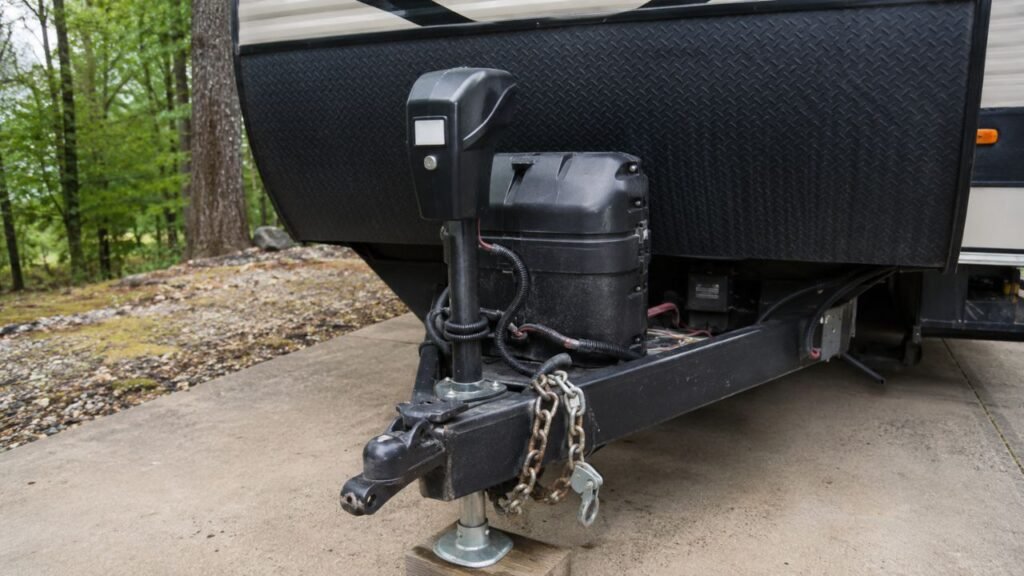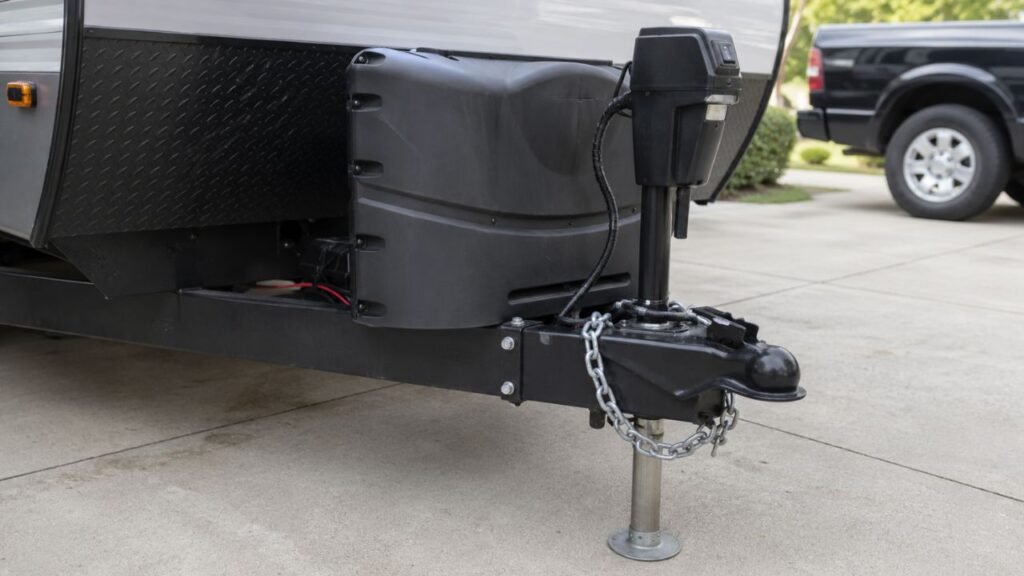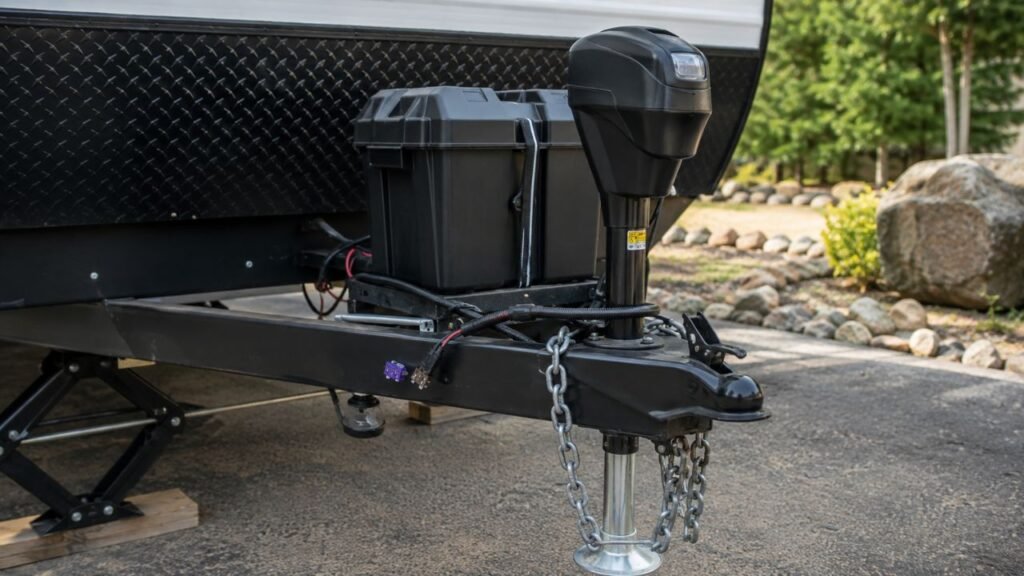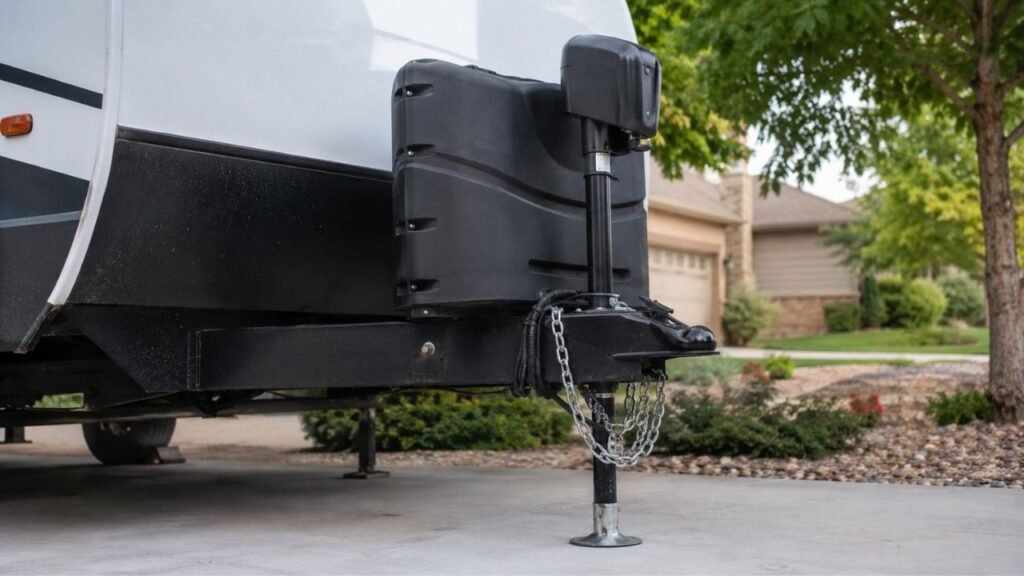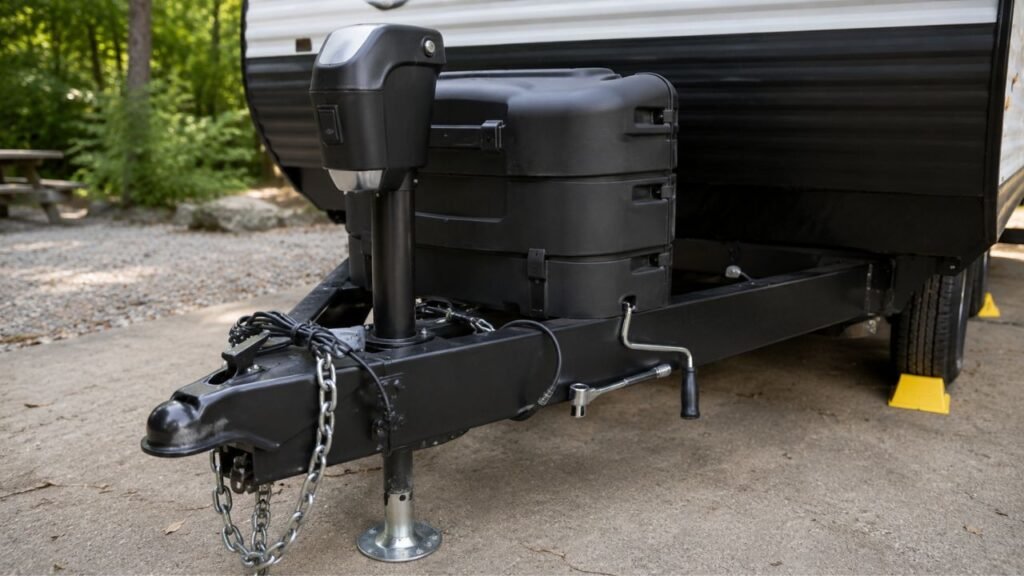
To manually operate an electric trailer jack, secure the trailer, disconnect power to the jack, remove the manual override cap, and attach the correct crank handle or socket. Slowly turn the override to extend or retract the jack. Always check your specific jack because socket size and turning direction can vary by model.
If your battery dies or the electric motor suddenly stops working, the manual override can help you get moving again. Below, I’ll show you exactly how to find it, use it safely, choose the right tool, and troubleshoot a jack that still refuses to move.
Key Takeaways
- Most electric trailer jacks include an emergency manual override.
- Chock the trailer wheels before manually operating the jack.
- Disconnect electrical power before inserting the override crank.
- Use the factory crank or the exact socket required for your model.
- Do not assume every jack turns the same direction.
- Stop cranking if the jack suddenly binds or requires excessive force.
- A jack that works manually but not electrically usually has an electrical issue.
- A jack that will not move manually may have an internal mechanical problem.
How Do You Manually Operate an Electric Trailer Jack?
Manually operating a power tongue jack is usually straightforward once you know where the override is located. The important part is keeping the trailer stable and avoiding assumptions about your particular jack.
1. Park the Trailer on Firm, Level Ground
Before touching the jack, make sure the trailer cannot roll.
Park on the firmest and most level surface available. Place wheel chocks securely against the trailer tires. If the trailer is still connected to your truck, set the parking brake as well.
You should also check the surface underneath the jack foot. Soft soil, loose gravel, or unstable blocks can shift when the tongue weight begins loading the jack.
A proper jack pad or solid leveling block can give the foot a more stable surface.
2. Disconnect Power to the Electric Jack
Next, isolate electrical power before installing the manual crank.
Depending on your jack, this may involve removing the inline fuse, disconnecting the jack’s 12-volt power source, or unplugging the trailer connection that supplies power.
You don’t necessarily have to disconnect the entire trailer battery if your jack has its own approved method of isolating power.
The goal is simple. You don’t want the electric motor unexpectedly operating while your crank or socket is attached to the manual override.
3. Locate the Manual Override Access
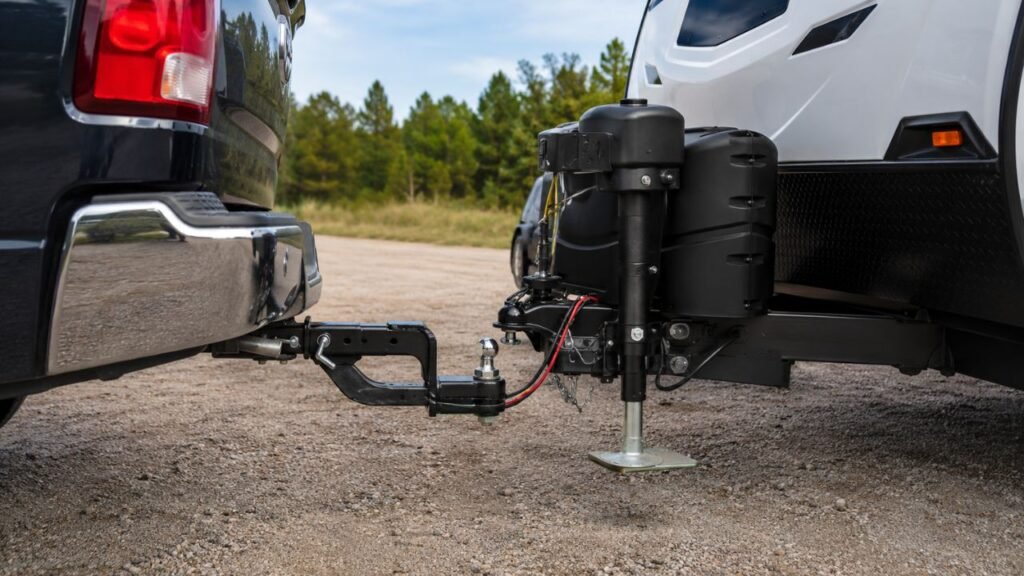
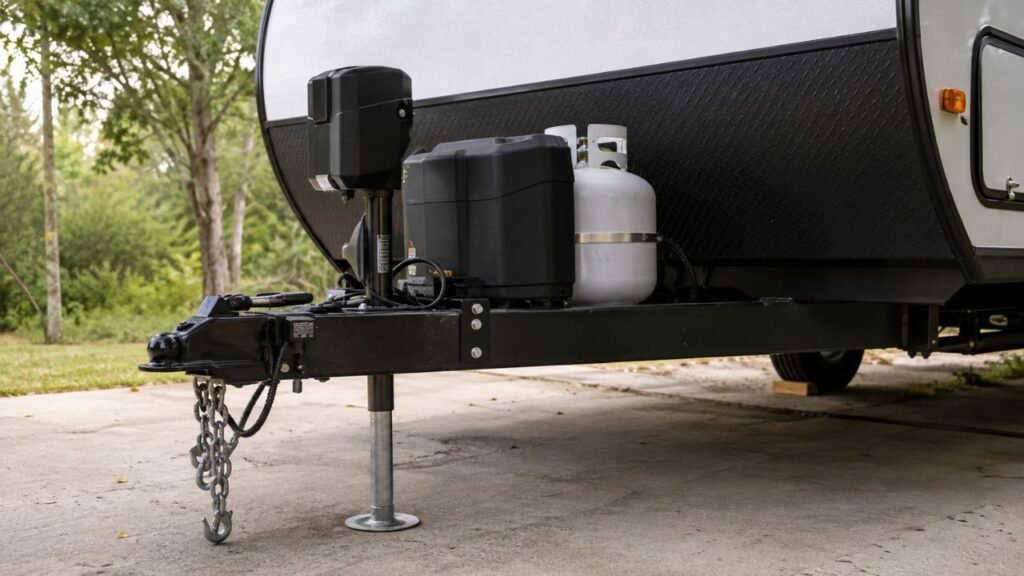
Look around the upper motor housing of the electric jack.
Many power tongue jacks have a rubber plug, plastic cap, removable cover, or similar access point near the top of the jack head. Removing it exposes the manual drive point underneath.
Some models make this very obvious. Others hide the override underneath a protective cover.
If you don’t immediately see it, check the model number and owner’s instructions before removing screws from the motor housing. You don’t want to open the gearbox unnecessarily when the actual override is somewhere else.
4. Insert the Correct Manual Crank or Socket
Once you find the override, attach the proper tool.
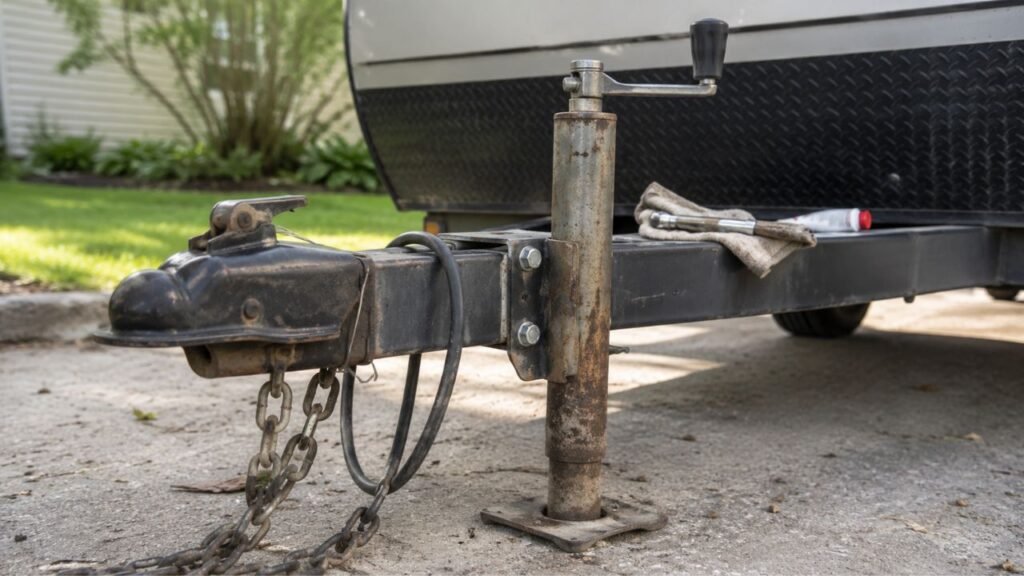
The safest choice is always the crank handle supplied with the jack. Many owners keep this handle inside the trailer’s storage compartment specifically for emergencies.
Some electric jacks instead use a hex-shaped override that accepts a socket and ratchet.
The important thing is not to guess the socket size.
Different electric trailer jacks can use different fittings. A socket that is slightly too large may slip and round the override nut.
Push the crank or socket completely onto the drive before applying force.
5. Determine Whether You Need to Extend or Retract the Jack
Before turning anything, decide what movement you actually need.
When you extend the jack, the inner leg moves downward toward the ground. Once the foot is firmly loaded, additional extension raises the trailer tongue.
When you retract the jack, the leg moves upward into the jack body. If the jack is supporting the tongue, this movement lowers the trailer tongue.
Knowing the difference between extending and retracting makes the next step much easier.
6. Turn the Crank Slowly in the Correct Direction
This is where you should avoid relying on a universal clockwise rule.
Some electric trailer jacks extend when turned counterclockwise and retract when turned clockwise. Other designs can operate differently.
Check the markings on your jack or the owner’s manual whenever possible.
If you are unsure, make a very small initial turn while watching the jack leg. You should quickly see whether the leg begins extending or retracting.
Continue turning smoothly once you confirm the direction.
Do not spin the crank aggressively. Slow, steady movement gives you better control and makes it easier to notice binding.
If the crank suddenly becomes extremely difficult to turn, stop. You may be reaching the jack’s travel limit or dealing with a mechanical problem.
7. Remove the Crank and Replace the Override Cap
Once the trailer tongue reaches the position you need, remove the crank or socket completely.
Press the protective cap or rubber plug firmly back into place. This helps keep water, road dirt, and debris away from the override mechanism.
Only restore electrical power after the manual tool has been removed.
If the jack originally stopped because of an electrical problem, troubleshoot that issue before depending on normal powered operation again.
What Tool Do You Need to Manually Crank an Electric Trailer Jack?
There is no single crank or socket size that works with every electric trailer jack. The correct tool depends on the manufacturer and exact model.
| Manual Override Type | Typical Tool | What You Should Do |
| Factory crank connection | Supplied manual crank | Keep the original crank inside your trailer |
| Hex override nut | Correct-size socket and ratchet | Confirm the size for your exact jack |
| Covered gearbox override | Manufacturer-specific crank | Remove only the designated access cover |
| Specialized power jack design | Model-specific tool | Follow the jack’s operating instructions |
Some electric tongue jacks use metric sockets, while others use completely different crank connections.
For that reason, I would not automatically reach for a 3/4-inch socket just because you’ve seen that size recommended somewhere.
If you still have the original crank, use it.
If the crank is missing, identify the jack’s manufacturer and model number before buying or using a replacement.
It’s also smart to keep the proper manual tool inside your tow vehicle or trailer rather than inside a storage area that could become inaccessible during a jack failure.
Which Way Do You Turn an Electric Trailer Jack Manually?
There is no universal clockwise or counterclockwise direction that applies to every electric trailer jack.
On some models, counterclockwise rotation extends the jack while clockwise rotation retracts it. Other designs may use a different arrangement.
That’s why I recommend thinking in terms of extend and retract rather than memorizing a direction from another jack.
Look for directional markings around the manual override first. If none are visible, check the owner’s manual for your exact model.
When you’re stuck without instructions, make only a small test rotation and watch the jack leg closely. If it begins moving opposite the direction you need, stop and reverse the crank.
Never keep turning aggressively just because you expect the jack to eventually move the correct way.
Can You Manually Operate an Electric Trailer Jack With a Dead Battery?
Yes, you can usually manually operate an electric trailer jack even when the trailer battery is completely dead.
The manual override mechanically turns the jack’s internal drive system instead of relying on the electric motor for power.
That is one of the main reasons manufacturers include an emergency crank system.
A dead battery, blown fuse, poor electrical connection, or failed switch does not normally prevent the manual override from operating.
However, a dead battery and a mechanically jammed jack are two completely different problems.
If the jack will not move even with the manual crank, the battery may not be your only issue.
What If the Electric Trailer Jack Won’t Crank Manually?
A jack that refuses to move manually deserves more attention because the problem may be mechanical rather than electrical. Don’t immediately apply a longer wrench or more force because doing so can damage internal parts.
The Jack May Be at Its Travel Limit
Electric tongue jacks have maximum extension and retraction limits.
If the jack has already reached one end of its travel, the crank may become extremely difficult or impossible to turn farther in that direction.
Try confirming whether the jack is already fully extended or fully retracted.
Never force the mechanism beyond its designed travel.
The Jack May Be Binding Under Load
A tongue jack should carry vertical tongue weight.
If the trailer shifts sideways, sits unevenly, or places side pressure against the jack tube, the mechanism can bind.
A bent inner tube can create a similar problem.
Make sure the trailer is properly chocked and the jack foot is sitting squarely on a solid surface.
If the jack looks visibly bent, don’t keep forcing it.
The Internal Screw or Gearbox May Be Damaged
The motor and manual override normally operate the same basic lifting mechanism.
So if the electric motor cannot move the jack and the manual override cannot move it either, an internal mechanical problem becomes more likely.
Possible trouble areas include the drive screw, gears, bearings, or other internal components.
A grinding sound, slipping crank, or repeated tight spots can also point toward internal damage.
The Crank May Not Be Engaged Correctly
Sometimes the jack is fine and the manual tool simply isn’t engaged.
Make sure the crank or socket is seated completely on the override connection.
A socket that is too large can rotate without properly turning the mechanism. A partially inserted factory crank can do the same thing.
Remove the tool, inspect the fitting, and reinstall it carefully.
Stop If the Jack Still Won’t Move
If the jack requires extreme force, don’t keep adding leverage.
You can strip the override, damage gears, bend the jack, or suddenly release trailer movement.
If you need to service or replace the jack, support the trailer with properly rated equipment before removing weight from the tongue jack.
Never crawl underneath a trailer that is supported only by its tongue jack.
Can You Use a Drill on an Electric Trailer Jack’s Manual Override?
I would avoid using a drill or impact driver unless the manufacturer specifically allows powered operation of the manual override.
A hand crank gives you much better feedback.
You can immediately feel when the jack reaches a travel limit, starts binding, or becomes unusually difficult to move.
A powerful drill can continue applying torque before you realize something is wrong.
An impact driver is even more aggressive because it introduces repeated shock loads into the override mechanism.
If your owner’s instructions specifically allow a drill and provide a recommended procedure, follow those directions. Otherwise, use a hand crank or ratchet.
It may take longer, but you’re much less likely to damage the jack.
How Can You Tell Whether the Problem Is Electrical or Mechanical?
The manual override is useful for more than getting your trailer hitched or unhitched. It can also help you narrow down why the electric jack stopped working.
The Jack Works Manually but Not Electrically
If you can easily move the jack with the crank, the mechanical lifting system is probably still functioning.
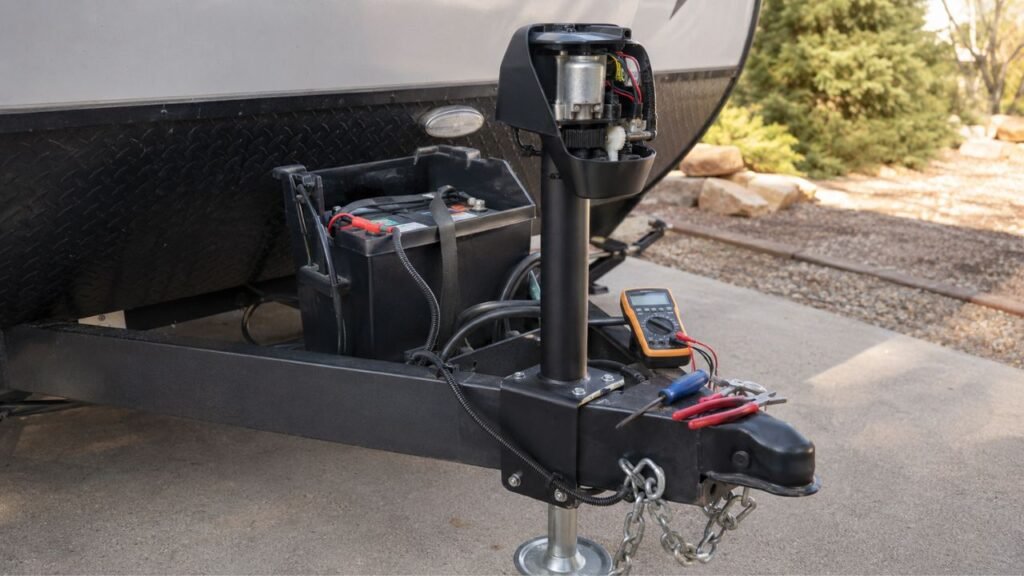
Start checking the electrical side.
Common possibilities include:
- Low or dead trailer battery
- Blown inline fuse
- Tripped circuit breaker
- Corroded battery connection
- Loose ground connection
- Damaged power wire
- Faulty extend/retract switch
- Failed electric motor
Start with battery voltage, fuse condition, wiring, and ground connections before assuming the motor needs replacing.
The Jack Doesn’t Work Electrically or Manually
When neither method works, pay closer attention to mechanical problems.
The jack may be jammed, bent, overloaded, stuck at its travel limit, or damaged internally.
Don’t repeatedly press the electric switch while also trying to force the manual override.
Instead, inspect the jack position and support the trailer safely before deeper troubleshooting.
The Motor Runs but the Jack Doesn’t Move
If you can hear the motor spinning but the jack leg stays in place, the electrical system may actually be supplying power correctly.
That points you toward the mechanical drive system.
Internal gears may be damaged, the drive mechanism may have disconnected, or the lifting screw may no longer be transferring movement properly.
Turn the motor off rather than letting it run continuously.
Continued operation can turn a smaller mechanical failure into a more expensive repair.
Safety Mistakes to Avoid When Manually Operating a Trailer Jack
A manual override is intended to help during a power failure, but you’re still working with substantial trailer tongue weight.
- Don’t operate the jack without chocking the trailer wheels.
- Don’t place the jack foot on loose or unstable ground.
- Don’t leave the manual crank installed while restoring electrical power.
- Don’t press the electric switch with the crank attached.
- Don’t put your hands or feet beneath the loaded trailer tongue.
- Don’t crawl under a trailer supported only by the tongue jack.
- Don’t force the jack after it suddenly becomes difficult to crank.
- Don’t exceed the jack’s extension or retraction limit.
- Don’t assume another jack’s socket size matches yours.
- Don’t assume every electric jack uses the same crank direction.
If something feels wrong, stop and inspect before continuing.
A few extra minutes of troubleshooting is far better than damaging the jack or allowing the trailer to shift unexpectedly.
How to Prepare for an Electric Trailer Jack Failure Before Your Next Trip
A manual override is only useful if you actually have the correct tool when the electrical system fails. A small emergency kit can save you plenty of frustration at a campground, storage lot, or roadside stop.
Keep these items accessible:
- Factory manual crank handle
- Correct socket and ratchet if your jack requires one
- Spare fuse of the manufacturer-specified rating
- Wheel chocks
- Solid jack pad
- Work gloves
- Flashlight
- Basic multimeter
- Jack model number and owner’s instructions
I also recommend manually testing the override occasionally.
You don’t need to crank the trailer through its entire travel. Just disconnect power properly, confirm the tool fits, make sure the override moves freely, and reinstall the protective cap.
That quick check tells you whether your emergency system will actually work before you’re depending on it.
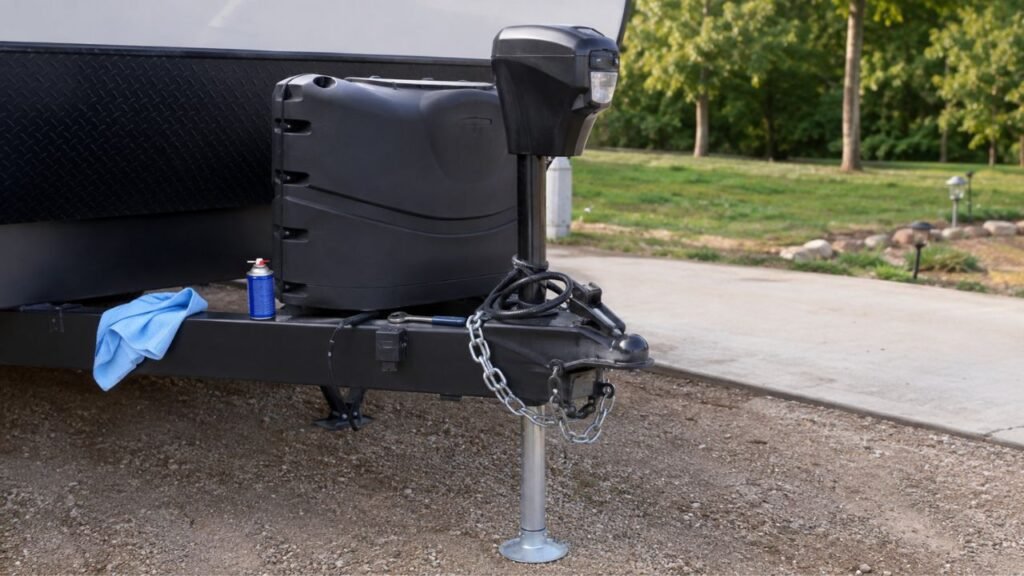
Keep the jack tube clean, inspect the power and ground wiring, and lubricate only the areas recommended by the manufacturer.
A little preventive maintenance can keep a minor electrical failure from becoming a stressful hitching problem.
Final Words
Manually operating an electric trailer jack is usually simple once the trailer is secure and you’ve found the proper override. Disconnect power, attach the correct crank or socket, and move the jack slowly until the tongue reaches the height you need.
The two details I would never guess are the tool size and the turning direction. Electric trailer jacks aren’t all built the same, so use your exact model’s markings or instructions whenever possible. And if the jack becomes extremely difficult to crank, stop rather than forcing it.
Related FAQs
Can All Electric Trailer Jacks Be Operated Manually?
Many electric trailer jacks have a manual override specifically for power failures, but the design varies between manufacturers. Check your exact model before assuming it has an emergency crank connection.
Where Is the Manual Override on an Electric Trailer Jack?
The manual override is commonly located near the top of the motor housing beneath a rubber plug, plastic cap, or removable cover. Its exact position varies by jack model.
What Size Socket Do I Need to Manually Operate an Electric Trailer Jack?
There is no universal socket size for electric trailer jacks. Some models use metric sockets, while others use a dedicated crank handle, so verify the correct size for your exact jack.
Can I Use a Socket Wrench Instead of the Factory Jack Handle?
You can use a socket wrench when your electric jack has a compatible hex-style manual override and you know the correct socket size. Don’t force an incorrectly sized socket onto the override.
Why Is My Electric Trailer Jack Hard to Crank Manually?
A jack can become difficult to crank because it is at its travel limit, binding under side load, poorly lubricated, bent, overloaded, or damaged internally. Stop if the resistance becomes excessive.
Will Manually Cranking an Electric Trailer Jack Damage It?
Manual cranking should not damage a jack designed with an emergency override when you use the correct tool and follow the proper procedure. Damage is more likely when the jack is forced past its limits.
Can I Manually Lower My Trailer Jack Without Power?
Yes, most electric tongue jacks with a manual override can be lowered without battery power. Insert the correct manual tool and rotate it in the direction specified for retracting your particular jack.
Should I Disconnect the Battery Before Manually Cranking the Jack?
You should isolate electrical power to the jack before using the manual override. Depending on the design, that may mean removing its fuse, disconnecting its power supply, or unplugging the applicable trailer connection.
Can a Dead Battery Cause an Electric Trailer Jack to Stop Working?
Yes. Electric tongue jacks usually depend on a 12-volt battery or another 12-volt power source. Low battery voltage can make the jack slow, weak, completely unresponsive, or unable to lift normal tongue weight.
What Should I Do If My Electric Trailer Jack Won’t Move at All?
Try the manual override after safely securing the trailer and disconnecting jack power. If the jack won’t move electrically or manually, inspect for binding, overextension, a bent tube, or internal mechanical damage before forcing it.

Ryan Mitchell writes for readers who prefer independent travel and practical outdoor motorhome living. His how-to guides and reviews focus on simplicity, durability, and real value. He brings a calm, hands-on perspective to every topic.