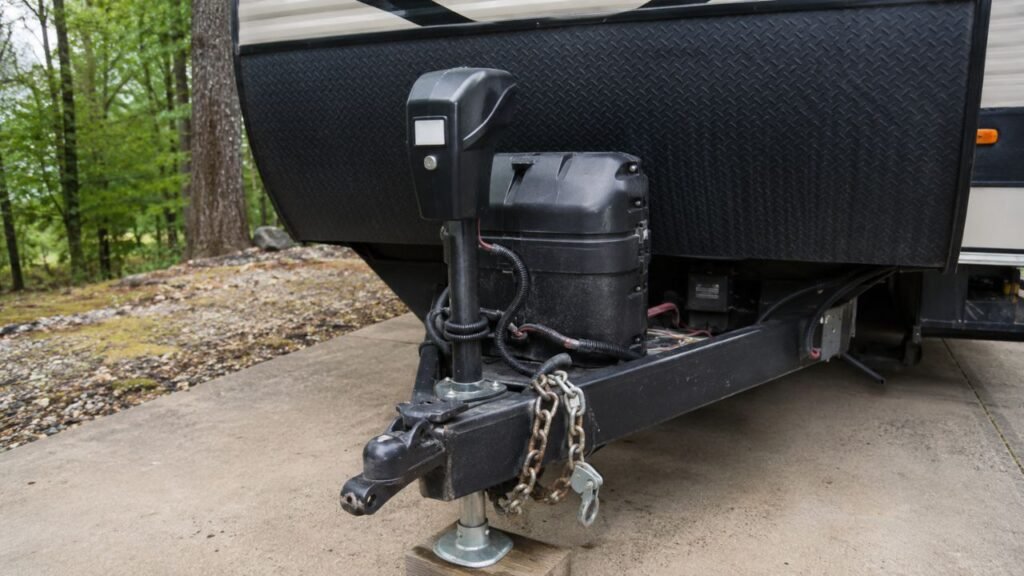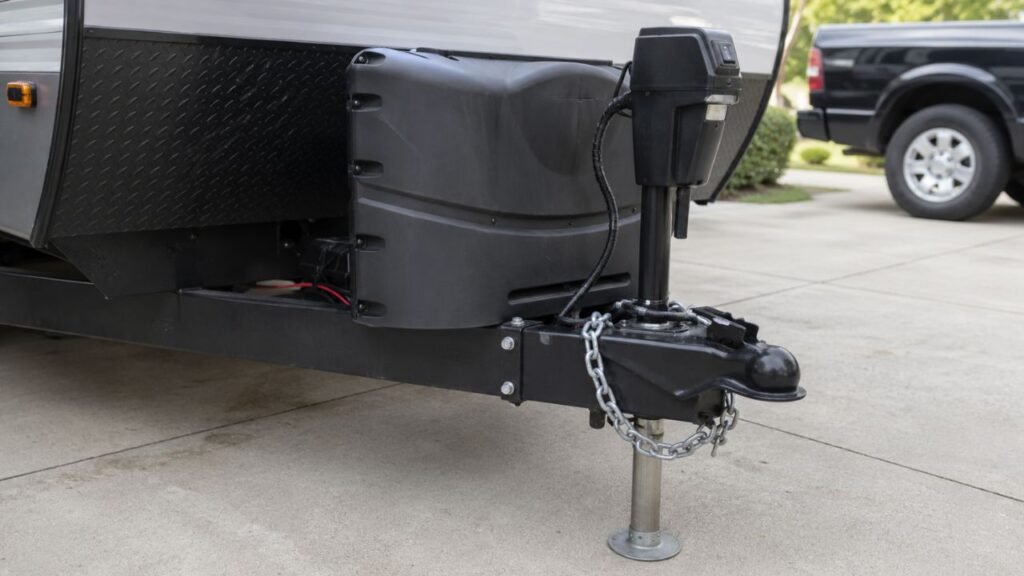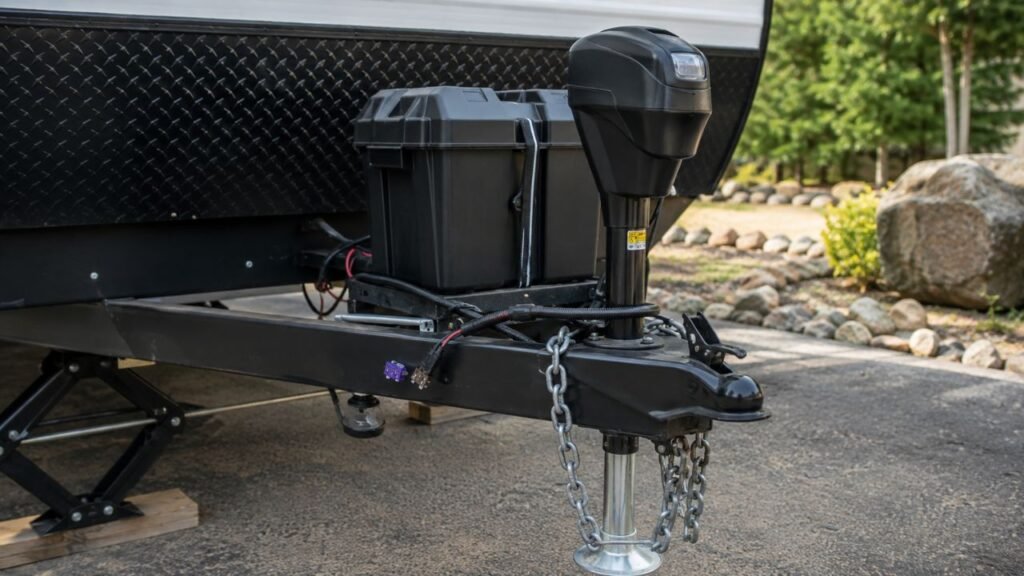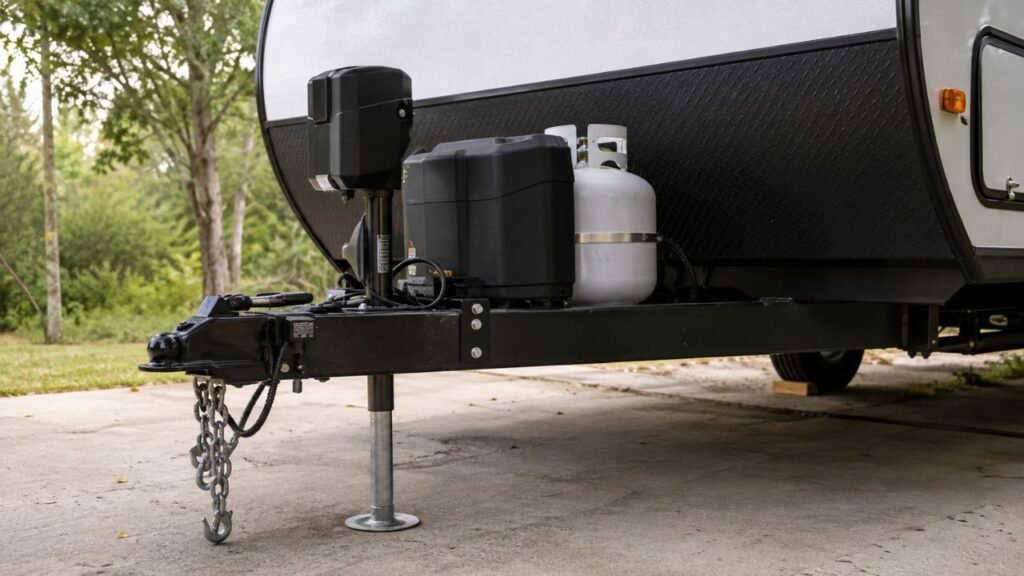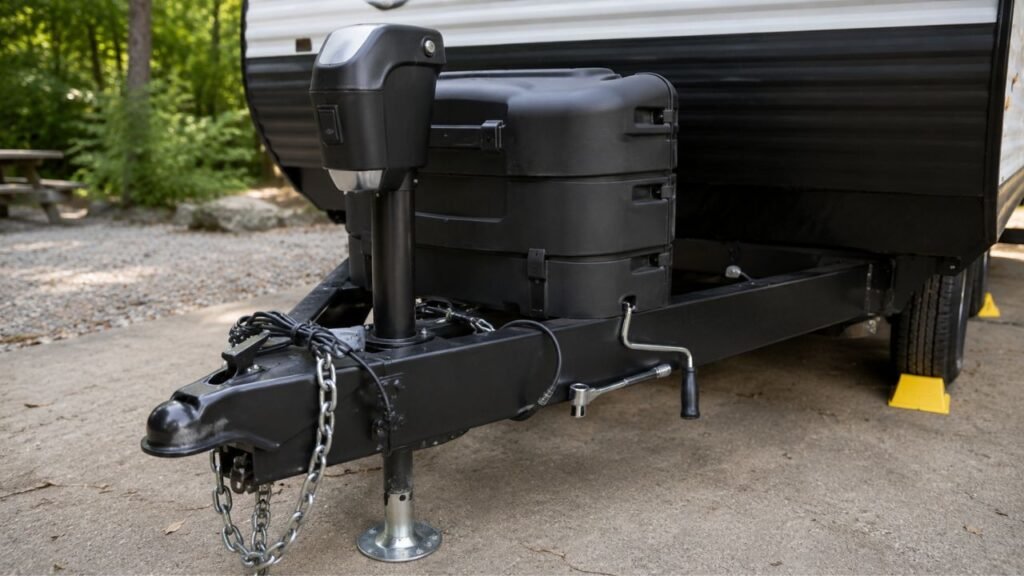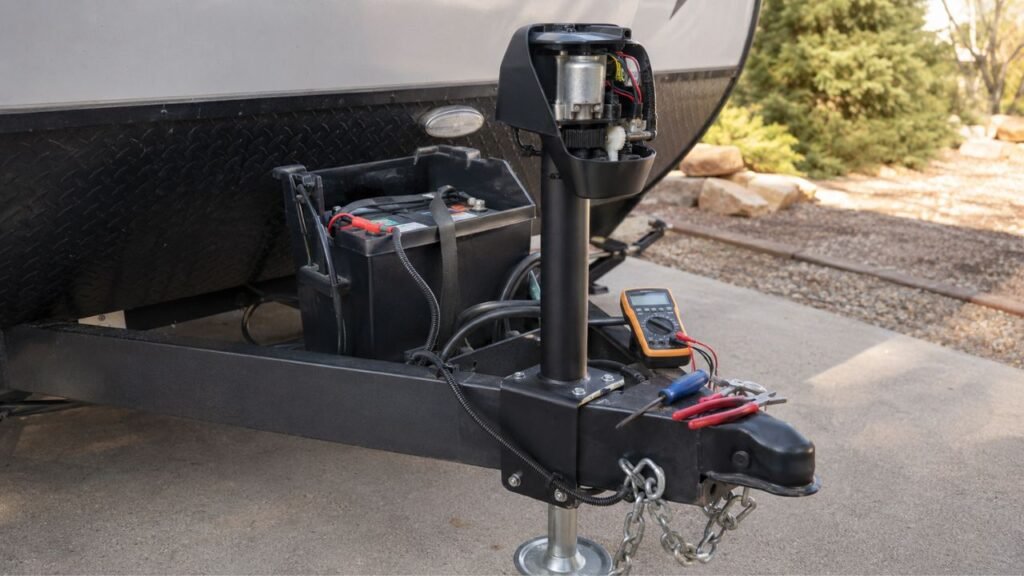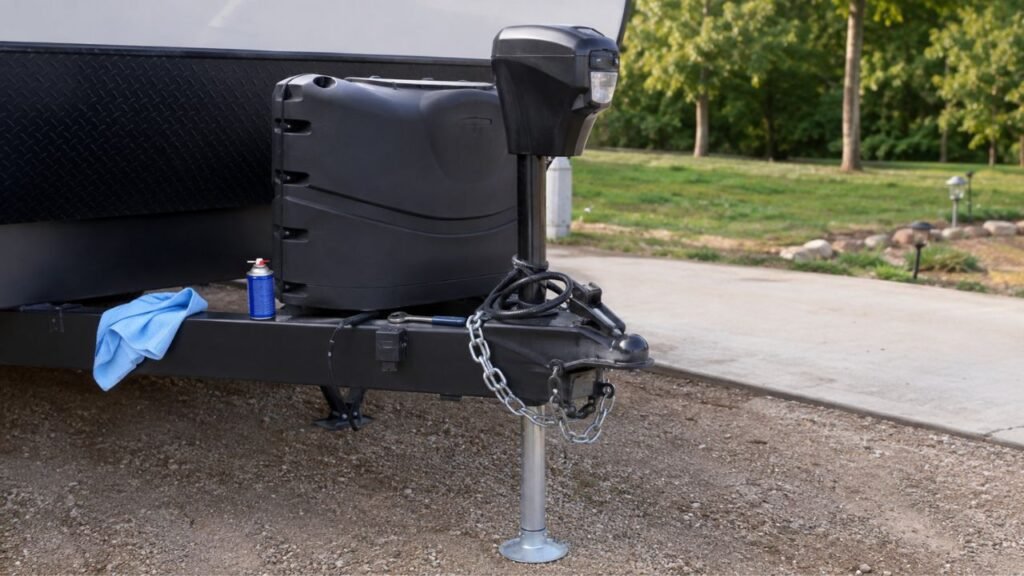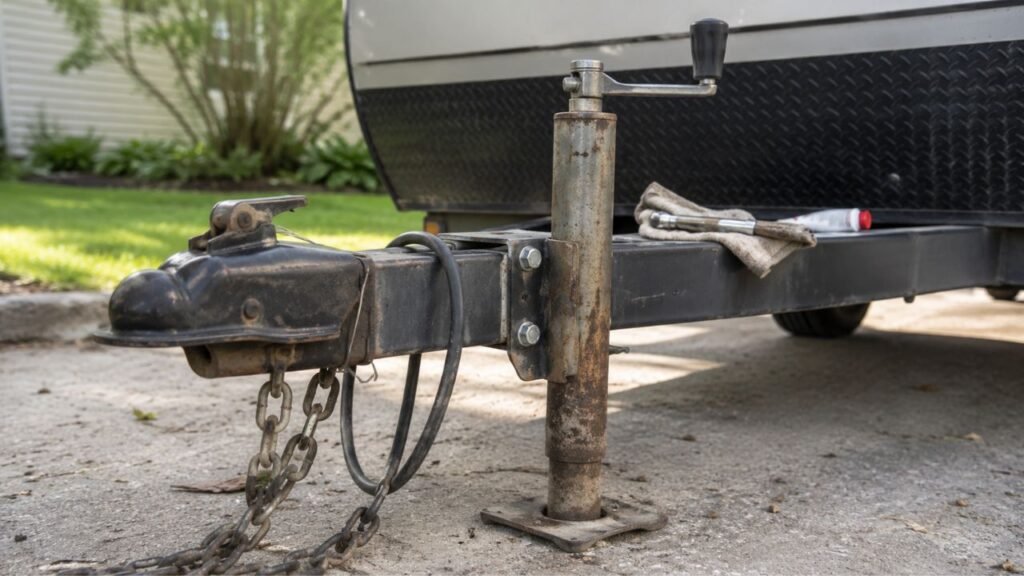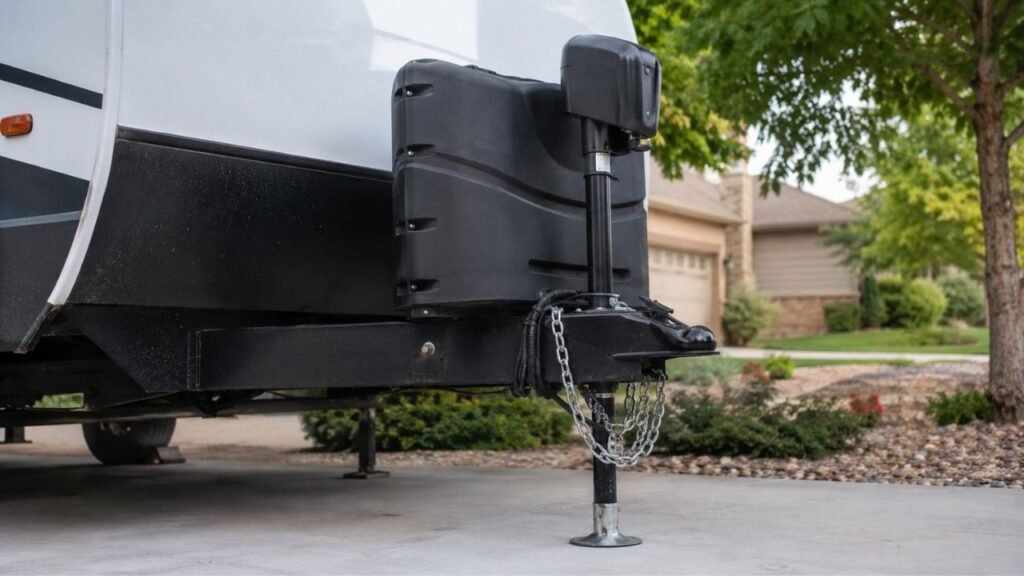
An electric trailer jack usually moves slowly because of a weak battery, poor ground connection, voltage drop, excessive tongue load, or mechanical binding inside the jack. Corroded terminals, dry components, water intrusion, or a weakening motor can also reduce its speed.
The good news is that you can usually narrow the problem down without replacing the jack. Below, I’ll walk you through the symptoms, tests, and fixes in the order I would check them.
Key Takeaways
- Start by checking the trailer battery and its connections.
- A battery can show voltage yet still sag badly under load.
- Corroded grounds and terminals can dramatically slow the motor.
- A jack that slows mainly while lifting may be overloaded.
- Difficult manual cranking usually suggests mechanical resistance.
- Easy manual cranking with slow powered movement points toward an electrical problem.
- Grinding, overheating, repeated stopping, or hot wiring needs immediate attention.
- Don’t replace the motor until you rule out battery, wiring, and mechanical drag.
Is It Normal for an Electric Trailer Jack to Move Slowly?
Electric trailer jacks are not designed to move especially fast. Their motors and gear reductions prioritize lifting force over speed, so a few seconds of steady travel is usually normal.
What matters more is whether your jack has become slower than it used to be.
If it has always operated at roughly the same speed, you may simply be seeing the normal characteristics of that particular model.
I would become more suspicious when the jack suddenly starts moving slower, struggles when lifting, changes speed during operation, or sounds noticeably different from before.
You should also pay attention if it moves normally downward but struggles upward. That usually tells us something about how the jack behaves when additional load is placed on the motor.
Why Does My Electric Trailer Jack Move Slowly?
Several electrical and mechanical problems can produce almost the same symptom. That is why I recommend checking the simple external causes first before assuming the jack motor or gearbox has failed.
Weak or Undercharged Trailer Battery
A weak battery is one of the most common causes of a sluggish electric trailer jack.
The motor needs considerable current when it begins lifting the trailer tongue. If the battery cannot maintain adequate voltage under that load, the motor loses torque and starts turning more slowly.
This can happen even when other 12-volt equipment still works normally.
Your trailer lights, monitor panel, or small accessories require much less current than the jack motor. Seeing those devices working therefore does not prove your battery is strong enough to operate the jack properly.
A battery that is discharged, aging, sulfated, damaged, or poorly charged deserves immediate attention.
Poor or Corroded Ground Connection
A bad ground can make a perfectly good jack behave like it has a weak motor.
Many A-frame electric tongue jacks use their mounting connection to the trailer frame as part of the electrical ground path. Other models use a dedicated ground wire.
Rust, paint, oxidation, dirt, or loose hardware can increase resistance between the jack and the trailer frame.
When resistance increases, less usable voltage reaches the motor.
If your jack grounds through its mounting plate, inspect the mounting bolts and metal contact areas carefully. Make sure you are looking at bare, clean, secure contact surfaces rather than assuming the bolts themselves are enough.
Loose or Corroded Positive Connections
The positive side of the circuit can cause exactly the same problem.
Inspect the connection at the battery, ring terminal, fuse holder, circuit breaker, wiring splice, and jack power lead.
A connection does not have to be completely disconnected to cause trouble.
Sometimes a slightly loose or corroded terminal still allows electricity to flow, but creates enough resistance to prevent the jack motor from receiving the current it needs.
That is why a slow jack can occasionally be fixed simply by cleaning and tightening connections.
Excessive Voltage Drop in the Wiring
This is one of the most useful things to understand when troubleshooting a slow electric jack.
You can measure acceptable voltage at the battery and still have poor voltage at the jack while the motor is running.
Resistance in a cable, terminal, ground, fuse holder, splice, or connector can cause voltage to drop when current demand increases.
That means checking the battery while everything is turned off does not tell the whole story.
A better test is to compare battery voltage with the voltage reaching the jack while the jack is operating.
If the battery holds reasonable voltage but the voltage at the jack falls significantly, start looking for resistance in the wiring and connections.
The Jack Is Carrying Too Much Weight
Electric trailer jacks have lifting limits.
Remember that the important figure here is usually the load being placed on the tongue jack, not the trailer’s entire gross vehicle weight.
A heavily loaded trailer tongue can place considerable strain on the motor.
The demand can increase even further when you use the tongue jack to lift part of the tow vehicle during weight-distribution hitch setup.
If your jack operates reasonably well without much load but becomes extremely slow as soon as it starts lifting the tongue, load should be high on your checklist.
Compare the actual application with the jack manufacturer’s lifting capacity.
Dry Gears or Lead-Screw Resistance
Your electric motor has to overcome friction inside the jack.
As lubrication deteriorates, the gears or screw mechanism may become harder to move. The motor then has to work harder, draw more current, and operate more slowly.
However, don’t automatically spray lubricant into the jack housing.
Different electric jacks have different lubrication requirements. Some components are serviceable while others are sealed.
Check your specific jack’s maintenance instructions before opening the head or applying grease.
Bent or Binding Inner Jack Tube
Mechanical binding can also slow the jack dramatically.
The inner tube can become bent or misaligned after an impact, excessive side loading, or repeated operation while the trailer is positioned awkwardly.
Rust, dirt, and physical damage can also make the tube drag as it extends or retracts.
Look closely for:
- Scraping marks
- Uneven tube movement
- Visible bending
- Rust
- Dirt buildup
- Jerky travel
- Side-to-side movement
A jack that sounds strained while moving through one particular area may be physically binding.
Water or Moisture Inside the Jack Head
Electric trailer jacks spend their lives outside, so moisture deserves attention.
Water entering the upper housing can corrode switch contacts, terminals, motor components, or internal metal parts.
You may notice the jack becoming sluggish after heavy rain, washing the trailer, or long outdoor storage.
Inspect the housing, switch area, wiring entry points, and protective cover for signs of damage.
Rust staining, green corrosion, moisture, or deteriorated seals can indicate that water has reached places where it should not be.
Worn Switch, Motor, Gearbox, or Internal Components
Once you rule out the battery, connections, load, and mechanical binding, the problem may actually be inside the jack.
A worn switch can create resistance.
A weakening motor may lose torque.
Worn gears can increase friction or begin slipping.
Internal corrosion can create additional resistance throughout the mechanism.
I would leave these possibilities toward the end of the diagnostic process because external electrical problems are usually easier and cheaper to correct.
What Does the Way Your Trailer Jack Slows Down Tell You?
The exact way the jack behaves can give you valuable clues. Use the symptoms below to decide where I would start looking first.
| What the Jack Is Doing | More Likely Causes | Check First |
| Slow in both directions | Weak battery, voltage drop, motor wear | Battery and connections |
| Slow mostly while lifting | Weak battery, overload, mechanical drag | Battery under load and tongue load |
| Slow mainly in one direction | Switch problem or mechanical resistance | Switch and manual operation |
| Starts fast, then slows | Voltage sag, heating connection, motor overheating | Battery and voltage drop |
| Runs better with charging support | Battery or supply problem | Trailer battery |
| Hard to move manually | Screw, tube, gears, or corrosion | Mechanical components |
| Easy manually but slow electrically | Wiring, switch, or motor | Electrical system |
| Stops and works again after cooling | Overload or thermal protection | Load and mechanical drag |
| Moves slowly with grinding | Gear damage or binding | Stop and inspect |
| Fuse holder or wiring becomes hot | High resistance or overload | Wiring and terminals |
How to Diagnose a Slow Electric Trailer Jack Step by Step
I recommend working through these checks in order. Doing so helps you avoid replacing parts before you know whether the problem is actually electrical, mechanical, or load-related.
Step 1: Test the Jack With Less Tongue Load
Start by seeing how the jack behaves when it is not carrying its normal heavy load.
You do not need to perform unsafe lifting or place yourself beneath the trailer. The goal is simply to compare how the jack sounds and moves under lighter versus heavier demand whenever conditions allow.
If the motor suddenly speeds up when the load decreases, the battery, jack capacity, or mechanical resistance deserves closer attention.
Step 2: Check the Trailer Battery
Inspect the battery before going deeper into the jack.
Check for loose terminals, corrosion, damaged cables, and an obvious low state of charge.
If you have a multimeter, measure battery voltage before operating the jack and again while the motor is running.
Different battery chemistries behave differently, so compare your readings with the manufacturer’s specifications rather than relying on one universal number.
A battery that looks fine at rest but drops sharply during operation may not be able to deliver enough current.
Step 3: Measure Voltage at the Jack While It Runs
This test can save you a lot of guessing.
Measure the voltage at the battery while the jack is running. Then measure as close to the jack’s power input as you safely can during the same type of operation.
If battery voltage remains reasonably stable but the jack sees noticeably less voltage, resistance exists somewhere between the battery and the motor.
Work backward through the fuse holder, wiring, terminals, connections, and ground path.
Step 4: Inspect and Clean the Ground Path
Check how your jack is grounded.
If it uses the mounting hardware and trailer frame, inspect the metal surfaces around the mounting plate.
Rust and paint can interfere with electrical contact.
Clean corrosion where appropriate and make sure the fasteners are secure.
If the jack uses a dedicated ground wire, inspect that wire and its connection just as carefully as you inspected the positive lead.
Step 5: Inspect the Positive Cable, Fuse, and Connections
Follow the positive wire from the battery toward the jack.
Look for:
- Loose battery terminals
- Corroded ring terminals
- Damaged wires
- Loose splices
- Burned fuse holders
- Corroded fuse contacts
- Loose circuit breaker terminals
Pay particular attention to anything that looks discolored or unusually warm.
Heat is often a sign that electrical resistance is occurring at that point.
Step 6: Try the Manual Override
The manual crank is not just there for emergencies. It is also a very useful diagnostic tool.
Disconnect or disable powered operation according to your jack’s instructions before manually operating it.
If the jack turns smoothly by hand but runs slowly on electric power, concentrate on the battery, wiring, switch, and motor.
If it is difficult to crank manually, the problem is more likely related to the screw, gears, tube, alignment, corrosion, or lubrication.
That single comparison can dramatically narrow your search.
Step 7: Inspect for Mechanical Binding
Watch the jack tube carefully while operating it.
Does it move smoothly through the entire range?
Does it suddenly slow at one particular point?
Can you see the tube rubbing against something?
Look for bent metal, rust, dirt, impact damage, or uneven alignment.
If the inner tube appears bent, continuing to force the motor can make the damage worse.
Step 8: Check for Moisture and Internal Damage
Inspect the head and switch housing for signs of water intrusion.
Pay special attention after heavy rain or long outdoor storage.
If your particular model allows access without violating service instructions, check accessible terminals and connections for corrosion.
Do not start dismantling a sealed motor or gearbox unless the manufacturer specifically allows service.
Step 9: Evaluate the Switch and Motor
If everything outside the jack looks healthy, the switch or motor becomes more likely.
A worn switch can restrict current before it reaches the motor.
A tired motor may run but lack the torque it once had.
You may also notice changes in motor sound, burning smells, excessive heat, intermittent movement, or worsening performance over time.
At this point, compare the cost of replacement parts with the price and age of the complete jack.
Why Is My Trailer Jack Slow Going Up but Faster Going Down?
A jack that raises slowly but lowers normally often has a problem that becomes obvious only under load.
Raising the trailer tongue requires the motor to do more work. Lowering usually requires less effort because gravity assists the movement.
That means a weak battery, voltage drop, overloaded jack, or worn motor may look reasonably normal while lowering but struggle badly while lifting.
Mechanical binding can behave similarly.
If the difference between up and down becomes extreme, also inspect the direction switch and wiring. A damaged switch contact can sometimes create higher resistance in one direction.
Why Does My Electric Trailer Jack Start Fast and Then Slow Down?
A jack that begins at normal speed and gradually fades often points toward a problem that develops as current continues flowing.
Battery voltage may sag under sustained demand.
A poor connection may heat up and create additional resistance.
The motor may become hot.
Mechanical friction can also increase current demand enough to trigger thermal protection.
Pay attention to how long the jack runs before slowing.
If it consistently starts working again after cooling, don’t simply keep cycling it. Find out why the motor is overheating or being overloaded.
Will Plugging Into Shore Power or the Tow Vehicle Make the Jack Faster?
Most electric tongue jacks are 12-volt DC devices powered by the trailer’s 12-volt electrical system.
Shore power does not normally run the jack motor directly. However, your RV converter or charger may support the battery while the trailer is connected to shore power.
Similarly, the tow vehicle may provide charging or electrical support depending on how your trailer and connector are wired.
If the jack suddenly works much better while the battery is being charged, consider that a diagnostic clue.
It suggests that battery condition or voltage delivery may be part of the original problem.
I would not use external charging support as a permanent workaround for a damaged battery, corroded ground, or bad cable.
Can an Overloaded Trailer Jack Simply Run Slower?
Yes. An electric jack can become noticeably slower when the motor is working close to its lifting limit.
The important thing is understanding how much load the jack is actually supporting.
Signs that excessive load may be involved include:
- Normal speed with little load
- Major slowdown while lifting the tongue
- A strained motor sound
- Repeated thermal shutdown
- Slow operation while lifting the tow vehicle during hitch setup
If you recently added cargo, changed hitch equipment, or altered trailer loading, tongue weight may have increased.
Don’t automatically move to a larger jack without understanding the trailer’s weight distribution, but make sure your existing jack is appropriately rated for the job.
Should I Lubricate a Slow Electric Trailer Jack?
Lubrication can help when mechanical friction is causing the slowdown, but it should not be your first automatic fix.
Some jacks have serviceable screw or gear components. Others use sealed assemblies with specific maintenance requirements.
Check the manufacturer’s procedure before lubricating anything.
Use only the recommended lubricant and approved service points.
I would especially avoid spraying penetrating oil randomly into the motor or switch housing. That may not reach the actual friction point and can create new problems around electrical parts.
Can I Keep Using an Electric Trailer Jack That Moves Slowly?
A jack that has always moved at a steady, slightly slow speed may simply be functioning normally.
A jack that suddenly becomes slower deserves inspection.
Stop relying on powered operation until you investigate if you notice:
- Repeated stalling
- Burning smell
- Hot wiring
- Hot fuse holders
- Repeated blown fuses
- Grinding noises
- Popping sounds
- Jerky movement
- Visible tube bending
- Severe corrosion
- Motor overheating
Most importantly, never place yourself beneath a trailer supported only by the tongue jack while troubleshooting.
Use appropriate support equipment whenever the trailer must remain raised.
When Should You Repair or Replace the Electric Trailer Jack?
Not every slow jack needs replacement. I would first separate simple serviceable problems from structural or internal failures.
Repair or Service It When
Repair usually makes sense when the problem involves:
- Dirty battery terminals
- Weak battery
- Corroded ground
- Loose connection
- Damaged fuse holder
- Replaceable wiring
- Replaceable switch
- Manufacturer-approved lubrication
These problems are often inexpensive compared with replacing the complete jack.
Consider Replacing It When
Replacement becomes more attractive when you find:
- A badly bent tube
- Severe internal corrosion
- Repeated gearbox problems
- A failing motor with unavailable parts
- Significant water damage
- Cracked structural components
- Repair costs close to the price of a new jack
You should also reconsider the jack if its lifting capacity is marginal for your trailer.
How to Prevent Your Electric Trailer Jack From Slowing Down Again
A little routine inspection can prevent many jack problems before they leave you struggling at the campsite or storage lot.
- Keep the trailer battery properly charged.
- Clean corrosion from battery terminals.
- Inspect the jack wiring periodically.
- Maintain a reliable ground connection.
- Keep the jack head protected from unnecessary water exposure.
- Follow the manufacturer’s lubrication schedule.
- Avoid exceeding the jack’s rated lifting capacity.
- Minimize side loading while operating the jack.
- Stop the motor if the jack physically binds.
- Inspect the tube after an impact.
- Replace damaged fuse holders and terminals early.
- Use an appropriately rated jack block when practical to reduce excessive travel.
Final Words
When your electric trailer jack starts moving slowly, don’t jump straight to replacing the motor. I would begin with the battery, terminals, ground, and voltage delivery because those problems are common and relatively easy to correct.
If the electrical system checks out, use the manual crank to help separate an electrical problem from mechanical resistance. From there, you can inspect the tube, screw mechanism, gears, switch, and motor with a much clearer idea of what you are looking for.
Related FAQs
Why Is My Electric Trailer Jack So Slow Under Load?
A jack that becomes much slower under load may have a weak battery, excessive voltage drop, too much tongue weight, mechanical binding, or a motor that is losing torque. Compare unloaded and loaded operation before replacing parts.
Can a Weak Battery Make an Electric Trailer Jack Run Slowly?
Yes. The jack motor needs considerably more current than small trailer accessories. A weak battery may still power lights while its voltage drops enough under jack load to make the motor run slowly.
Can a Bad Ground Cause a Trailer Jack to Move Slowly?
Yes. Corrosion, paint, rust, loose mounting hardware, or a damaged ground wire can create resistance. That resistance reduces the usable voltage reaching the jack motor and can cause slow or intermittent movement.
Why Does My Electric Trailer Jack Slow Down After a Few Seconds?
A jack that starts normally and then slows may be experiencing battery voltage sag, connection heating, motor overheating, excessive mechanical friction, or overload. Letting it repeatedly cool and restarting it does not correct the underlying cause.
Why Does My Trailer Jack Go Down Normally but Raise Slowly?
Raising the trailer places more load on the motor than lowering it. A weak battery, overloaded jack, high-resistance connection, worn motor, or mechanical drag can therefore become much more noticeable while lifting.
Will My Electric Trailer Jack Work With the Truck Connected?
It may, depending on how your trailer and tow vehicle charging circuit are wired. However, the trailer battery normally remains an important part of the system, so truck connection should not be used to hide a failing battery or damaged wiring.
Does Shore Power Run an Electric Tongue Jack?
The jack itself normally runs on 12-volt DC power. Shore power may allow the RV converter or charger to support the battery, which can sometimes make a weak electrical system appear to perform better.
How Fast Should an Electric Tongue Jack Move?
There is no single normal speed for every electric tongue jack because motor power, gear ratio, load, and jack design vary. A sudden reduction from its previous operating speed is usually more important than the exact travel rate.
How Do I Know if My Electric Trailer Jack Motor Is Bad?
A bad motor becomes more likely when battery voltage, wiring, ground, load, and mechanical movement all check out. Other signs include excessive heat, unusual motor noise, burning smell, intermittent operation, or steadily declining torque.
Should I Lubricate My Electric Tongue Jack?
Lubricate the jack only according to the manufacturer’s maintenance instructions. Some screw and gear assemblies require periodic lubrication, while others are sealed and should not be opened or sprayed with random lubricants.
Can I Manually Crank an Electric Trailer Jack?
Most electric tongue jacks include some form of manual override, although the procedure varies by model. It is useful during power failure and can also help determine whether the jack has electrical or mechanical resistance.
When Should I Replace My Electric Trailer Jack?
Consider replacement when the tube is badly bent, the gearbox or motor is failing, internal corrosion is severe, water damage is extensive, important parts are unavailable, or repair costs approach the price of a suitable new jack.

Ryan Mitchell writes for readers who prefer independent travel and practical outdoor motorhome living. His how-to guides and reviews focus on simplicity, durability, and real value. He brings a calm, hands-on perspective to every topic.