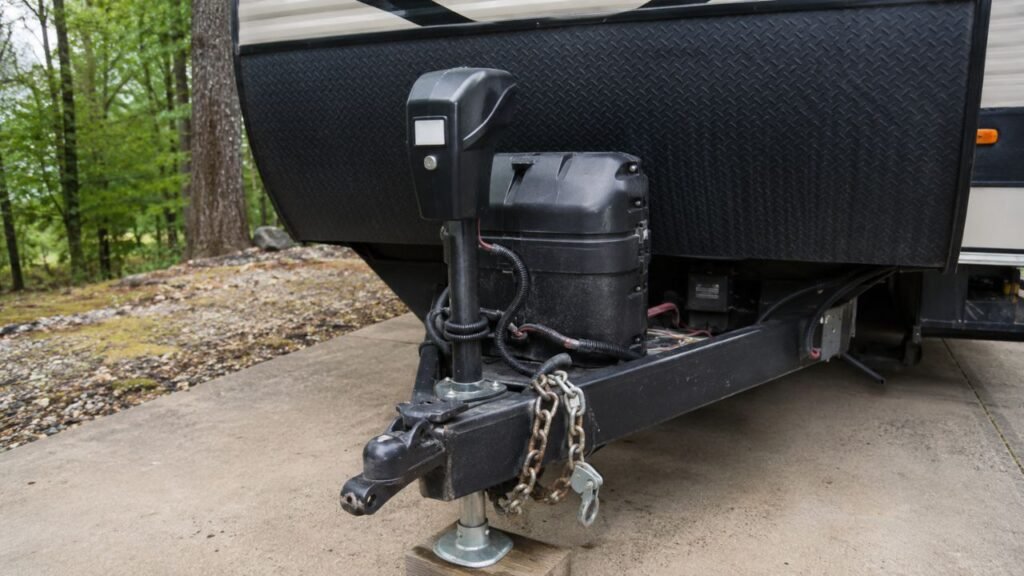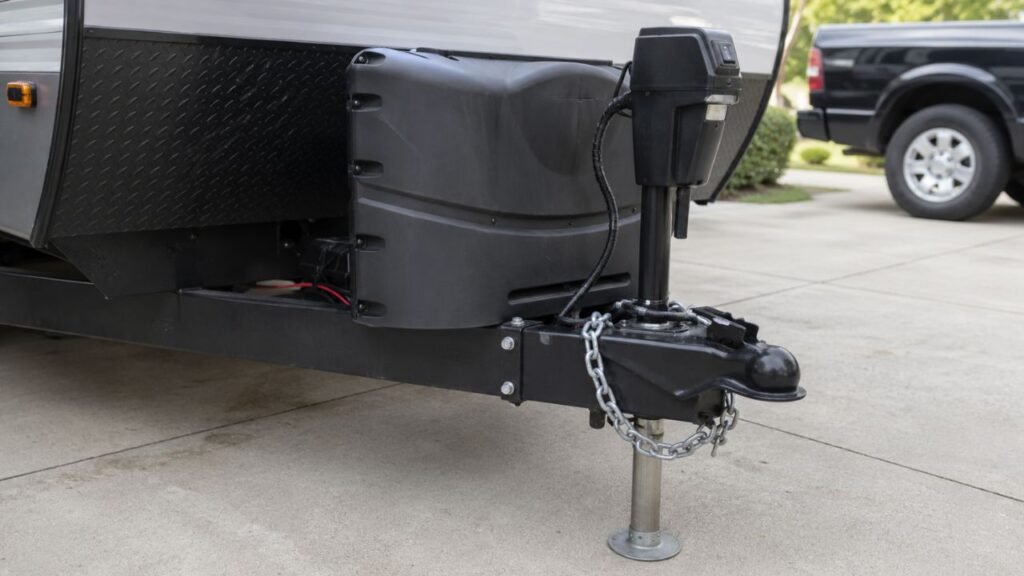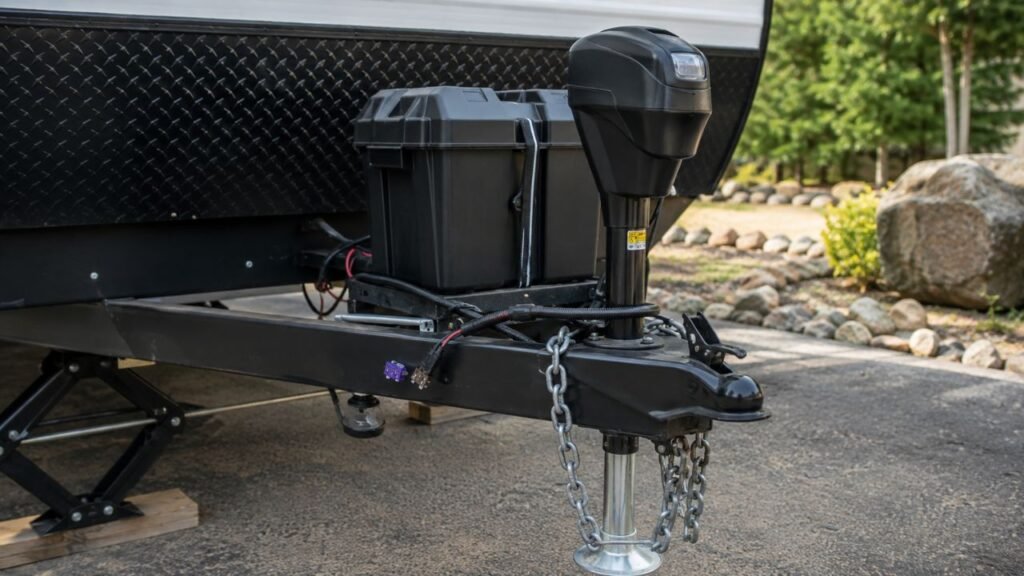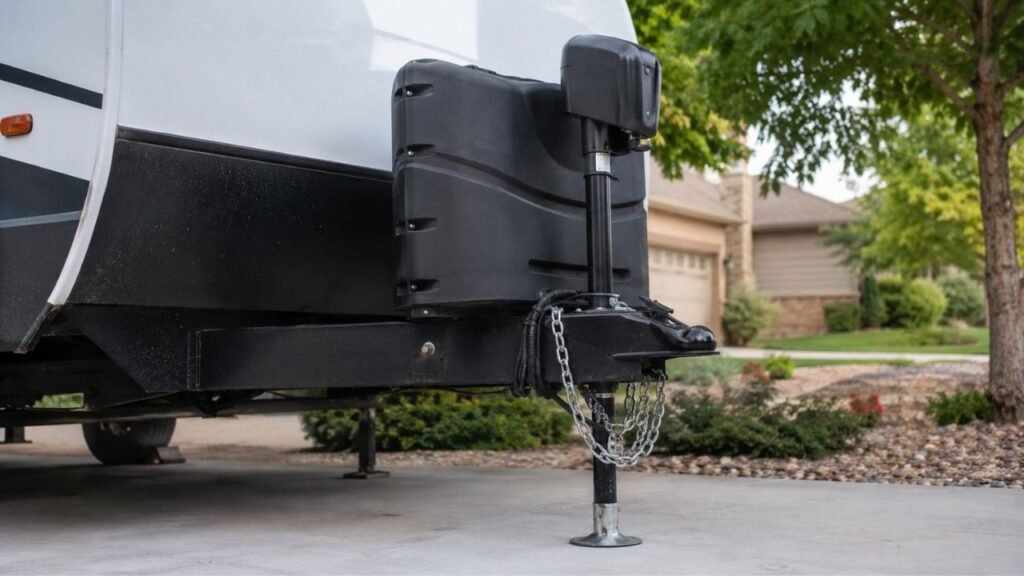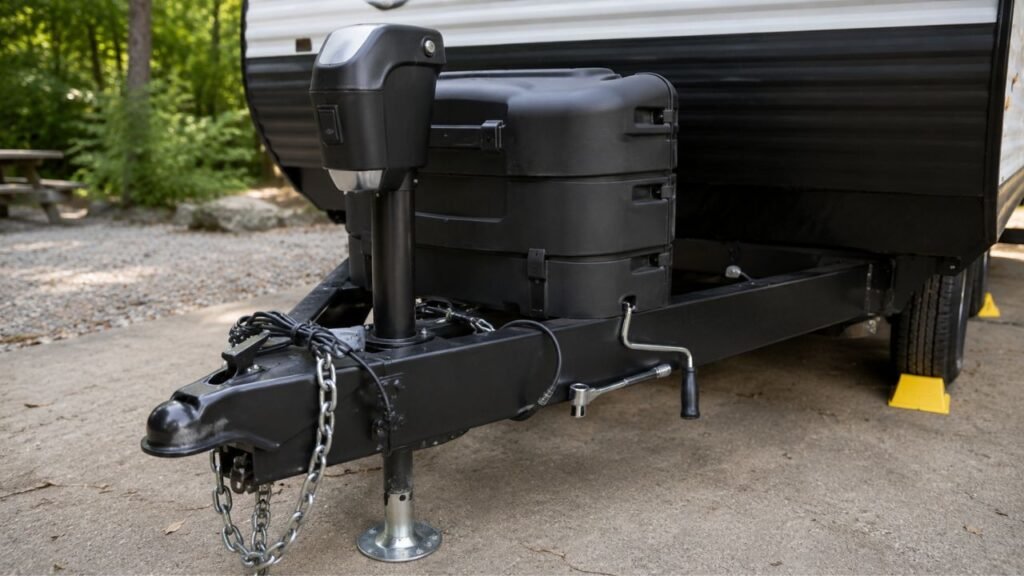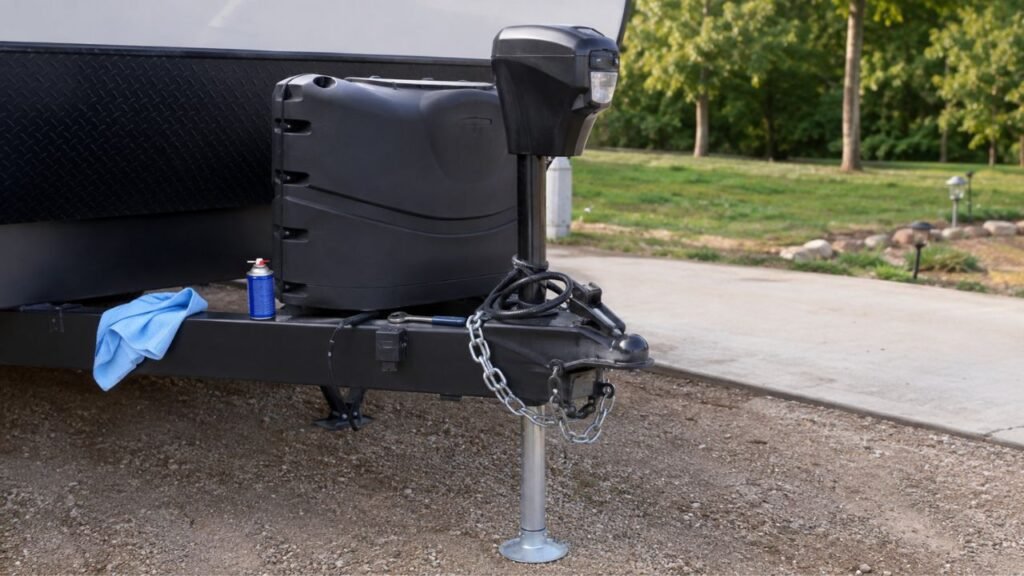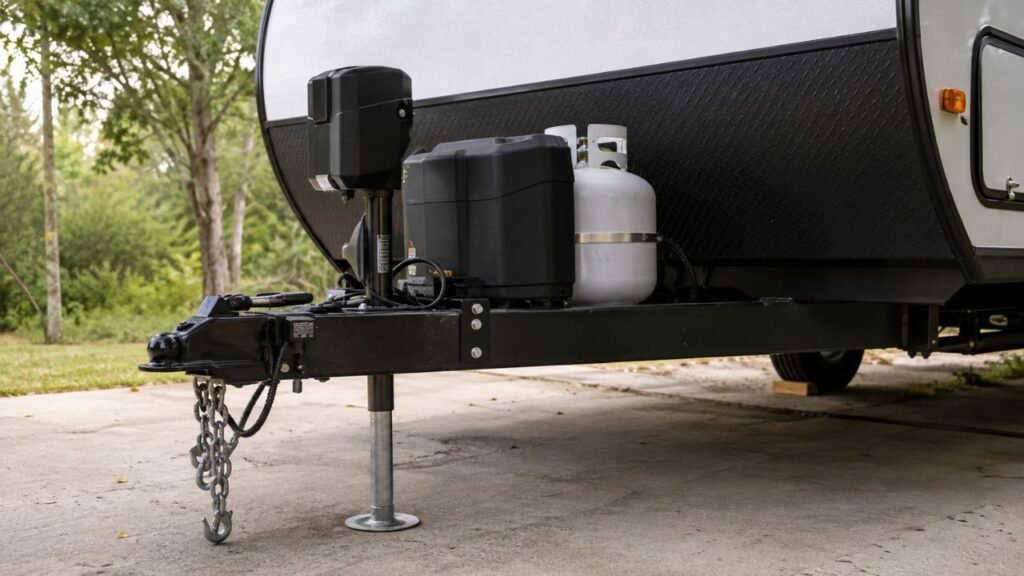
An electric trailer jack usually stops under load because the motor cannot get enough usable electrical power or cannot overcome the resistance of the load. A weak battery, poor ground, voltage drop, tripping breaker, overloaded jack, mechanical binding, or worn internal parts are the most common causes.
The good news is that you can narrow the problem down without replacing parts randomly. I’ll walk you through the symptoms, tests, and fixes so you can figure out whether the problem is electrical, mechanical, or simply too much load for the jack.
Key Takeaways
- A jack that works unloaded but stops while lifting usually has a load-related problem.
- A weak battery may appear normal until the jack begins drawing heavy current.
- Loose, rusty, or corroded connections can cause serious voltage drop.
- A poor ground can let the jack operate lightly but stall under weight.
- Repeated stopping and restarting can indicate an auto-reset breaker tripping.
- Difficult manual cranking usually points toward mechanical binding.
- Never install a larger fuse or breaker to hide an overload problem.
- Confirm the jack’s rated capacity before assuming something has failed.
What Does It Mean When an Electric Trailer Jack Only Stops Under Load?
When your electric trailer jack runs normally until it starts lifting the trailer, that detail tells you quite a bit about the problem.
With no weight on the jack, the motor needs relatively little torque. It may extend and retract perfectly even if the battery, wiring, ground, or motor is already somewhat weak.
Everything changes once the jack foot contacts the ground.
Now the motor has to lift the trailer tongue. Current demand increases, mechanical resistance rises, and weaknesses that were hidden during unloaded operation become noticeable.
For example, a slightly corroded battery terminal may still carry enough power to run the jack freely. Once the motor needs considerably more current, that same connection can restrict power enough to make the motor slow down or stop.
That is why a jack working without weight does not automatically mean the jack itself is healthy.
Electric Trailer Jack Stopping Under Load: Quick Diagnosis
The way your jack stops can give you an early clue about where to look. Use this table before you start taking anything apart.
| What Your Jack Does | Likely Problem | What to Check First |
| Runs until the foot touches the ground | Weak battery, ground, or voltage drop | Test voltage while lifting |
| Gets slower before stopping | Weak electrical supply or mechanical drag | Battery and manual crank |
| Stops, then works again later | Breaker tripping or overheating | Breaker and excessive current |
| Works better with shore power connected | Weak battery or battery-side wiring | Battery under load |
| Lights work but motor stalls | High-current electrical problem | Voltage at the jack |
| Very difficult to crank manually | Mechanical binding | Tube, screw, and gears |
| Stops at the same height repeatedly | Binding or travel-limit issue | Jack extension and mechanism |
| Makes grinding or clicking sounds | Gearbox or drive problem | Internal mechanical components |
| Keeps blowing a fuse under load | Excessive current or short | Wiring, motor, and binding |
The important thing is to follow the symptoms rather than replacing the motor immediately.
Why Does My Electric Trailer Jack Stop Under Load?
Several faults can produce almost the same symptom. Let me break them down so you can determine which one fits what your jack is doing.
1. The Trailer Battery Is Weak Under Load
A weak battery is one of the first things I would check.
Your battery can sometimes show what appears to be acceptable voltage while the jack is sitting idle. However, the voltage may drop sharply once the motor begins pulling significant current.
That explains why your trailer lights may work normally while the tongue jack struggles.
Lights require much less current than a motor lifting hundreds or thousands of pounds of tongue-side load.
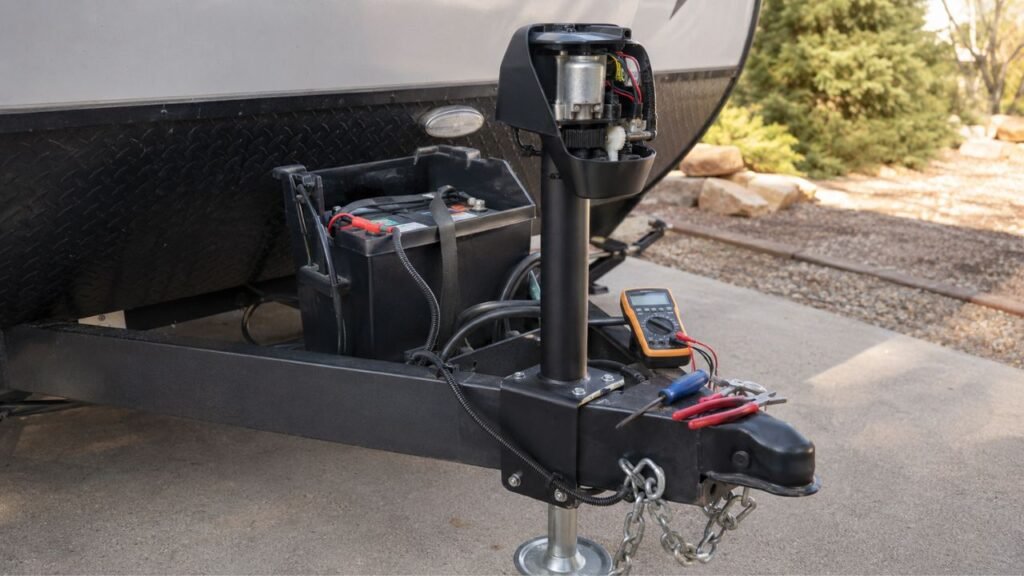
Use a multimeter to watch battery voltage while operating the jack. The important reading is what happens when the jack actually begins lifting.
Also inspect the battery terminals. Loose clamps, corrosion, damaged cable ends, or an aging battery can all create problems under heavy demand.
Don’t rely on one universal minimum-voltage number. Different jack manufacturers have their own operating specifications, so compare your reading with the manual for your model.
2. The Ground Connection Has Too Much Resistance
A bad ground can produce exactly the symptom you’re seeing.
Some electric tongue jacks ground through their mounting plate and bolts. Others use a dedicated ground wire.
If your jack relies on frame grounding, rust, paint, corrosion, or loose mounting hardware can interfere with the electrical path.
The jack may still operate without a load because the motor doesn’t need much current. Under load, resistance in that ground connection becomes far more significant.
Inspect the mounting area carefully.
Look for loose bolts, heavy rust, corrosion, or anything preventing the manufacturer-specified grounding surfaces from making good contact.
If your jack has a dedicated ground cable, inspect both ends of that cable instead.
Don’t start grinding paint from random areas of the trailer frame. Follow the grounding method specified for your particular jack.
3. There Is Excessive Voltage Drop in the Power Circuit
This problem often gets mistaken for a bad battery.
You can have a perfectly good battery and still deliver weak voltage to the jack motor.
Every connection between the battery and jack creates an opportunity for resistance.
Common trouble areas include:
- Corroded battery terminals
- Loose ring terminals
- Poor wire crimps
- Damaged fuse holders
- Corroded connectors
- Partially broken cables
- Poorly repaired wiring
- Incorrect replacement wire size
- Excessively long electrical runs
The best way to find this is to compare voltage at the battery with voltage reaching the jack while it is trying to lift.
If battery voltage remains reasonably stable but voltage at the jack drops significantly, you likely have resistance somewhere between the two points.
That’s a much better test than simply looking at the wires and assuming they are good.
4. The Auto-Reset Circuit Breaker Is Tripping
Pay attention to this symptom:
The jack lifts for several seconds, suddenly stops, sits there for a short period, and then starts working again.
That pattern often points toward circuit protection cycling.
Many electric trailer jacks use a breaker or another protective device designed to interrupt excessive current.
The breaker itself may not necessarily be the original problem.
Something else can make the motor draw too much current, including:
- Mechanical binding
- Excessive trailer load
- An aging motor
- Poor electrical connections
- A failing gearbox
A deteriorating breaker can also begin tripping more easily than it should.
Whatever you do, don’t bypass the breaker or install a larger fuse just to keep the jack running. The protection is there to prevent overheated wiring and motor damage.
Find out why the circuit is drawing excessive current first.
5. The Jack Is Carrying More Load Than Expected
Electric jack capacity is another area that can cause confusion.
You don’t compare the jack rating directly with the trailer’s entire GVWR because the tongue jack isn’t lifting the whole trailer.
What matters is the actual vertical load being placed on the jack.
However, that load can sometimes be higher than you realize.
Things that can increase it include loaded cargo near the trailer tongue, batteries, propane cylinders, storage equipment, and certain hitching procedures.
You may also put considerably more strain on the tongue jack when using it to raise the rear of the tow vehicle and trailer together while connecting weight-distribution bars.
Check your jack’s rated lifting capacity and compare it with the actual job you’re asking it to perform.
If your jack is operating near its maximum capacity regularly, even a small electrical or mechanical problem can become much more noticeable.
6. The Screw or Inner Tube Is Binding
Not every under-load problem is electrical.
Inside your jack, mechanical components have to move smoothly while carrying considerable force.
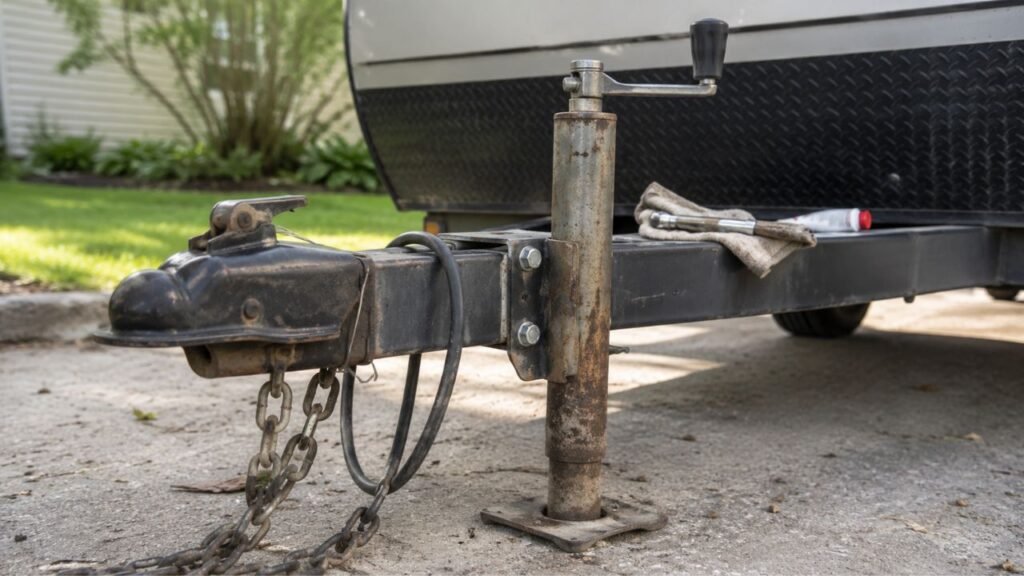
Dried lubrication, rust, contamination, a bent inner tube, damaged screw threads, or misalignment can increase resistance.
The motor may overcome that resistance without weight but stall once the trailer tongue pushes back against it.
This is where the manual override becomes very useful.
If the jack is extremely difficult to turn manually while properly supported and operated according to the manufacturer’s instructions, I would start looking harder at mechanical resistance.
You may also notice jerky movement, scraping noises, or resistance at certain positions.
7. The Motor Is Worn and Drawing Excessive Current
Electric motors don’t always fail completely at once.
An aging jack motor can continue running with no load yet struggle once lifting torque is required.
You may notice that the jack has gradually become slower over several months.
Other warning signs can include:
- Motor becoming unusually hot
- Sluggish lifting
- Breaker repeatedly tripping
- Different motor sound than before
- Jack working unloaded but stalling immediately under weight
If the battery, ground, wiring, and mechanical movement all check out, motor wear becomes more likely.
A motor drawing excessive current can also make a breaker trip even though the breaker itself is functioning correctly.
8. The Gearbox, Drive Screw, or Internal Gears Are Worn
Internal mechanical damage can behave differently from an electrical failure.
For example, your motor may continue making noise while the trailer barely moves.
You may hear clicking, grinding, or skipping when weight reaches the jack.
That can indicate worn gears, a damaged drive mechanism, a stripped component, or problems with the screw assembly.
One useful distinction is this:
A weak electrical supply usually causes the motor to slow or stall.
Damaged mechanical components may allow the motor to keep spinning while the lifting mechanism slips or fails to transfer force.
If you hear repeated grinding or gear skipping, stop using the power switch. Continuing to operate it can turn a repairable component into a completely damaged gearbox.
9. The Jack Is Near Its Travel Limit
Sometimes the problem isn’t really a failure.
Your jack may be approaching the end of its designed extension or retraction range.
Depending on the design, resistance may increase or operation may change near the travel limit.
If your jack always stops at roughly the same extension, check its available travel before assuming the motor is bad.
Use the drop leg properly if your jack includes one. A correctly positioned drop leg reduces unnecessary jack travel and can shorten lifting time.
Avoid holding the switch after the jack reaches or approaches its mechanical limit.
How to Troubleshoot an Electric Trailer Jack That Stops Under Load
I recommend working through these checks in order. Starting with the simple electrical tests can save you from disassembling a perfectly good jack.
Step 1: Secure the Trailer Before Testing
Safety comes first because you’re working around a trailer tongue carrying substantial weight.
Park on a solid and reasonably level surface whenever possible.
Chock the trailer wheels securely and set the tow vehicle parking brake when appropriate.
Keep your hands, feet, and body away from pinch points while operating the jack.
Most importantly, never crawl beneath a trailer that is supported only by the tongue jack.
If the trailer needs additional support during testing, use properly rated equipment intended for that purpose.
Step 2: See Whether the Jack Works With No Load
Your first diagnostic question should be simple:
Does the jack run normally when it isn’t lifting significant weight?
If it extends and retracts smoothly without load but immediately struggles when lifting starts, focus on:
- Battery performance
- Voltage drop
- Ground resistance
- Breaker operation
- Excessive load
- Mechanical resistance under compression
If the jack is slow, noisy, or unreliable even without weight, the motor, switch, wiring, gearbox, or internal mechanism deserves more attention.
Step 3: Test Battery Voltage While Operating the Jack
Grab a multimeter if you have one.
Set it to DC voltage and measure directly across the battery terminals.
First record the resting voltage.
Then operate the jack and watch the meter once the foot contacts the ground and lifting begins.
You’re looking for what happens during the exact moment the jack struggles.
A battery that looks fine while resting can drop considerably when asked to provide high current.
If the voltage collapses under load, charge and test the battery before blaming the jack.
Step 4: Measure Voltage at the Jack Under Load
If the battery stays healthy during the test, check what the jack itself is actually receiving.
This test helps identify voltage drop through the cables and connections.
Measure according to your jack’s wiring configuration while the motor is operating under load.
Compare that reading with the voltage measured directly at the battery.
If the battery remains strong but noticeably less voltage reaches the jack, inspect the wiring path.
You’re looking for resistance, not necessarily a completely disconnected wire.
A corroded terminal can pass some current while still severely limiting the motor under load.
Step 5: Clean and Verify the Ground
Next, inspect the ground circuit.
If your jack grounds through its mounting hardware, make sure the mounting area and hardware are in the condition required by the manufacturer.
Look for rust, corrosion, loose hardware, and damaged mounting components.
If your model has a dedicated ground wire, inspect that cable from the jack to its termination point.
Clean or repair faulty connections as appropriate for your jack.
Then test the jack again before moving to more complicated repairs.
Step 6: Inspect the Fuse, Breaker, and Positive Cable
Follow the positive power cable from the battery toward the jack.
Check for damaged insulation, overheated connectors, loose terminals, corrosion, and melted fuse holders.
Inspect the fuse or breaker as well.
If the jack repeatedly stops and then comes back to life, pay special attention to an auto-reset breaker.
However, don’t assume the breaker is automatically defective.
If the motor is drawing excessive current because of binding or overload, the breaker may simply be doing its job.
Always replace electrical protection with the exact type and rating specified for your jack.
Step 7: Try the Manual Override
If your electric jack has a manual override, it can tell you a lot about what’s happening.
Follow the manufacturer’s manual-crank procedure carefully.
If the jack moves reasonably smoothly by hand, the main screw and lifting mechanism may still be mechanically functional.
That shifts your attention toward the battery, wiring, ground, switch, breaker, or motor.
If the jack is extremely hard to move manually, mechanical binding becomes much more likely.
If the manual drive turns but the jack doesn’t actually raise or lower, you may have an internal gear or drive-system problem.
Step 8: Verify the Actual Load and Jack Capacity
Find the jack’s model number and capacity rating.
Then think about what you’re actually asking the jack to lift.
Consider trailer tongue weight plus anything that changes the load near the front of the trailer.
Also consider whether you’re using the tongue jack to lift part of the tow vehicle during hitch setup.
A jack that’s comfortable during normal tongue lifting can struggle when asked to lift considerably more than usual.
Don’t repeatedly force a jack that is already operating at its limit.
Step 9: Listen and Feel for Mechanical Binding
Electrical problems often occur quietly. Mechanical problems tend to give you more physical clues.
Watch and listen for:
- Grinding
- Clicking
- Scraping
- Jerking
- Sudden resistance
- Gear slipping
- Uneven tube movement
- Bent components
- Excessive motor heat
If something sounds mechanically wrong, stop operating the jack.
Repeatedly pressing the switch while the jack is jammed can damage the motor, wiring, gears, or circuit protection.
Electrical Problem or Mechanical Problem? How to Tell
You don’t always need to disassemble the jack to separate an electrical problem from a mechanical one. A few observations can narrow things down quickly.
| Test or Symptom | More Likely Electrical | More Likely Mechanical |
| Jack turns smoothly with manual crank | Yes | Less likely |
| Manual crank is extremely difficult | Less likely | Yes |
| Works much better with a strong battery | Yes | Less likely |
| Breaker repeatedly resets | Yes | Possible |
| Motor runs but jack doesn’t move | Less likely | Yes |
| Stops at exactly the same position | Possible | More likely |
| Light works but motor stalls | Yes | Possible |
| Grinding occurs during lifting | Possible | Yes |
| Voltage at jack drops under load | Yes | Less likely |
| Tube looks bent or moves unevenly | Less likely | Yes |
There can be overlap. Mechanical binding, for example, can make the motor draw excessive current and create what initially looks like an electrical problem.
That’s why the manual-crank test and loaded-voltage test work so well together.
Why Does the Jack Lower but Stop When Raising?
If your electric trailer jack lowers normally but struggles or stops while raising, the difference in motor load is an important clue.
Lowering the trailer allows gravity to assist the movement. Raising requires the motor to overcome the trailer’s tongue load.
A weak battery, excessive voltage drop, bad ground, worn motor, or mechanical resistance can therefore show up much more clearly while raising.
Test the electrical system while the jack is actually lifting.
If the jack also becomes difficult to move manually in the upward direction, investigate mechanical binding.
If one direction doesn’t work even when the jack is unloaded, the switch or directional control circuit may also need inspection.
Why Does My Electric Trailer Jack Stop and Then Start Again?
A jack that stops and then mysteriously begins working again often has a different problem from one that stays completely dead.
Many electric trailer jacks use automatic circuit protection.
If current becomes excessive, the breaker may temporarily open the circuit. Once it cools or resets, power returns and the jack operates again.
The real question is why the current became excessive.
Possible causes include an overloaded jack, binding screw, weak motor, poor electrical connection, or faulty breaker.
If it happens every time you lift the trailer, don’t simply operate the jack in short bursts forever. Find the underlying cause before additional damage occurs.
Can a Fully Charged Battery Still Cause the Jack to Stop?
Yes. A battery can appear fully charged and still be part of the problem.
Resting voltage only tells you part of the story.
The battery must also maintain adequate voltage when the jack motor begins demanding substantial current.
Internal battery deterioration can cause voltage to drop heavily during loading.
There is another possibility too.
Your battery may be perfectly healthy while corroded cables or connections prevent that power from reaching the jack.
That’s why I recommend checking voltage at both the battery and the jack while the jack is actually lifting.
And don’t assume the battery is fine just because your trailer lights work. The jack motor demands much more current than typical lighting circuits.
Should I Lubricate an Electric Trailer Jack That Binds Under Load?
Lubrication can help if mechanical resistance is coming from dry moving surfaces, but use only the maintenance procedure recommended for your jack.
Many designs allow cleaning and lubrication of certain exposed moving components.
However, that doesn’t mean you should spray lubricant into the motor housing, electrical switch, or sealed gearbox.
Clean dirt and corrosion from approved areas and use the lubricant specified by the manufacturer.
If the jack tube is bent, the gears are damaged, or the drive screw has failed, adding lubricant won’t solve the underlying problem.
When Should You Repair or Replace the Electric Trailer Jack?
Some jack problems are inexpensive to correct, while others make replacement the safer option. The condition of the mechanical components should guide your decision.
You can usually troubleshoot or repair simpler problems such as:
- Weak battery
- Dirty battery terminals
- Corroded ground connection
- Loose wiring
- Damaged fuse holder
- Correctly diagnosed breaker failure
- Minor manufacturer-approved lubrication needs
Consider professional repair or replacement when you find:
- A visibly bent jack tube
- Severe internal grinding
- Stripped gears
- Jack slipping while supporting weight
- Repeated motor overheating
- Serious wiring heat damage
- Damaged internal drive components
- Persistent stalling despite proper voltage and grounding
- A jack that no longer reliably supports its intended load
Don’t keep using a jack that unexpectedly slips or loses support. That’s no longer just an inconvenience; it can become a safety problem.
How to Prevent Your Electric Trailer Jack From Stalling Under Load
A little preventive maintenance can eliminate many of the problems that eventually make an electric tongue jack struggle. Focus on keeping both the electrical supply and mechanical system healthy.
- Keep the trailer battery properly charged.
- Inspect battery terminals for corrosion.
- Check the jack’s ground connection periodically.
- Keep electrical connectors protected from moisture.
- Inspect the positive cable for damage.
- Maintain the jack according to its owner’s manual.
- Keep the exposed inner tube clean.
- Lubricate only where the manufacturer recommends.
- Avoid side-loading the jack.
- Use the drop leg correctly when equipped.
- Stay within the jack’s rated lifting capacity.
- Don’t continue holding the switch at the travel limit.
- Keep the manual override handle accessible.
- Investigate new grinding, clicking, or slowing immediately.
Catching a small change in performance early is much easier than dealing with a jack that completely fails while you’re trying to hitch the trailer.
Final Words
If your electric trailer jack works freely but stops as soon as it starts lifting, begin with the electrical supply. Test the battery under load, inspect the ground, check for voltage drop, and look at the fuse or breaker before assuming the motor has failed.
If the electrical side looks healthy but the jack is also difficult to move manually, mechanical binding or internal wear becomes much more likely. Working through the problem in this order usually saves time and helps you avoid replacing good parts unnecessarily.
Related FAQs
Why Does My Electric Trailer Jack Work Without a Load but Not With Weight?
The motor requires much more current and torque once the jack begins lifting the trailer. A weak battery, poor ground, voltage drop, overloaded jack, worn motor, or mechanical binding may therefore appear only when weight is applied.
Why Does My Electric Trailer Jack Stop After a Few Seconds?
A jack that runs briefly and then stops may be tripping an auto-reset breaker because of excessive current. Overloading, mechanical binding, an aging motor, poor connections, or a faulty breaker can all contribute.
Why Does My Electric Trailer Jack Work When Plugged Into Shore Power?
If the jack performs noticeably better while your RV is connected to shore power, your battery or battery-side electrical supply deserves attention. Charging equipment may be supporting system voltage that the battery alone cannot maintain.
Can a Bad Ground Make a Trailer Jack Stop Under Load?
Yes. A poor ground can pass enough current for unloaded operation while creating too much resistance once the motor begins lifting. Corrosion, rust, loose hardware, or damaged ground wiring can all cause this problem.
Why Does My Electric Trailer Jack Click but Not Lift?
Clicking without lifting can come from low voltage, poor electrical connections, a stalled motor, tripping protection, or damaged internal gears. Check loaded voltage and try the manual override before deciding which component has failed.
Why Does My Electric Trailer Jack Go Down but Not Up?
Raising requires the motor to work against the trailer’s tongue weight, while lowering is assisted by gravity. Weak voltage, a bad ground, excessive resistance, or a worn motor can therefore cause problems primarily while raising.
Can a Weak Battery Still Show 12 Volts?
Yes. A weak battery can show seemingly normal resting voltage but drop significantly once a high-current motor begins operating. Test battery voltage while the jack is actually lifting rather than relying only on the resting reading.
How Do I Know if My Electric Trailer Jack Motor Is Bad?
Motor failure becomes more likely when proper voltage and ground reach the jack, the mechanism moves smoothly with the manual override, but the motor still runs slowly, overheats, stalls, or fails to operate correctly.
Should I Replace the Fuse With a Larger One if It Keeps Blowing?
No. Never increase the fuse or breaker rating just to stop repeated failures. Use the protection specified by the jack manufacturer and find the excessive-current, short-circuit, overload, motor, or binding problem causing it to trip.
Can I Use the Manual Crank if My Electric Trailer Jack Stops?
Yes, if your jack includes a manual override and you follow the manufacturer’s procedure. The manual crank can also help diagnose the problem because unusually difficult manual movement often indicates mechanical binding.

Ryan Mitchell writes for readers who prefer independent travel and practical outdoor motorhome living. His how-to guides and reviews focus on simplicity, durability, and real value. He brings a calm, hands-on perspective to every topic.