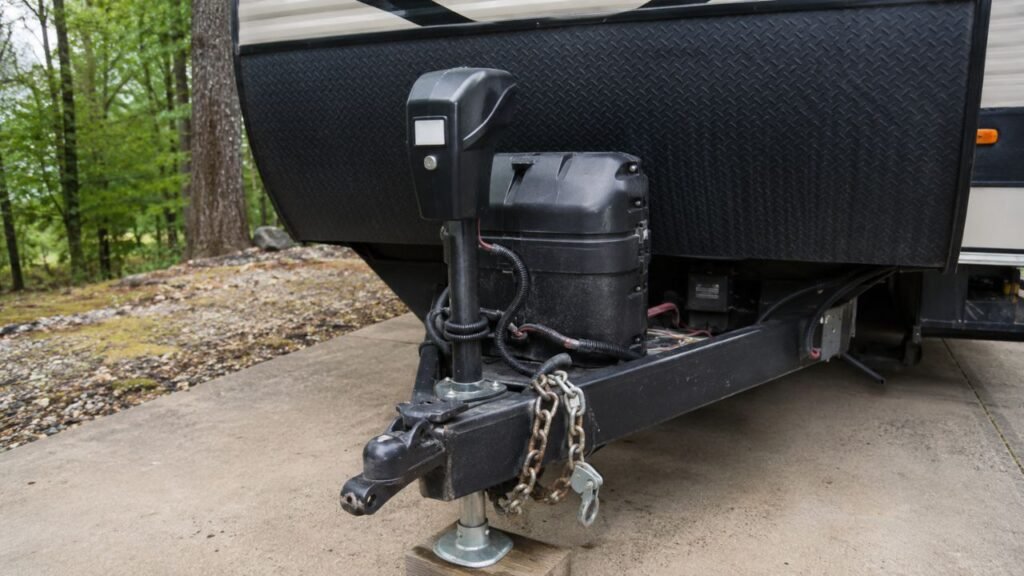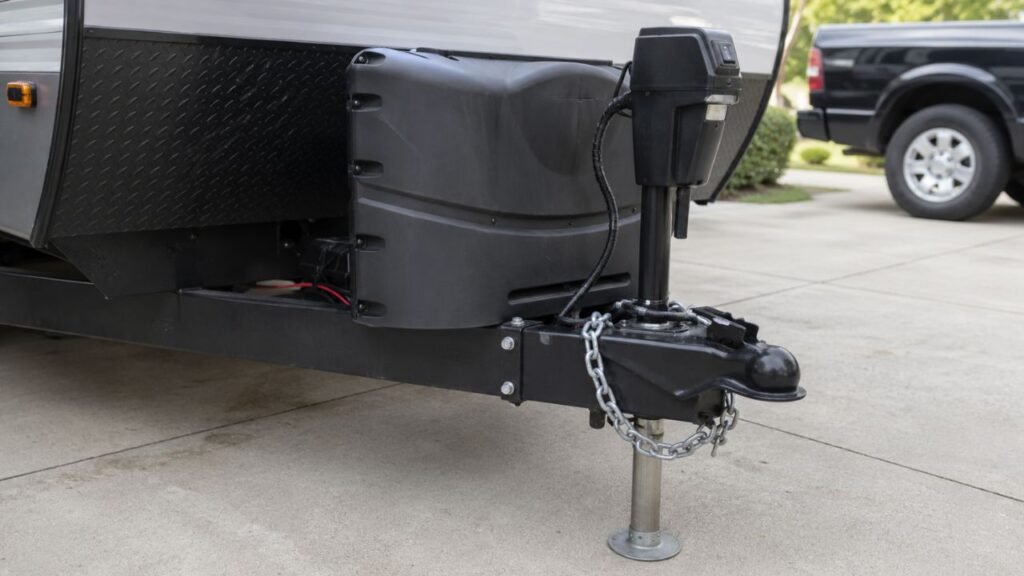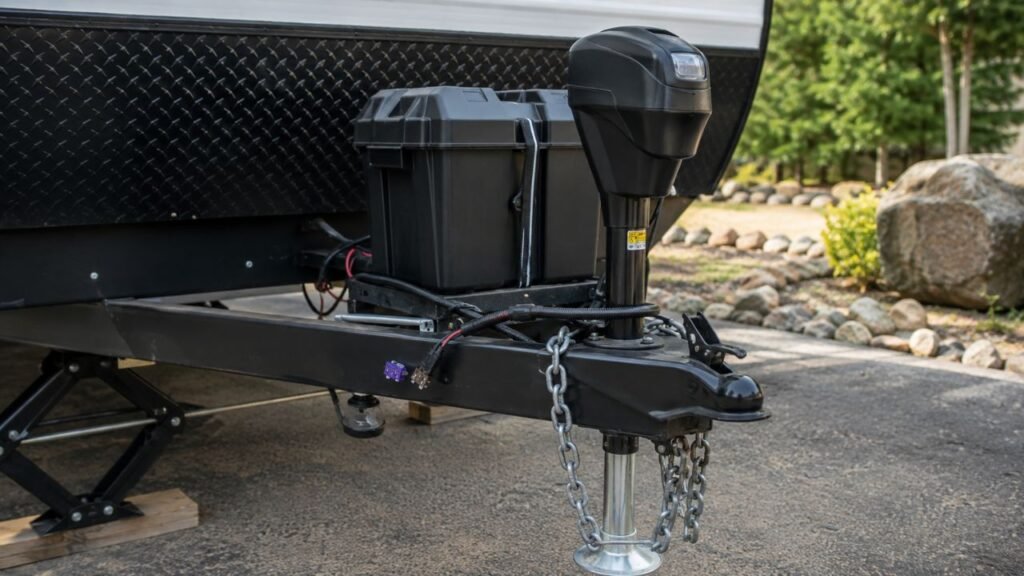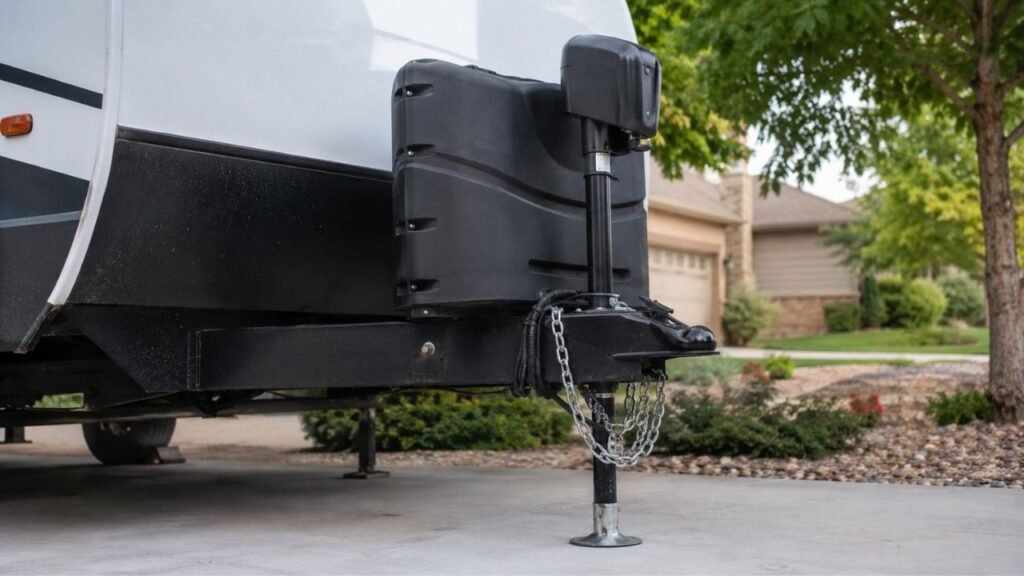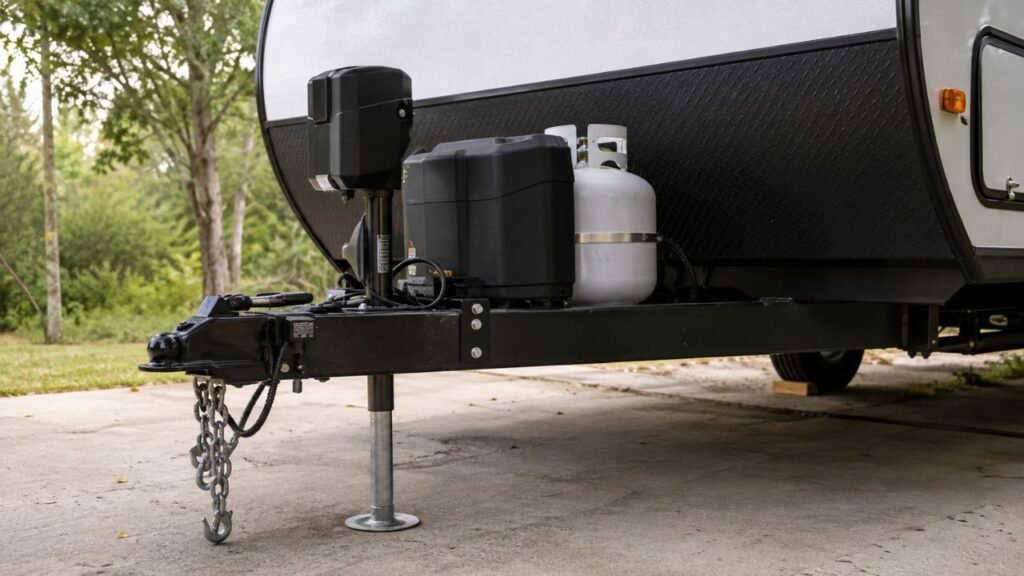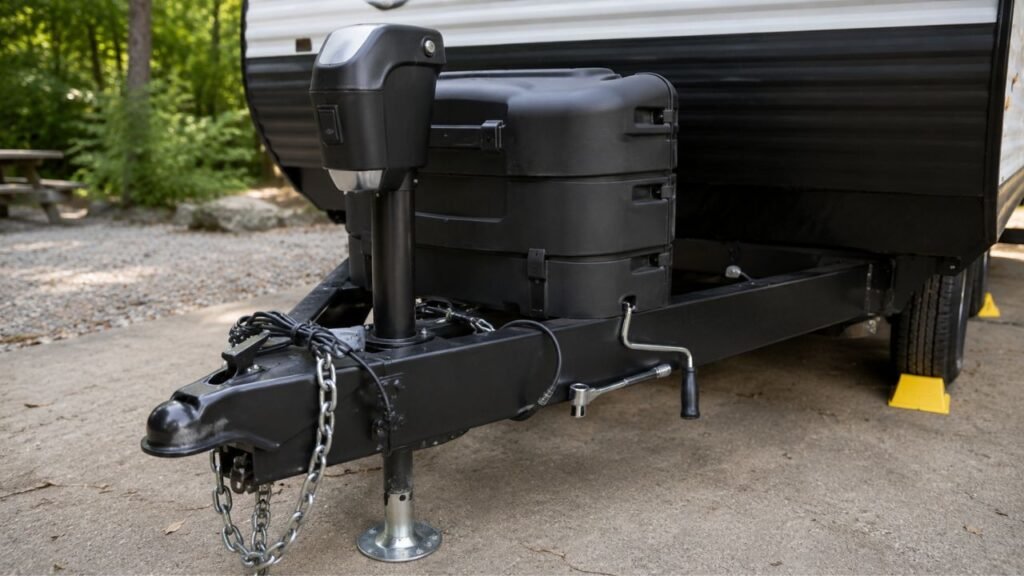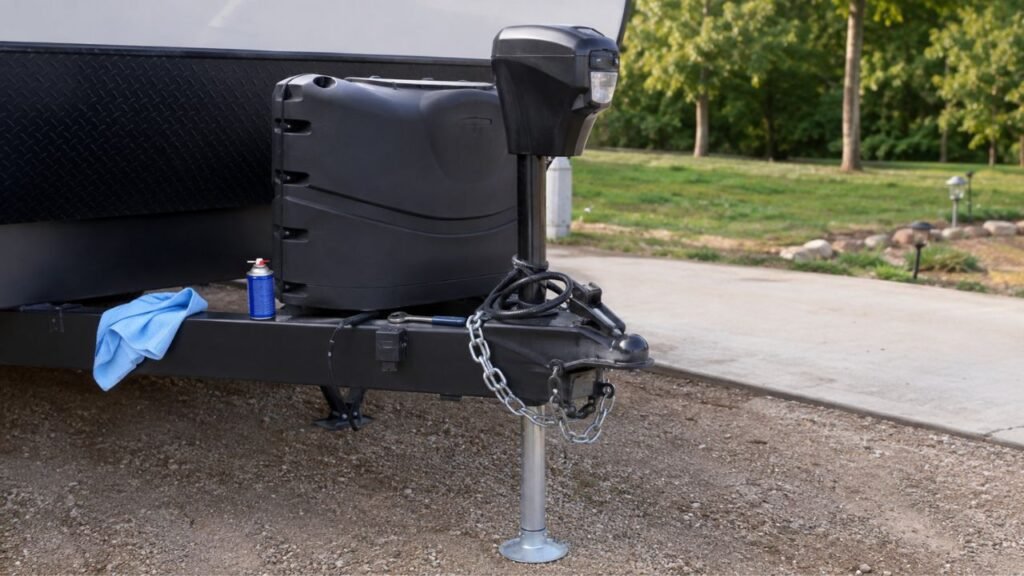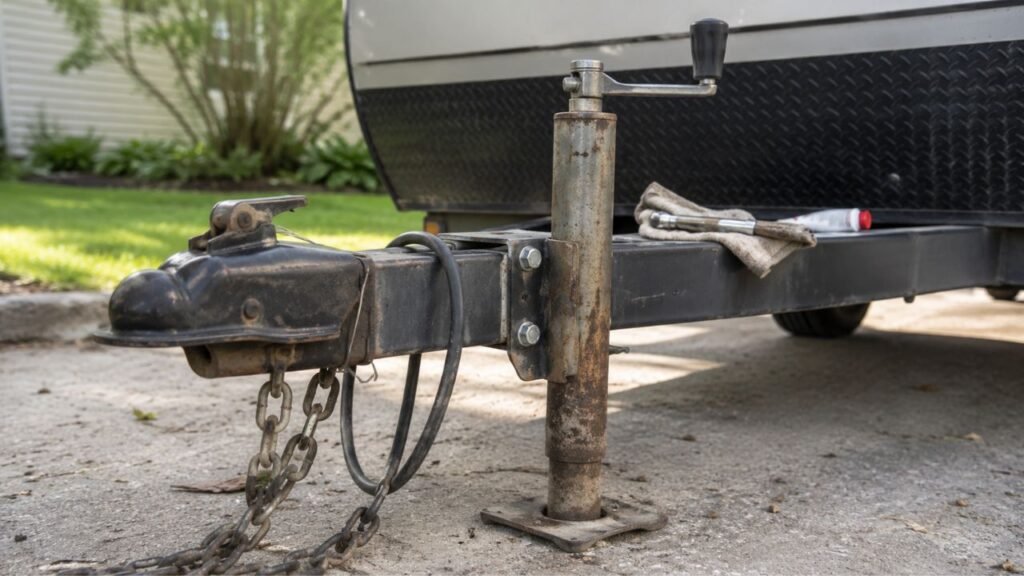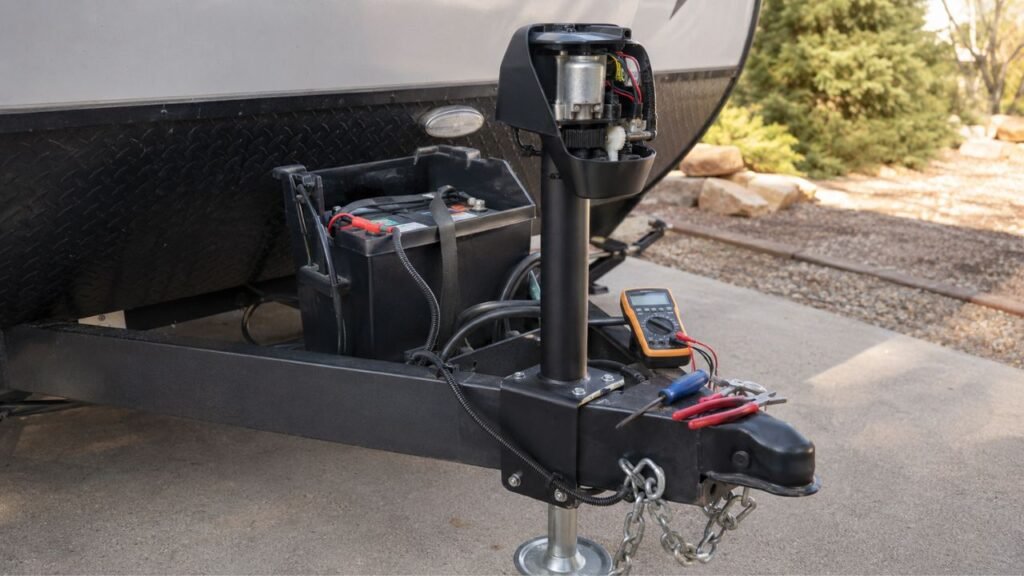
To test an electric trailer jack motor, first confirm the battery, fuse, ground, and switch are supplying proper 12-volt power. Then check voltage at the motor. If necessary, isolate the motor and briefly apply properly fused 12-volt power directly to its leads. If the motor runs, the problem is usually elsewhere in the jack’s electrical circuit.
I’ll walk you through the checks in a sensible order. This way, you can find the actual problem without replacing a perfectly good motor.
Key Takeaways
- Check the trailer battery before testing the jack motor.
- Inspect the fuse, breaker, wiring, and ground connections first.
- A working jack light does not prove the motor has enough power.
- Use a multimeter to confirm voltage reaches the switch and motor.
- Direct 12-volt testing can help isolate the motor from the controls.
- Follow your jack’s wiring diagram before connecting jumper wires.
- If the motor runs directly, suspect the switch, wiring, or ground.
- If the motor receives proper power but stays dead, inspect the motor.
- Mechanical binding can sometimes look like an electrical motor failure.
- Stop testing if the motor overheats, stalls, or wiring becomes hot.
How Do You Test an Electric Trailer Jack Motor?
The easiest way to diagnose the motor is to work through the electrical circuit in order. Start at the battery, then move toward the jack until you find where power disappears.
Check the battery voltage first. After that, inspect the fuse or circuit breaker and confirm the jack has a reliable ground. Test for voltage entering and leaving the control switch. Finally, check whether proper power reaches the motor when you press EXTEND or RETRACT.
If power reaches the motor but nothing happens, you can perform a direct 12-volt motor test. This bypasses the normal switch circuit and helps determine whether the motor itself can run.
Do not immediately assume the motor is bad because the jack will not move. Weak batteries, corroded connections, poor grounds, damaged switches, and mechanical binding can create very similar symptoms.
What You Need to Test an Electric Trailer Jack Motor
You do not need specialized diagnostic equipment for most electric tongue jack tests. A few basic electrical tools should be enough.
- Digital multimeter
- Fully charged 12-volt trailer battery
- Properly sized fused jumper wires
- Screwdrivers
- Socket or wrench set
- Wire labels or masking tape
- Small wire brush
- Electrical contact cleaner
- Jack manufacturer’s wiring diagram
- Wheel chocks
- Suitable trailer support
- Safety glasses
Avoid using very thin jumper wires for a direct motor test. Electric trailer jack motors can draw considerably more current than small automotive accessories.
Also, never guess which wire is positive or negative based only on color. Trailer jack manufacturers do not all use exactly the same wiring arrangement.
Before Testing the Motor, Rule Out the Simple Problems
Before opening the jack housing, spend a few minutes checking the basic electrical system. Many apparent motor failures come from something much simpler.
Secure the Trailer
Park the trailer on firm and reasonably level ground.
Place wheel chocks securely around the tires before working near the tongue. If the jack is already malfunctioning, do not depend on it as your only support.
Use appropriate supporting equipment whenever the trailer tongue must remain elevated during troubleshooting.
Keep your hands, wiring, tools, and clothing away from the jack’s moving parts.
Check the Trailer Battery
Start by testing the battery directly at its terminals.
Set your multimeter to DC volts. Place the red probe on battery positive and the black probe on battery negative.
A healthy, fully charged 12-volt lead-acid battery at rest will commonly read around 12.6 volts. However, battery type and state of charge affect the exact reading.
The more important test is what happens when the jack tries to operate.
Hold the jack switch briefly while watching the meter. If battery voltage drops dramatically, the battery may be weak or unable to provide the required current.
Do not assume the battery is healthy because the trailer lights work. An LED light needs very little current compared with an electric jack motor.
Check the Fuse
Most electric tongue jacks have an inline fuse or another form of overcurrent protection.
Look along the jack’s positive power wire, usually near the battery connection.
Remove the fuse and inspect it. However, visual inspection alone is not always enough. A fuse can sometimes look normal while still having a poor internal connection.
Use the continuity function on your multimeter when possible.
You can also check voltage on both sides of the fuse while the circuit is powered.
Always replace a fuse with the rating specified by the jack manufacturer. Installing a larger fuse can allow wiring or motor components to overheat.
Check the Circuit Breaker
Some electric jacks use a resetting circuit breaker rather than only a traditional fuse.
If the motor stops after operating under a heavy load, the breaker may have opened temporarily.
Allow the jack to cool for a short period. Then test it again.
Repeated breaker trips should not be ignored. They can indicate overload, mechanical binding, excessive resistance, low voltage, or a failing motor.
Check the Jack Ground
A poor ground is one of the first things I would investigate when a trailer jack acts weak, intermittent, or completely dead.
Some electric tongue jacks ground through their mounting hardware. The jack mounting plate must therefore contact clean metal on the trailer frame.
Rust, paint, corrosion, dirt, and loose bolts can create resistance.
Remove corrosion around the mounting area if your jack uses this grounding method. Make sure the mounting bolts are clean and properly tightened.
Other jack designs have a dedicated negative wire running back to the battery.
If your jack has one, inspect that wire carefully.
Check:
- Battery negative terminal
- Ring terminals
- Crimp connectors
- Ground wire condition
- Frame connections
- Corrosion
- Loose hardware
Do not assume your jack grounds through its mounting bolts. Check its wiring diagram first.
Try the Manual Override
Most electric tongue jacks include a manual operating method for emergencies.
Use the manufacturer’s manual crank procedure and see whether the jack mechanism moves normally.
If the jack turns smoothly by hand, a severe mechanical jam becomes less likely.
If the manual crank is extremely difficult to turn, something may be binding inside the jack.
Possible problems include:
- Damaged gears
- Bent jack tube
- Dry screw mechanism
- Internal corrosion
- Worn bearings
- Jammed drive components
A motor cannot easily overcome a mechanical problem that prevents the jack from turning manually.
Test Whether Power Is Reaching the Trailer Jack Motor
Before bypassing the switch, determine where voltage is present in the normal circuit. This often reveals the problem without needing a direct motor test.
Test Power Going Into the Switch
Remove the jack housing cover according to the manufacturer’s instructions.
Identify the power wire entering the EXTEND/RETRACT switch.
Set your multimeter to DC volts.
Place the black probe on a known good ground. Then carefully place the red probe on the switch’s incoming power terminal.
You should see battery voltage or something very close to it.
If there is no voltage here, the problem is probably upstream from the switch.
Check:
- Battery connection
- Inline fuse
- Circuit breaker
- Positive cable
- Wiring connector
- Ground circuit
- Damaged or corroded terminals
There is little reason to replace the motor if power never reaches the jack’s controls.
Test Voltage Coming Out of the Switch
Now check whether the switch actually sends power toward the motor.
Have the meter connected while briefly pressing EXTEND.
Then perform the same test while pressing RETRACT.
A properly operating reversing switch changes the electrical path so the motor can turn in opposite directions.
If proper voltage reaches the switch but does not leave it when commanded, the switch may be faulty.
Possible causes include:
- Burned switch contacts
- Corroded terminals
- Broken internal connection
- Loose wire
- Damaged connector
- Failed relay
- Control board problem
Some newer jacks use relays or electronic controls instead of sending full motor current directly through a simple rocker switch.
Use your specific wiring diagram before probing unfamiliar circuits.
Test Voltage at the Motor
The next step is checking whether voltage reaches the actual motor.
Locate the motor connections.
While monitoring the voltage, briefly operate the jack switch.
If the motor receives the expected voltage but remains completely still, your suspicion can move toward the motor itself or the mechanical drive.
If little or no voltage reaches the motor, keep tracing backward toward the switch and wiring.
This test often saves you from unnecessarily removing or replacing the motor.
How to Perform a Voltage-Drop Test on the Jack Circuit
A circuit can show normal voltage with no load yet fail once the motor starts demanding current. A voltage-drop test helps uncover resistance in cables, switches, terminals, and grounds.
Test the Positive Side
Set the multimeter to DC volts.
Place one probe at the battery positive terminal.
Place the other probe at the motor’s positive supply point.
Now briefly command the jack to operate.
The meter shows how much voltage is being lost between those two points.
An unusually large voltage drop means there is excessive resistance somewhere along that path.
Potential causes include:
- Corroded battery terminal
- Damaged fuse holder
- Loose crimp
- Weak circuit breaker connection
- Undersized wiring
- Damaged power wire
- Burned switch contacts
- Loose connector
Move the probes closer together through the circuit until you isolate the connection producing the largest loss.
Test the Ground Side
You can perform a similar test on the ground circuit.
Place one probe at battery negative.
Place the other at the motor ground or jack ground point.
Operate the jack briefly.
A significant reading here indicates resistance between the jack and battery negative.
For mounting-grounded jacks, inspect the jack plate, mounting bolts, star washers, trailer frame, and battery-to-frame connection carefully.
Ground problems often become obvious only when the motor draws substantial current.
How to Test an Electric Trailer Jack Motor With Direct 12V Power
A direct-power test removes the switch and much of the normal jack wiring from the equation. However, you need to identify the motor wiring correctly before doing it.
Step 1: Disconnect Normal Jack Power
Disconnect the jack from the battery before opening connectors or moving motor wires.
You do not want an exposed wire becoming energized unexpectedly while you work.
Remove the fuse or disconnect the battery cable according to your jack’s setup.
Step 2: Remove the Jack Housing Cover
Remove the protective housing or motor cover.
Keep screws and seals organized.
Be careful with weather seals. Damaging them can allow water to enter the motor housing later.
Step 3: Identify the Motor Leads
Find the wires going directly into the electric motor.
Do not simply select wires because they look like positive and negative leads.
Trace them carefully.
Take a picture before disconnecting anything. You can also place labels on each wire so reassembly is easier.
If the jack contains a control board, relay system, or unusual motor wiring, consult its manual before continuing.
Step 4: Isolate the Motor From the Control Circuit
Disconnect the motor from the switch, relay, or control board according to the jack’s wiring arrangement.
The purpose is to test the motor by itself.
You do not want your jumper wires accidentally backfeeding the switch or electronic control system.
Keep disconnected terminals separated so they cannot short against the housing.
Step 5: Apply Fused 12-Volt Power Directly
Connect appropriately sized fused jumper leads to a known-good 12-volt battery.
For a basic reversible DC motor, power is normally applied across the motor circuit according to the jack’s wiring diagram.
Make the final connection only when everything is secure.
The motor may start immediately.
Do not leave it connected unnecessarily.
A brief test is usually enough to see whether the motor operates.
Step 6: Test the Opposite Direction
Many electric trailer jack motors reverse direction when polarity is reversed.
If your manufacturer’s wiring diagram confirms this type of motor, reverse the jumper polarity.
The motor should now turn in the opposite direction.
Do not assume every electric jack can be tested using this exact method. Jacks with electronic motor controls may require a different procedure.
Step 7: Observe the Motor Carefully
Pay attention to more than whether the motor simply moves.
Listen and watch for:
- Smooth rotation
- Slow rotation
- Intermittent operation
- Humming
- Clicking
- Excessive sparking
- Grinding sounds
- Rapid heating
- Complete silence
How the motor behaves can tell you almost as much as whether it runs at all.
What Do Your Electric Trailer Jack Motor Test Results Mean?
Once you have completed the electrical tests, the results should point you toward a much smaller group of possible failures.
| Test Result | Likely Problem Area | What to Check Next |
| No voltage reaches the jack switch | Supply circuit | Battery, fuse, breaker, positive wiring |
| Voltage reaches switch but not motor | Switch or control circuit | Switch, relay, connectors, wiring |
| Proper voltage reaches motor but it stays silent | Motor or mechanical problem | Direct motor test and manual override |
| Motor works with direct battery power | Motor is probably good | Switch, relay, wiring, ground |
| Motor runs directly in both directions | Reversing motor is probably good | Control switch and reversing circuit |
| Motor runs slowly with direct power | Motor wear or mechanical drag | Gearbox, screw drive, motor condition |
| Motor hums but does not turn | Stalled motor or mechanical binding | Manual operation and drive mechanism |
| Motor is silent during direct test | Failed motor becomes likely | Verify connections, then inspect motor |
| Manual crank is also difficult | Mechanical problem likely | Gears, screw mechanism, jack tube |
| Fuse or breaker repeatedly opens | Excessive current draw | Binding, overload, short, weak motor |
| Motor works unloaded but struggles under load | Voltage or mechanical issue | Battery, voltage drop, jack capacity |
Do not use one result alone to diagnose every jack. Combine your electrical readings with the jack’s mechanical behavior.
How Do You Know If the Electric Trailer Jack Motor Is Bad?
Several symptoms can point toward motor failure, but I would still verify power and mechanical operation before replacing anything.
- Proper voltage reaches the motor but it does not respond.
- The motor fails a correctly performed direct 12-volt test.
- The motor operates only intermittently with solid connections.
- The motor becomes unusually hot very quickly.
- The motor smells burned during a brief test.
- Internal corrosion or water damage is visible.
- The motor turns very slowly with a known-good power source.
- The jack mechanism moves manually but not electrically.
- Brush or internal motor wear causes unreliable operation.
The strongest evidence is usually a failed direct-power test combined with a freely moving mechanical jack.
If the motor is being supplied correctly and the mechanism is not jammed, motor failure becomes much more likely.
Why Does the Jack Light Work but the Motor Does Not?
A working jack light does not mean the electric motor has enough power. The light usually requires only a small amount of current, while the jack motor needs considerably more.
A weak battery may therefore illuminate the light without successfully running the jack. Corroded cables and poor grounds can create the same situation because they restrict current when the motor is loaded.
If the light works but the motor does not, check battery condition, voltage drop, the ground connection, fuse holder, switch, and motor circuit before buying replacement parts.
What If the Motor Runs but the Trailer Jack Still Does Not Move?
If you can hear the motor turning but the jack tube remains stationary, the problem is probably beyond the electrical motor itself.
Possible causes include:
- Stripped gearbox teeth
- Broken drive gear
- Failed motor-to-gear coupling
- Worn screw mechanism
- Bent inner jack tube
- Dry or corroded screw
- Internal bearing damage
- Jammed gearbox
- Slipping clutch
- Travel limit reached
- Excessive tongue load
Try the manual override after securely supporting the trailer.
If manual operation also feels rough or unusually difficult, the jack likely needs mechanical service.
Do not keep holding the switch while the motor spins without moving the jack. Continued operation can damage gears, the clutch, or the motor.
Can You Test the Motor Without Removing the Trailer Jack?
Yes, you can usually perform most electric trailer jack motor tests without removing the entire jack from the trailer.
Battery testing, fuse inspection, ground checks, switch testing, voltage measurements, and many direct motor tests can usually be performed while the jack remains mounted.
The trailer must still be safely supported before you open the housing or disconnect jack wiring.
You normally need to remove the entire jack only when mechanical inspection, motor replacement, gearbox repair, or structural damage makes removal necessary.
Should You Test the Motor With Trailer Weight on the Jack?
Start your diagnosis with as little unnecessary load as practical.
A heavy tongue load increases motor current and can make a weak battery, poor connection, worn motor, or mechanical problem more noticeable. However, it also adds stress during troubleshooting.
First confirm that the jack and motor can operate normally under safe conditions.
After basic operation is verified, you can evaluate performance under the trailer’s normal tongue load while staying within the jack’s rated capacity.
Stop immediately if the motor stalls, the clutch repeatedly slips, the breaker trips, or the wiring becomes hot.
Never exceed the jack’s rated lifting capacity simply to test the motor.
When Should You Replace the Motor or the Entire Electric Jack?
Sometimes replacing the motor makes sense. Other times, replacing the complete jack is the more practical repair.
Replace the Motor When
- Direct testing confirms the motor has failed.
- The motor is available separately.
- The gearbox remains in good condition.
- The screw mechanism operates smoothly.
- The jack tube is straight.
- The housing is structurally sound.
- Replacement motor cost is reasonable.
A motor-only repair can be worthwhile on a good-quality jack with readily available service parts.
Replace the Complete Jack When
- The motor and gearbox are both damaged.
- The main screw is badly worn.
- The jack tube is bent.
- Water has severely corroded several internal components.
- Replacement parts are discontinued.
- The jack has repeated mechanical failures.
- Repair costs approach the price of a new unit.
- The jack’s capacity is inadequate for your trailer.
Consider the overall condition of the jack rather than focusing only on the motor.
Replacing a motor inside a badly worn jack may only delay another failure.
How to Prevent Electric Trailer Jack Motor Problems
A little routine maintenance can prevent many of the issues that eventually look like motor failure.
- Keep the trailer battery properly charged.
- Clean battery terminals regularly.
- Inspect the inline fuse holder for corrosion.
- Keep ground connections clean and tight.
- Protect electrical connectors from moisture.
- Check mounting bolts periodically.
- Follow the manufacturer’s lubrication schedule.
- Keep the jack tube clean.
- Avoid repeatedly reaching the jack’s travel limit.
- Do not lift more weight than the jack is rated for.
- Stop if the motor stalls.
- Investigate repeated circuit breaker trips.
- Keep the manual crank accessible.
- Inspect the housing seals for water entry.
- Repair damaged wires before corrosion spreads.
Pay attention when the jack begins operating more slowly than usual.
A gradual slowdown is often an early warning of battery weakness, resistance in the wiring, mechanical drag, or motor deterioration.
Final Words
Testing an electric trailer jack motor becomes much easier when you follow the circuit instead of guessing. Start with the battery, fuse or breaker, ground, switch, and motor voltage before bypassing anything.
If the motor runs normally with properly applied direct 12-volt power, it probably does not need replacement. Look closely at the switch, wiring, connections, relays, and ground circuit instead.
If the motor receives proper power but still will not operate, check whether the jack moves manually. A freely moving jack combined with a failed direct motor test gives you much stronger evidence that the motor itself has failed.
Taking a few extra minutes to test each part can save you from buying a motor or complete jack you never needed.
Related FAQs
Can I Connect an Electric Trailer Jack Motor Directly to a 12-Volt Battery?
Yes, many basic 12-volt electric jack motors can be tested directly from a known-good battery after being isolated from the normal control circuit. Use properly sized fused jumper leads and confirm the motor wiring in the manufacturer’s diagram before making connections.
What Voltage Does an Electric Trailer Jack Motor Use?
Most electric A-frame tongue jacks used on travel trailers in the USA operate from a 12-volt DC electrical system. However, you should always verify the voltage specified for your particular jack before testing it directly.
How Can I Tell Whether My Trailer Jack Switch Is Bad?
Check voltage entering the switch and then test the output while pressing EXTEND and RETRACT. If proper voltage reaches the switch but the appropriate output does not reach the motor, the switch or associated control circuit may be faulty.
Why Does My Electric Trailer Jack Work in Only One Direction?
A jack that works only up or only down may have a worn reversing switch, bad relay, loose connection, damaged wire, or control circuit problem. Because the motor already works in one direction, the motor itself may still be functional.
Can a Bad Ground Stop an Electric Trailer Jack Motor?
Yes. A weak or corroded ground can prevent enough current from reaching the motor even when some accessories still work. Inspect dedicated ground wires or clean the jack’s mounting surfaces if your model grounds through its mounting hardware.
Why Does My Electric Trailer Jack Click but Not Move?
Clicking can indicate that a switch or relay is activating while the motor is not receiving enough current. Check the battery, terminals, fuse, ground, voltage drop, motor connections, and mechanical jack movement before replacing the motor.
Why Does My Electric Trailer Jack Motor Run Slowly?
Slow operation can result from a weak battery, voltage drop, poor ground, corroded wiring, excessive trailer tongue weight, mechanical binding, cold conditions, or a worn motor. Test voltage under load to narrow down the cause.
Does a Working Jack Light Mean the Motor Is Getting Enough Power?
No. The jack light uses far less current than the motor. A weak battery or high-resistance connection may still power the light while preventing the motor from operating properly.
Can a Blown Fuse Make the Electric Trailer Jack Look Like the Motor Failed?
Yes. A blown fuse interrupts power before it reaches the motor, making the jack appear completely dead. Always test the fuse and verify voltage on both sides before diagnosing a failed motor.
What Should I Do If the Motor Runs but the Jack Does Not Move?
If the motor runs but the jack does not move, inspect the gearbox, coupling, clutch, screw mechanism, and inner jack tube. The problem is likely mechanical rather than an electrical motor failure.
Can Low Battery Voltage Damage an Electric Trailer Jack Motor?
Repeatedly running a jack from a weak battery can make the motor draw higher current and operate hotter than normal. Correct low-voltage problems rather than repeatedly holding the switch while the motor struggles.
Should I Replace the Jack If the Motor Fails?
Not necessarily. If the jack is otherwise in good condition and a replacement motor is available, replacing only the motor may make sense. Replace the complete jack when significant gearbox, screw, tube, corrosion, or structural damage is also present.

Ryan Mitchell writes for readers who prefer independent travel and practical outdoor motorhome living. His how-to guides and reviews focus on simplicity, durability, and real value. He brings a calm, hands-on perspective to every topic.