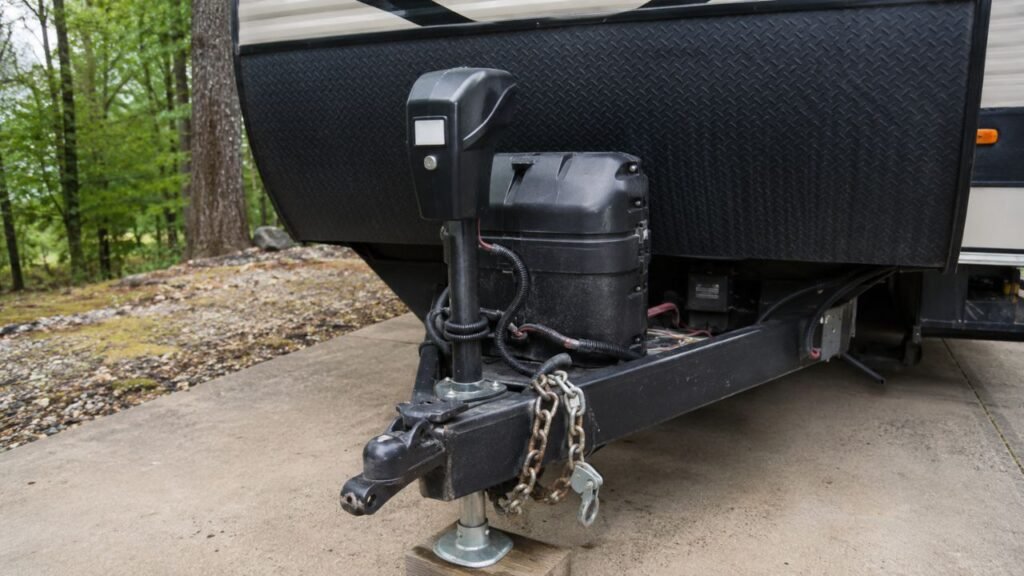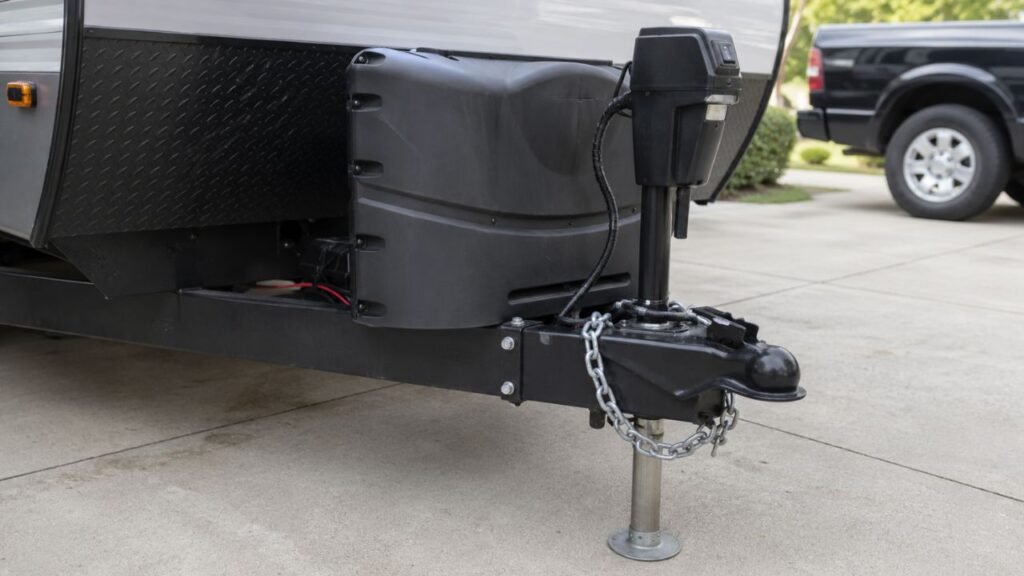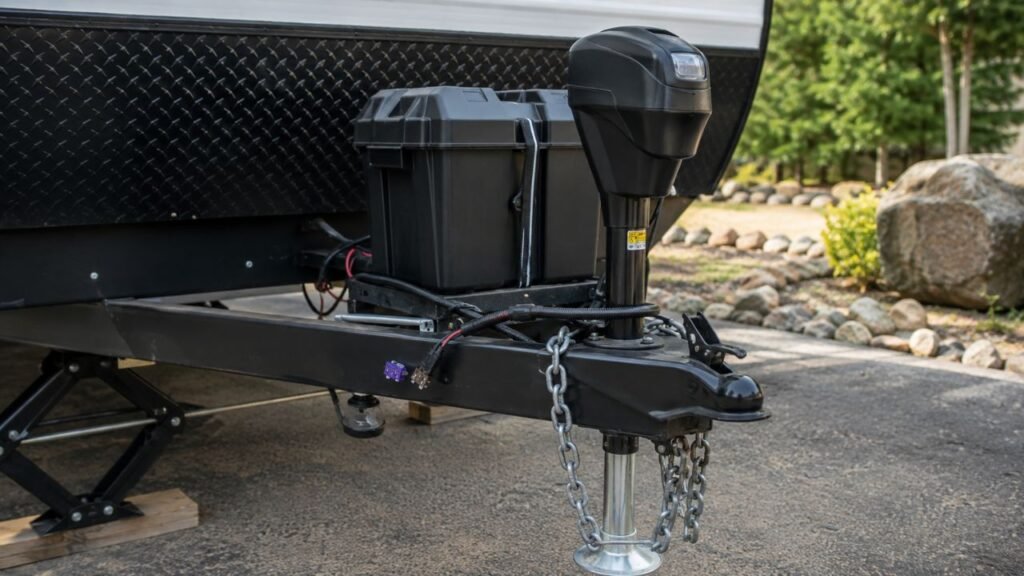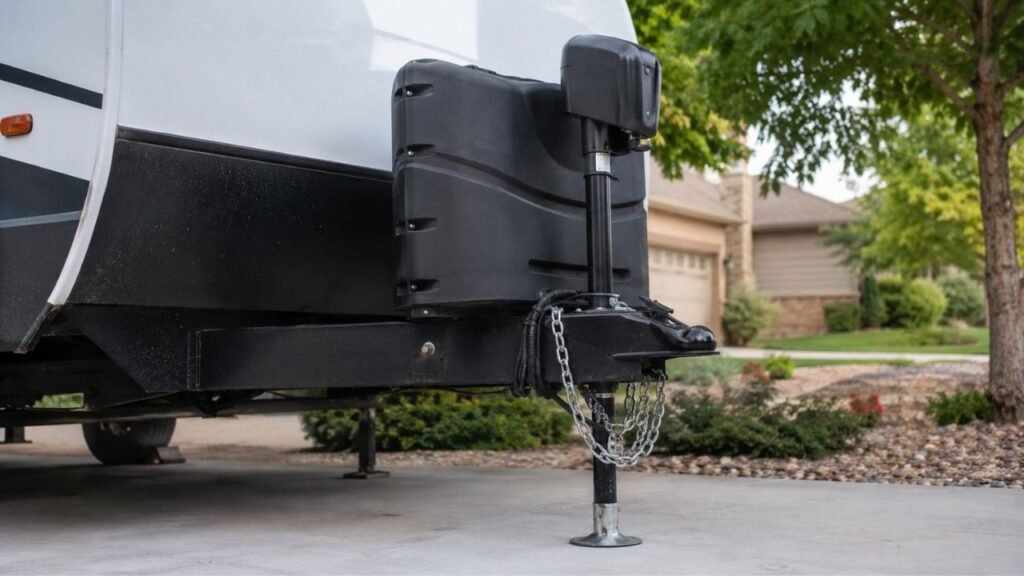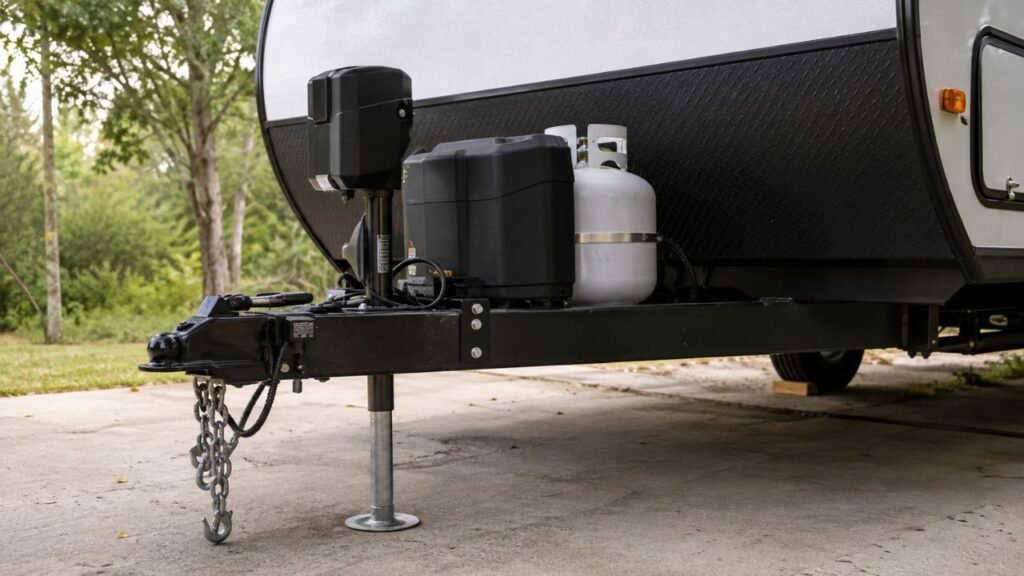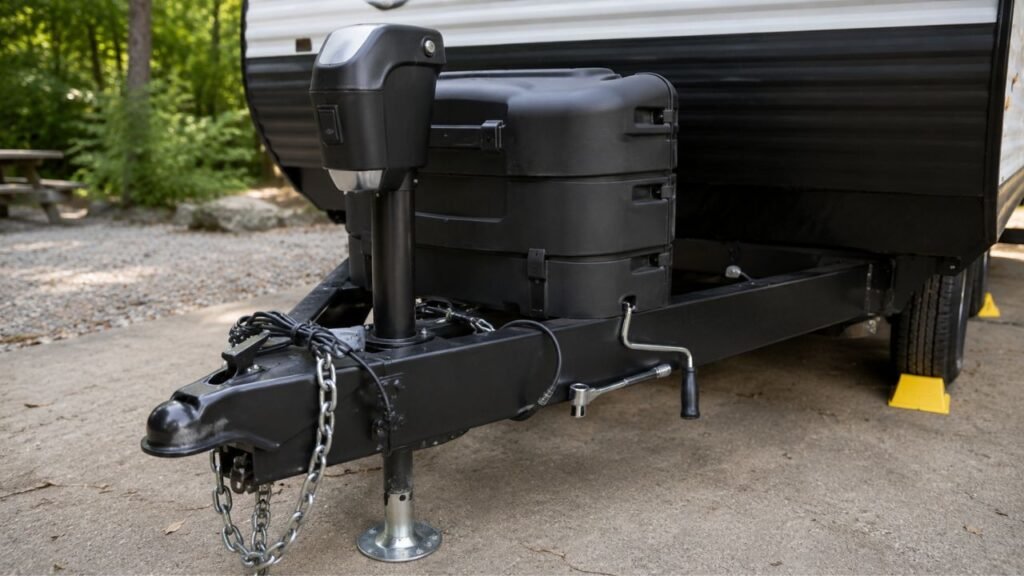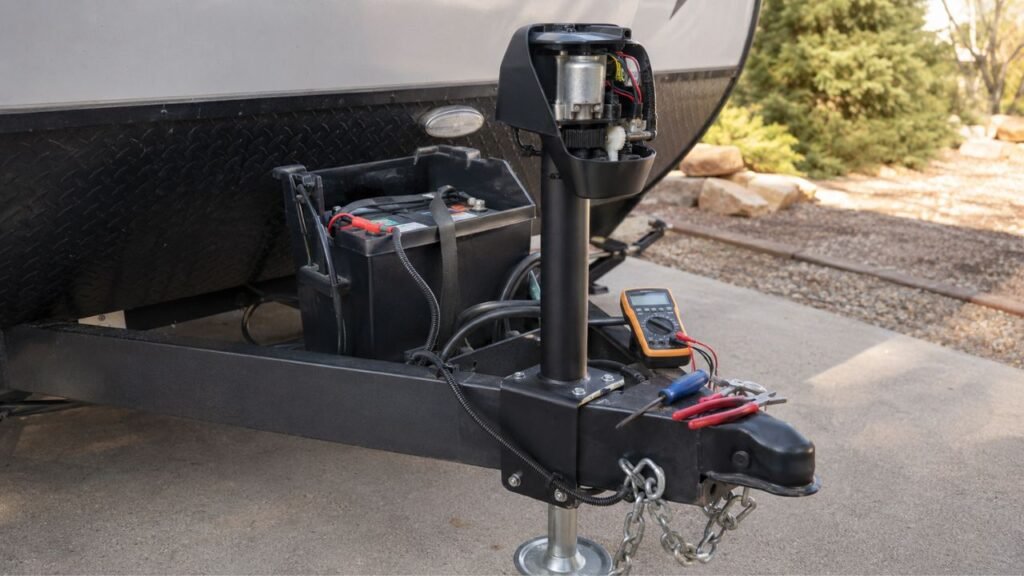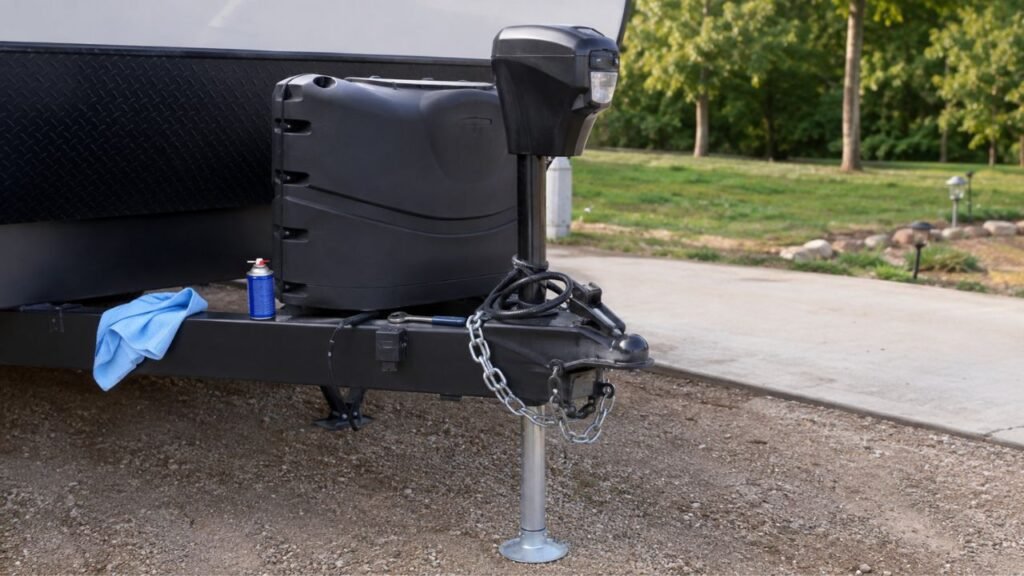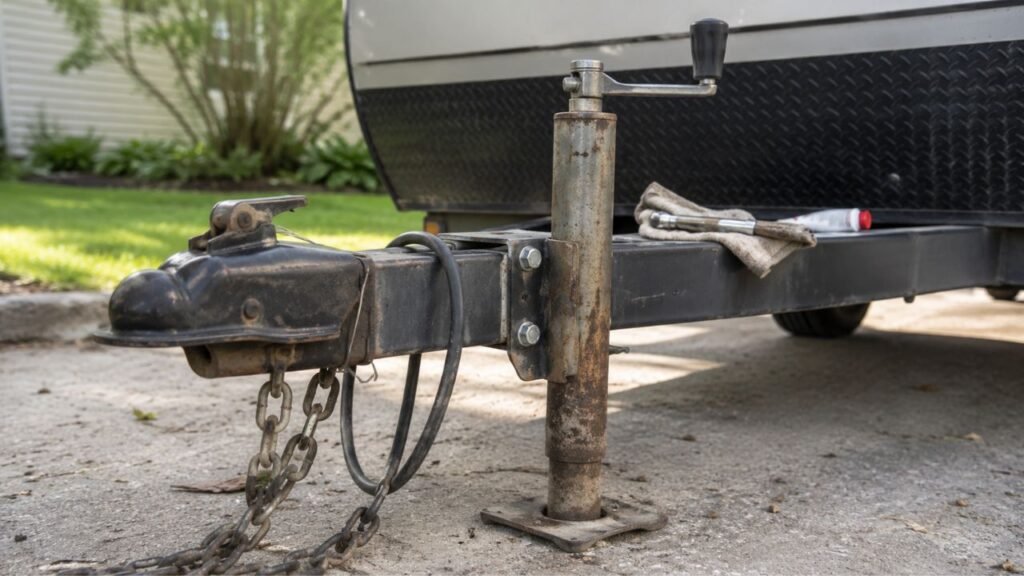
A trailer jack is usually hard to turn because the internal screw lacks lubrication, rust has formed inside the jack, or dirt is binding the telescoping tubes. Excessive tongue weight, incorrect gearing, bent components, or worn internal gears can also make cranking unusually difficult.
The good news is that you can often narrow down the problem quickly. I’ll help you identify what the jack is telling you, troubleshoot it safely, and decide whether cleaning, lubrication, repair, or replacement makes the most sense.
Key Takeaways
- Dry internal screws and gears commonly make trailer jacks harder to crank.
- Rust can develop inside the jack even when damage looks minor outside.
- A jack that turns easily unloaded may be struggling with excessive weight.
- Stiffness at one specific point can indicate bent or damaged components.
- Grinding, clicking, or skipping usually deserves closer mechanical inspection.
- Two-speed jacks should normally use low gear when lifting heavy tongue weight.
- Never keep forcing a jack that suddenly becomes much harder to turn.
Why Is My Trailer Jack Hard to Turn?
Several parts inside a trailer jack must move smoothly together. When one part becomes dry, rusty, overloaded, or damaged, you feel that resistance directly through the crank handle. These are the most common causes I would check.
The Jack Screw or Gears Need Lubrication
The internal lead screw does most of the lifting work. As you turn the handle, the screw moves through a threaded nut and raises or lowers the jack.
That creates a lot of friction if lubrication becomes thin or dries out.
The gears at the top of the jack also need proper lubrication. When grease disappears from these contact surfaces, every crank requires more effort.
You may notice the problem developing gradually. The jack might feel slightly heavier one month and noticeably stiff later.
If the jack otherwise operates normally, lubrication should be one of your first checks.
Rust or Corrosion Is Binding the Screw
Moisture can enter a trailer jack through small openings around the handle, gearbox, seams, or lower tube.
Once moisture reaches the internal screw, corrosion can develop on the threads. Those rough surfaces then drag against the threaded nut.
Boat trailers are especially vulnerable because they regularly encounter water. Utility and travel trailers can also develop corrosion from rain, road spray, snow, and road salt.
A jack that worked normally before storage but feels stiff afterward deserves a corrosion inspection.
Dirt or Grit Is Trapped Between the Jack Tubes
The exposed inner tube collects dirt whenever you tow or park.
Mud, dust, sand, and road grit can stick to grease on the surface. As the jack retracts, some contamination may be pulled toward the outer tube.
This creates extra friction between the telescoping sections.
Look closely at the exposed tube. Scratches, dirty grease, or shiny rubbing marks can show where binding occurs.
A good cleaning sometimes makes a surprisingly noticeable difference.
The Trailer Is Putting Too Much Weight on the Jack
A jack becomes harder to turn as the load increases. That does not automatically mean something is broken.
The important question is whether your jack is lifting within its rated capacity.
Trailer owners sometimes focus only on the largest weight number shown for a jack. However, lifting capacity and static support capacity are not always identical.
The jack must have enough lifting capacity for your actual tongue weight and operating conditions.
If your jack turns easily without weight but becomes extremely difficult once loaded, capacity should be high on your troubleshooting list.
A Two-Speed Jack Is in the Wrong Gear
Some heavy-duty trailer jacks use two gearing ranges.
High gear moves the jack faster but provides less mechanical advantage. Low gear moves more slowly while making heavy loads easier to lift.
If you try lifting a heavy trailer in high gear, the crank can feel surprisingly difficult.
Switching into low gear may solve the problem immediately.
If you own a two-speed jack, verify the gear position before assuming something is damaged.
The Inner Tube or Jack Screw Is Bent
Trailer jacks are designed primarily for vertical loading.
Side forces can bend the inner tube or internal screw.
This sometimes happens when:
- The trailer moves while the jack remains extended.
- The tow vehicle pulls before the jack is raised.
- The jack strikes a curb or obstacle.
- The trailer shifts sideways while supported.
- The jack is overloaded.
- The trailer is dropped or moved unexpectedly.
A bent component often causes resistance in one particular area of travel.
You might crank smoothly for several turns, reach one spot, and suddenly feel much more resistance.
Lubrication will not permanently fix a bent screw or tube.
The Bevel Gears Are Worn or Damaged
The crank handle usually transfers your effort through gears inside the jack head.
Those gears can wear, chip, crack, or lose teeth over time.
Common signs include:
- Clicking while cranking
- Uneven resistance
- Handle movement without smooth jack movement
- Skipping under load
- Metal grinding
- Excessive looseness in the crank handle
If the gears are damaged, continuing to crank hard can make the problem worse.
Some jacks allow gear replacement. Others are more economical to replace completely.
The Thrust Bearing Is Worn or Failing
A thrust bearing helps support the heavy axial load created while lifting.
When that bearing becomes dry or damaged, cranking effort can increase significantly.
You may also feel roughness through the handle. In some cases, the jack sounds gritty or produces a low grinding noise under load.
Bearing problems are easy to overlook because the jack can still move.
However, resistance usually becomes worse as the bearing deteriorates.
Old or Contaminated Grease Is Creating Extra Drag
Adding more grease does not solve every stiff jack.
Old grease can collect dirt, metal particles, moisture, and rust debris. Eventually, that mixture becomes thick and abrasive.
Different grease types may also behave poorly when mixed.
If the jack became stiff despite repeated lubrication, cleaning out old grease may be more helpful than adding another layer.
Follow the jack manufacturer’s lubrication requirements whenever possible.
The Jack Is at the End of Its Travel
Sometimes nothing is actually wrong with the jack.
The crank becomes difficult because the jack has reached maximum extension or full retraction.
Once the mechanism reaches its mechanical stop, additional handle force cannot move it farther.
Do not keep forcing the crank.
Excessive torque at the travel limit can damage gears, screw threads, pins, or other internal parts.
What Does the Way Your Trailer Jack Feels Tell You?
The exact way your jack feels can narrow down the problem quickly. Before taking anything apart, compare your symptom with this table.
| What You Notice | Most Likely Cause | Quick Check | Likely Next Step |
| Hard loaded but easy unloaded | Heavy tongue weight or wrong gearing | Remove the load | Check capacity and gear |
| Hard loaded and unloaded | Dry or corroded screw | Crank with no tongue weight | Clean and lubricate |
| Hard at one point | Bent screw, tube, or damaged threads | Move slowly through travel | Inspect for bending |
| Grinding while cranking | Gear or bearing damage | Listen near jack head | Inspect internal parts |
| Clicking or skipping | Damaged gears | Watch handle movement | Repair or replace gears |
| Very stiff near full extension | End of travel | Check jack position | Stop cranking |
| Stiff after storage | Rust or dried grease | Inspect exposed tube | Clean and lubricate |
| Handle spins without lifting | Stripped gear or screw damage | Watch tube movement | Repair or replace |
| Harder after adding grease | Contaminated grease | Inspect old lubricant | Clean before relubricating |
How Do I Troubleshoot a Trailer Jack That Is Hard to Turn?
The best approach is to work from simple checks toward internal problems. You usually do not need to disassemble the jack immediately. Start with load, movement, cleanliness, and obvious damage.
Step 1: Safely Remove the Load From the Jack
Before inspecting or servicing the jack, remove trailer tongue weight from it.
Connect the trailer securely to the tow vehicle or support it using equipment designed for the job.
Do not crawl underneath a trailer supported only by the tongue jack.
Once the jack is unloaded, you can test its movement more accurately.
Step 2: Turn the Jack While It Is Unloaded
This is one of the most useful diagnostic tests.
Crank the jack after removing tongue weight.
If it suddenly becomes easy to turn, the problem is probably related to:
- Excessive load
- Incorrect jack capacity
- High gear on a two-speed jack
- Side loading
- Load-sensitive internal wear
If the jack remains hard to crank while unloaded, focus more on lubrication, rust, binding, gears, bearings, or a bent screw.
Step 3: Check Whether It Is Hard in Both Directions
Raise and lower the jack slowly while unloaded.
Pay attention to when resistance appears.
If it is difficult in both directions, internal friction is likely.
If it becomes difficult mostly while raising, load or thrust-bearing issues may be more noticeable.
If resistance appears at the exact same position repeatedly, inspect for a bent screw or tube.
These small differences can tell you much more than simply knowing the jack feels stiff.
Step 4: Inspect the Inner Tube
Fully expose as much of the inner tube as safely possible without forcing the jack against its travel stop.
Look for:
- Rust
- Mud
- Dried grease
- Deep scratches
- Dents
- Bending
- Scoring
- Uneven wear marks
Clean the surface and operate the jack again.
If movement improves, contamination was probably contributing to the resistance.
Step 5: Check the Handle and Gearbox
Look around the crank handle and upper gearbox.
Check for loose fasteners, unusual shaft movement, cracked housings, damaged pins, or excessive play.
Turn the handle slowly and listen.
Grinding suggests something different from ordinary resistance. Clicking or skipping may point toward damaged gear teeth.
If your jack has a grease fitting, inspect that area as well.
Step 6: Check the Jack’s Load Rating
Find the model information on the jack.
Compare its lifting capacity with your trailer’s actual tongue weight.
Remember that the jack does more than simply hold the coupler.
It must raise the trailer tongue high enough to connect or disconnect from the tow vehicle.
On weight-distribution setups, the jack may temporarily experience significant load while hitching or unhitching.
Using a jack too close to its limit makes operation harder and can shorten service life.
Step 7: Check the Gear Position on a Two-Speed Jack
If your jack has two speeds, select low gear before lifting heavier loads.
Low gear requires more crank rotations, but each rotation needs less effort.
Use high gear primarily when the load is light or when quickly moving the unloaded jack leg.
A surprising number of stiff-jack complaints are simply gearing issues.
Step 8: Stop If You Find Grinding, Bending, or Severe Binding
Do not try to overpower serious resistance.
A jack that suddenly locks, grinds, bends, or skips gears needs closer inspection.
Forcing it may strip gears, damage the nut, break the crank mechanism, or leave the trailer stuck in an inconvenient position.
At that point, repair or replacement is safer than additional force.
How Do You Fix a Trailer Jack That Is Hard to Turn?
Once you know what is causing the resistance, fixing the jack becomes much easier. Start with cleaning and lubrication before considering internal repairs unless you already see obvious mechanical damage.
Clean the Exposed Inner Tube
Start by removing dirt from the telescoping leg.
Use a clean cloth to wipe away mud, dust, old grease, and road debris.
For light surface rust, gently clean the affected area without removing unnecessary metal.
The goal is to restore a smooth sliding surface.
After cleaning, operate the jack through part of its travel and see whether resistance improves.
Lubricate the Jack Correctly
Use the lubrication method recommended for your jack.
Some models have grease fittings. Others require access through the top cap or gearbox.
Depending on the design, lubrication may be needed around:
- The lead screw
- Threaded nut
- Bevel gears
- Bearings
- Bushings
- Grease fittings
Turn the crank after applying lubricant so it spreads across the moving surfaces.
Avoid assuming one lubricant works for every trailer jack.
The jack manufacturer’s instructions should always take priority.
Remove Light Surface Rust
Minor surface corrosion can often be cleaned before it becomes serious.
Clean rust from exposed sliding surfaces and inspect the tube for pitting.
If the rust is only superficial, the jack may continue working normally after cleaning and lubrication.
Deep corrosion is different.
Heavy pitting can weaken parts and create permanent roughness inside the mechanism.
Clean Out Old or Contaminated Grease
If the jack has been repeatedly greased for years, the lubricant inside may be dirty.
Old grease can hold:
- Dust
- Rust particles
- Moisture
- Tiny metal fragments
If the jack is serviceable, clean contaminated lubricant before adding fresh grease.
This can reduce drag and prevent abrasive material from continuing to circulate through the gears and screw.
Shift a Two-Speed Jack Into Low Gear
Use low gear whenever the tongue weight makes high gear difficult.
Do not treat slower cranking as a problem.
Low gear is intentionally slower because it provides greater mechanical advantage.
That tradeoff makes lifting easier and reduces the force required at the handle.
Reduce Excessive Load on the Jack
If the jack is overloaded, lubrication will not solve the underlying problem.
Check your tongue weight and jack rating.
Also verify that cargo loading has not increased tongue weight dramatically.
Heavy cargo placed far forward in a trailer can add substantial weight to the coupler.
If your current jack is undersized, replacing it with a properly rated model is usually the better solution.
Replace Damaged Gears or Bearings If Serviceable
Some trailer jacks have replaceable gear kits, bearings, pins, or crank components.
If replacement parts are readily available, repairing a good-quality jack may make sense.
However, compare the repair cost with replacement cost.
Older inexpensive jacks often become better replacement candidates once internal parts start failing.
Replace a Bent or Severely Corroded Jack
A bent jack deserves caution.
Straightening structural components may weaken them or hide damage.
Severe corrosion can also reduce the jack’s strength even if it still turns.
If the main tube, screw, mounting area, or load-bearing components are badly damaged, I would replace the jack rather than depend on a questionable repair.
What Should You Not Do When a Trailer Jack Gets Hard to Turn?
When a jack becomes stiff, using more force feels like the obvious solution. That can turn a small lubrication problem into damaged gears or a broken jack, so avoid these common mistakes.
- Do not keep cranking harder without finding the cause.
- Do not force the jack beyond full extension or retraction.
- Do not exceed the jack’s rated lifting capacity.
- Do not work beneath a trailer supported only by the tongue jack.
- Do not assume penetrating oil provides permanent lubrication.
- Do not mix lubricants without checking compatibility.
- Do not use an impact tool to overpower severe binding.
- Do not continue using a visibly bent jack.
- Do not ignore grinding, skipping, or sudden stiffness.
- Do not assume the highest capacity number always means lifting capacity.
Why Is My Trailer Jack Hard to Turn Only Under Load?
If the jack turns smoothly with no weight but becomes difficult under the trailer, the internal mechanism may still be working correctly. The load itself is likely revealing another problem.
First, check the jack’s actual lifting capacity against your tongue weight. A jack operating close to its limit naturally requires more crank effort.
Next, check whether the jack is being side-loaded. The trailer should apply weight vertically through the jack. If the trailer shifts sideways, the inner tube can bind.
Two-speed jack owners should also confirm that low gear is selected.
If everything is properly sized and aligned but the jack still becomes unusually stiff under load, inspect the thrust bearing, screw, and gears for wear.
Why Is My Trailer Jack Hard to Turn in One Spot?
A jack that becomes stiff at the same position every time deserves closer attention.
Localized resistance usually suggests something mechanical rather than simple lack of lubrication.
The lead screw may have damaged threads in one area. The inner tube may also be slightly bent or dented.
Corrosion can produce the same symptom if one part of the screw remained exposed to moisture during storage.
Crank slowly while unloaded and note exactly where resistance appears.
If the rough spot repeats consistently after cleaning and lubrication, internal damage becomes much more likely.
Why Is My Trailer Jack Hard to Turn After Sitting?
Storage gives moisture and corrosion plenty of time to create problems.
Condensation may form inside the jack even when rain does not directly enter it.
Grease can also thicken, dry, or collect contaminants during long periods without movement.
Start by cleaning the exposed tube.
Then test the jack unloaded and apply the manufacturer-approved lubricant.
Operating the jack occasionally during long storage periods can help keep grease distributed across internal surfaces.
Does Cold Weather Make a Trailer Jack Harder to Crank?
Cold temperatures can make some lubricants thicker and increase cranking effort.
The effect becomes more noticeable when the jack already contains old grease, dirt, moisture, or corrosion.
A slightly heavier crank during very cold weather does not automatically mean the jack is failing.
However, severe stiffness should still be investigated.
For trailers used through northern winters, use lubricants approved for the jack and expected temperature range.
Should I Use WD-40, Penetrating Oil, or Grease on a Trailer Jack?
Different products solve different problems. A product that helps free rusty parts is not always the best long-term lubricant, so use each one for the job it actually performs.
Penetrating Oil
Penetrating oil can help loosen light rust and corrosion.
It is especially useful when parts have begun sticking after storage.
However, penetrating oil should not automatically replace the heavier lubricant intended for the jack screw or gears.
Think of it primarily as a freeing or cleaning aid.
Grease
Grease is commonly used for high-load moving components inside trailer jacks.
It stays in place longer than light oils and provides better protection between heavily loaded metal surfaces.
Use the grease type recommended for your particular jack.
If the jack has a grease fitting, follow the manufacturer’s service procedure.
Dry or Silicone Lubricants
Dry or silicone-based lubricants may be useful on certain exposed surfaces where attracting dust is a concern.
However, they are not automatically suitable replacements for gear or lead-screw grease.
Use them only where appropriate for your specific jack design.
Why You Should Check the Manufacturer’s Lubricant Specification
Trailer jacks use different materials, seals, gears, and internal designs.
That means there is no single perfect lubricant for every jack.
Before adding a new product, check what the manufacturer recommends.
Using the correct lubricant helps reduce wear and avoids compatibility problems with existing grease.
How Often Should You Lubricate a Trailer Jack?
There is no universal lubrication interval for every trailer jack.
Some heavy-duty jacks require relatively frequent servicing, while lighter recreational trailer jacks may have different maintenance schedules.
Follow your jack manufacturer’s instructions first.
I would also inspect and lubricate more frequently if the trailer regularly experiences:
- Rain
- Boat ramps
- Road salt
- Snow
- Dust
- Sand
- Mud
- Long outdoor storage
Do not wait for the crank to become extremely stiff.
A small increase in resistance is often your first warning that lubrication or cleaning is overdue.
When Should You Replace a Hard-to-Turn Trailer Jack?
Lubrication can solve friction, but it cannot restore damaged load-bearing parts. If you find significant mechanical damage, replacement is usually safer than forcing the jack to keep working.
Consider replacement when:
- The inner tube is visibly bent.
- The main jack body is damaged.
- Structural rust is severe.
- The lead screw has damaged threads.
- Gears repeatedly skip under load.
- The jack binds after proper cleaning and lubrication.
- The crank shaft is bent or deforming.
- Replacement parts are unavailable.
- The jack’s lifting capacity is too low.
- Repair costs approach the cost of a replacement jack.
How Can You Keep a Trailer Jack Turning Smoothly?
A few simple habits can prevent most stiffness before it becomes a roadside problem. The goal is to keep water, dirt, and unnecessary stress away from the jack’s moving parts.
- Wipe dirt from the inner tube regularly.
- Clean mud after off-road or campground use.
- Rinse road salt from exposed surfaces.
- Inspect boat trailer jacks after water exposure.
- Lubricate approved service points when required.
- Operate the jack periodically during long storage.
- Avoid side-loading the extended jack.
- Keep the trailer from rolling while supported.
- Do not exceed the jack’s lifting capacity.
- Stop cranking when the jack reaches its travel limit.
- Inspect gears and hardware when movement changes.
- Deal with minor rust before it becomes severe.
Final Words
When a trailer jack becomes hard to turn, I would not immediately assume it needs replacement.
Start with the simple diagnostic sequence: remove the load, test the jack, inspect the tube, clean it, lubricate it, and check its capacity.
If the jack turns smoothly unloaded, investigate tongue weight, gearing, or side loading. If it remains stiff without weight, focus more on lubrication, corrosion, gears, bearings, or a damaged screw.
Most importantly, do not keep forcing severe resistance. A trailer jack often gives you warning before complete failure, and dealing with that warning early can save both the jack and a frustrating hitching situation.
Related FAQs
Why Is My Trailer Jack Hard to Crank Up but Easy to Lower?
A jack that is harder to raise than lower may simply be experiencing increased resistance from trailer weight. However, excessive tongue weight, worn thrust bearings, dry screw threads, or high gear on a two-speed jack can make lifting noticeably harder.
Why Is My Trailer Jack Hard to Turn Even With No Weight on It?
If the jack remains stiff while unloaded, the problem is probably inside the jack rather than trailer weight. Check for dried grease, rust, contaminated threads, damaged gears, a bent screw, or tube binding.
Can You Grease a Manual Trailer Jack?
Yes, many manual trailer jacks require grease on the internal screw, gears, or designated grease fittings. The exact lubrication point and grease type depend on the jack design, so follow the manufacturer’s instructions.
Where Do You Lubricate a Trailer Jack?
Common lubrication areas include the lead screw, threaded nut, gearbox, bearings, and grease fittings. Some jacks provide external grease points, while others require limited disassembly to reach internal components.
Can I Use WD-40 on a Trailer Jack?
A light penetrating product can help loosen rust or remove moisture, but it may not provide the long-lasting lubrication required by heavily loaded screw threads and gears. Use the jack manufacturer’s recommended grease for routine lubrication.
Why Does My Trailer Jack Grind When I Turn It?
Grinding can indicate dry gears, damaged bearings, contaminated grease, rust, or worn gear teeth. Stop forcing the jack and inspect it, especially if the sound appears suddenly or becomes worse under load.
Why Does My Trailer Jack Get Stuck Halfway?
A jack that repeatedly binds halfway may have a bent inner tube, damaged screw threads, localized corrosion, or debris inside the telescoping sections. Test it unloaded and check whether the resistance occurs at the same point.
Can Too Much Tongue Weight Damage a Trailer Jack?
Yes. Excessive tongue weight can increase crank effort and place unnecessary stress on the gears, screw, bearings, and mounting structure. Always use a jack with sufficient lifting capacity for your trailer.
How Do I Know If My Trailer Jack Is Bent?
Look for uneven tube clearance, visible curvature, scraping marks, or resistance at the same point during travel. A jack that binds consistently after an impact or sideways trailer movement may have a bent tube or screw.
Can I Use a Drill on a Manual Trailer Jack?
Only use a drill if the jack manufacturer specifically allows powered operation. Never use a drill or impact tool to force a jack that is binding, because additional torque can damage internal gears or screw threads.
How Long Should a Manual Trailer Jack Last?
Trailer jack lifespan depends on load, weather exposure, maintenance, build quality, and usage frequency. A properly sized jack that stays lubricated and protected from corrosion can usually last much longer than a neglected or overloaded jack.
Is It Better to Repair or Replace a Stiff Trailer Jack?
Cleaning and lubrication make sense when the jack is structurally sound. Replacement is usually better when the tube is bent, corrosion is severe, gears repeatedly fail, the screw is damaged, or the jack is undersized.

Ryan Mitchell writes for readers who prefer independent travel and practical outdoor motorhome living. His how-to guides and reviews focus on simplicity, durability, and real value. He brings a calm, hands-on perspective to every topic.