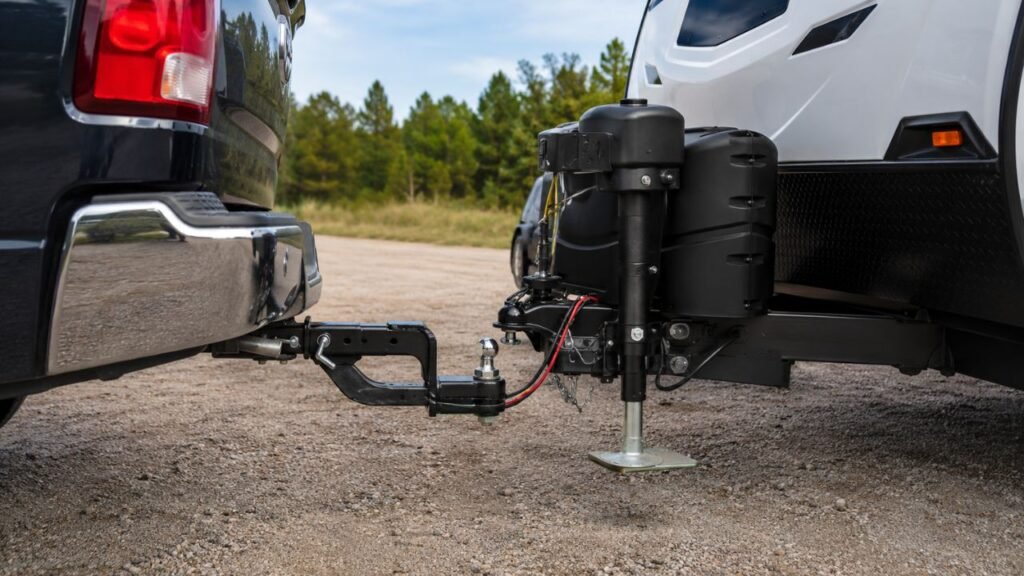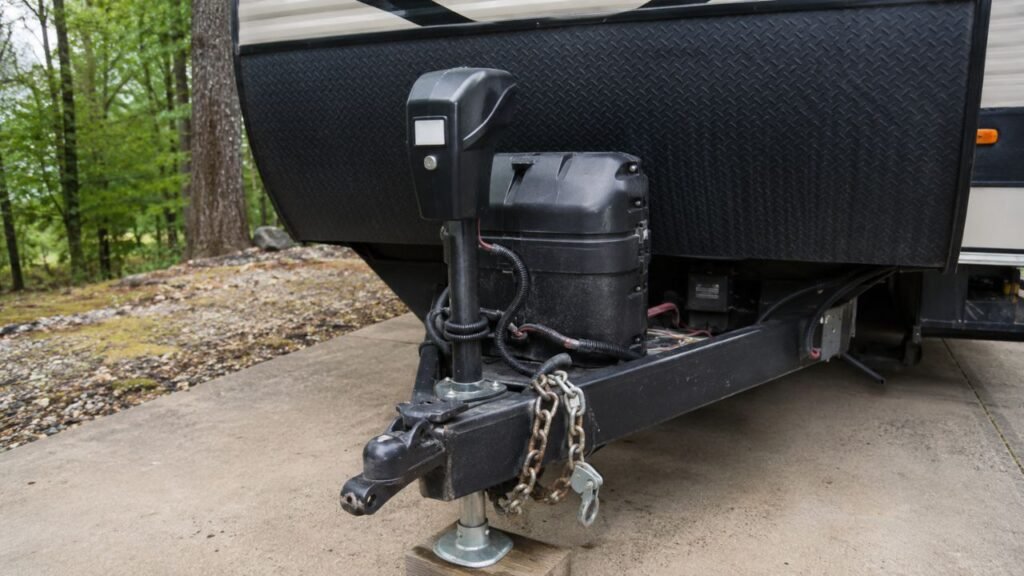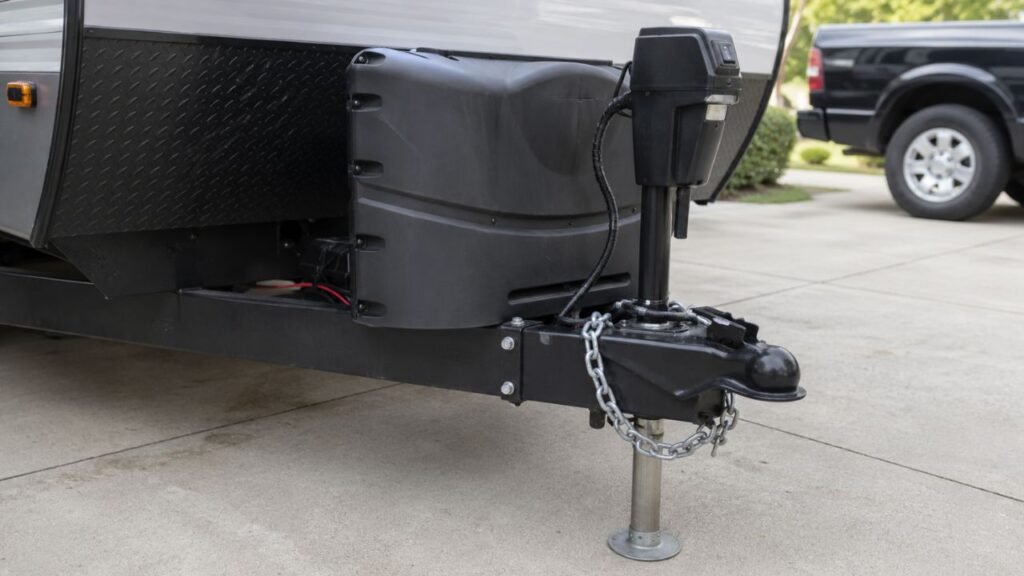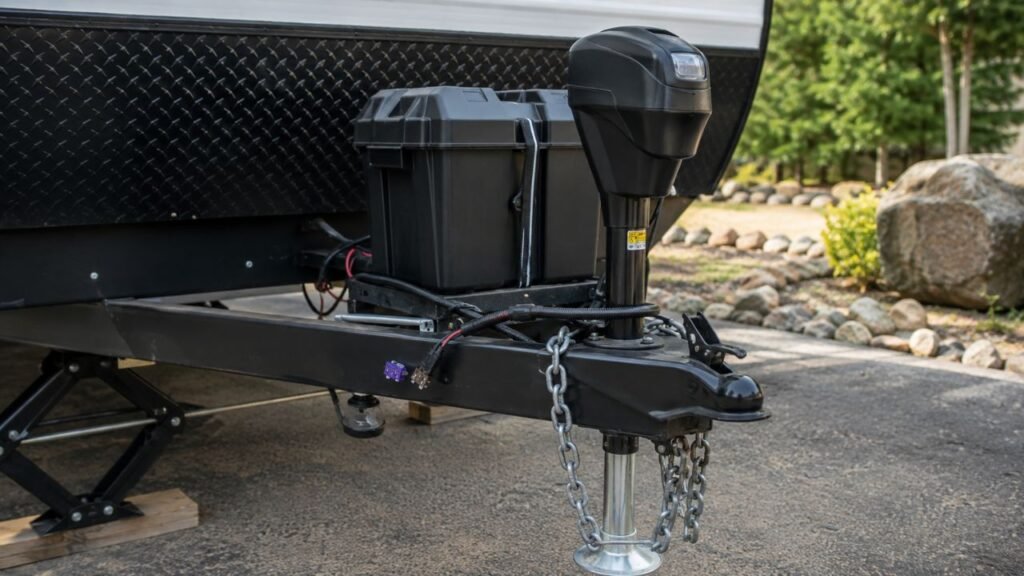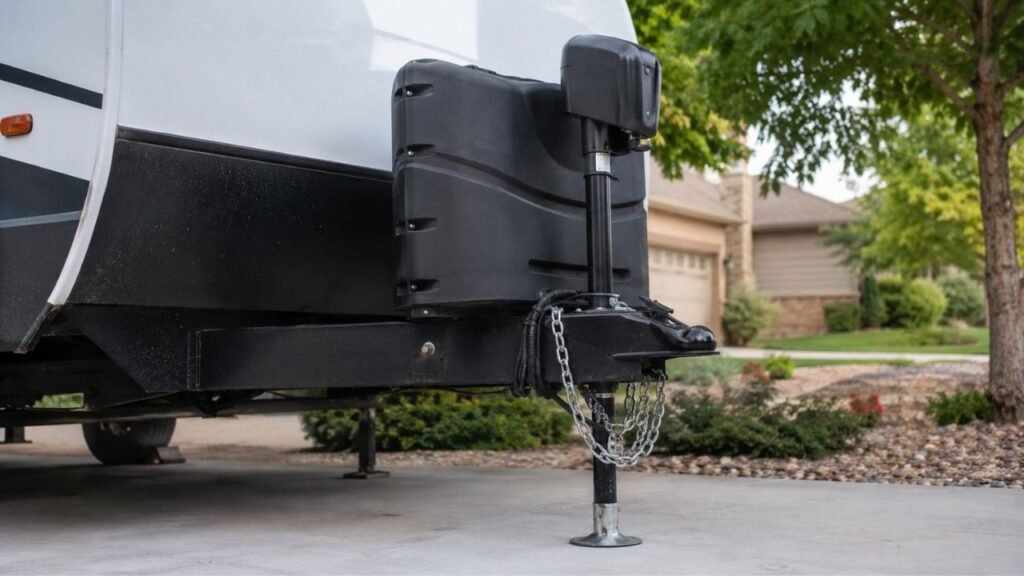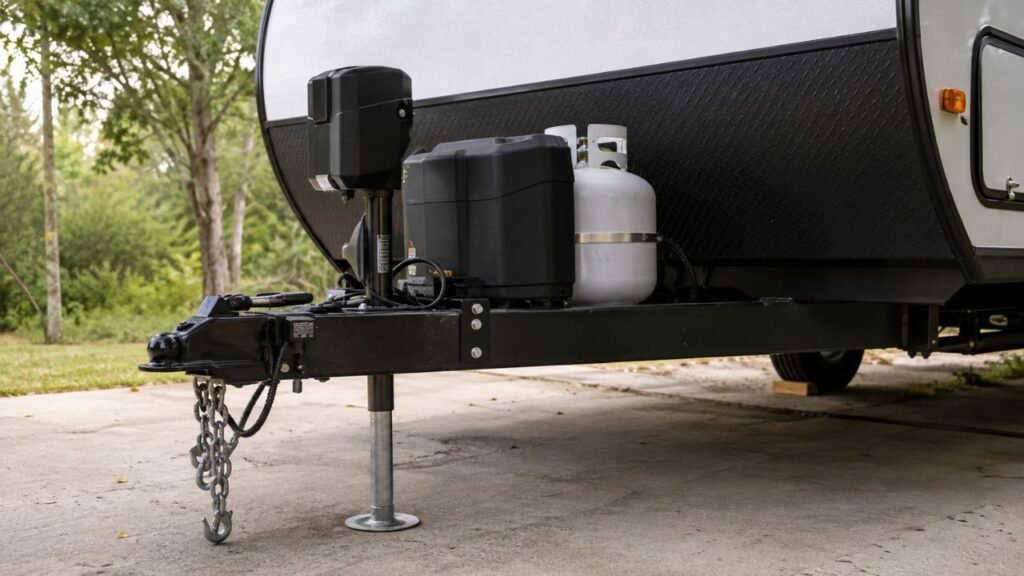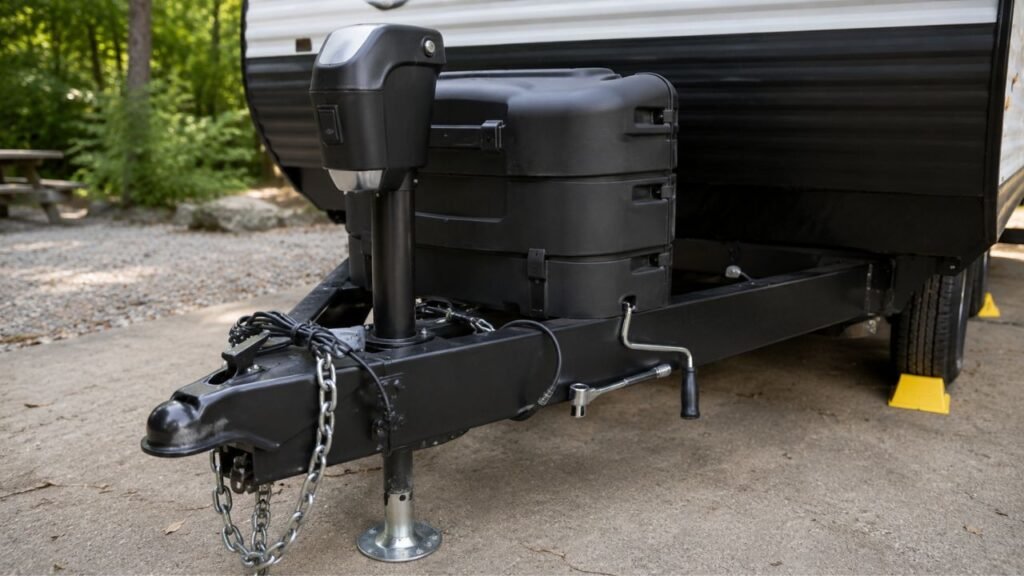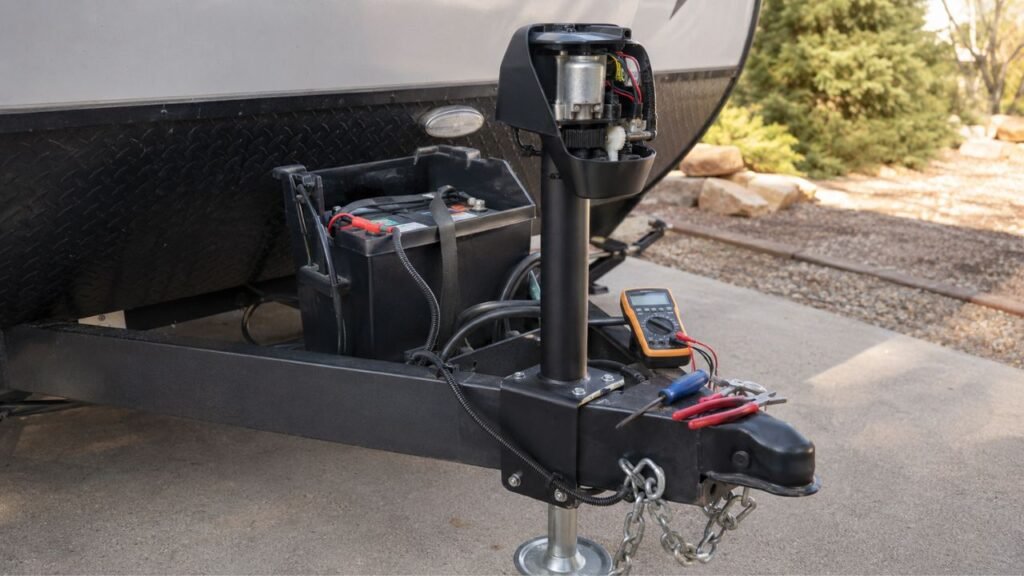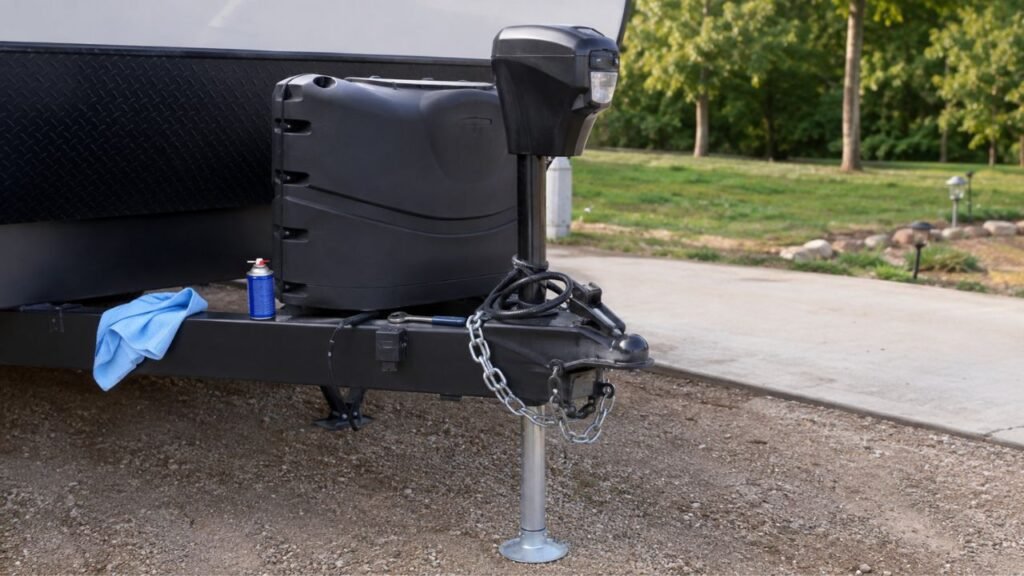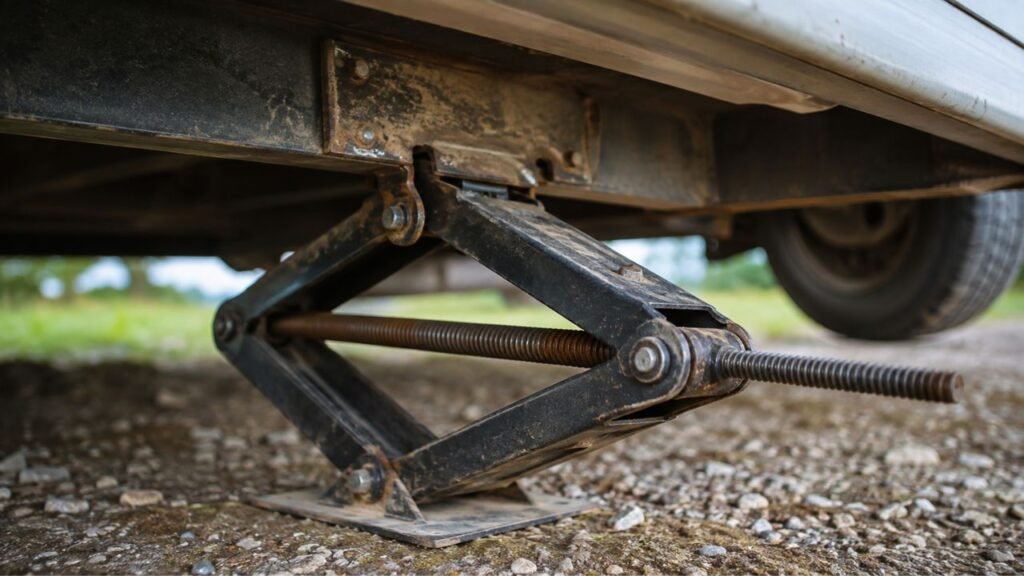
An RV stabilizer jack is usually hard to operate because the screw is dirty, rusty, dry, bent, misaligned, or under too much load. Electric stabilizer jacks can also struggle because of weak battery voltage, poor wiring connections, motor problems, or mechanical binding.
The good news is that you can often narrow down the problem by noticing when and where the jack becomes difficult to move. Below, I’ll help you diagnose the cause, safely fix common problems, and know when replacement makes more sense.
Key Takeaways
- Dirt, rust, and poor lubrication commonly make stabilizer jacks difficult to operate.
- A jack that gets hard only after touching the ground may be overloaded.
- Binding at the same point can indicate bent or damaged components.
- Electric stabilizers can have both electrical and mechanical problems.
- Stabilizer jacks are designed mainly to reduce RV movement, not level the camper.
- Lubrication requirements vary between jack models, so check your manual.
- Never force a badly binding jack with excessive leverage or an impact tool.
- Bent, damaged, or severely worn stabilizers may need replacement.
Why Is My Stabilizer Jack Hard to Operate?
A stabilizer jack becomes difficult to operate when something increases resistance inside its moving parts. That resistance can come from contamination, corrosion, dry threads, damaged components, poor alignment, or excessive pressure against the ground.
The timing of the resistance gives you an important clue.
If the jack is difficult throughout its entire movement, start by looking for dirt, rust, or lubrication problems. If it jams at one particular point, you may have a bent screw, damaged threads, or misaligned arms.
If the jack operates normally until its foot reaches the ground, the issue may be excessive loading rather than a mechanical defect.
With electric stabilizers, you also have to consider battery voltage, wiring, switches, motors, and gear assemblies.
What Your Stabilizer Jack’s Symptoms Can Tell You
Before taking anything apart, pay attention to exactly how the jack behaves. A few simple observations can save you from replacing parts unnecessarily.
| What You Notice | Possible Cause | What to Check First |
| Hard throughout extension and retraction | Dirt, corrosion, dry threads | Screw and moving joints |
| Binds at the same point | Bent screw, damaged threads, misalignment | Arms, screw, and brackets |
| Easy until it touches the ground | Excessive stabilizing pressure | How much load is being applied |
| Hard near full retraction | Binding near the stop | Retracted position and alignment |
| Only one jack is difficult | Local damage or contamination | Compare it with the other jacks |
| Electric jack moves slowly | Low voltage or mechanical drag | Battery and jack movement |
| Motor strains or sounds weak | Binding, overload, or motor problem | Mechanical resistance first |
| Jack squeaks while moving | Dry or contaminated components | Threads and pivot points |
| Gets harder every season | Corrosion, buildup, wear | Cleaning and maintenance |
The important point is not to assume that every stiff jack simply needs more lubricant. The symptom usually tells you where to start looking.
7 Common Reasons an RV Stabilizer Jack Becomes Hard to Operate
Several problems can create similar symptoms. I recommend checking the simplest causes first before assuming the jack itself has failed.
1. Dirt and Road Grime Are Packed Into the Screw
Your stabilizer jacks live underneath the RV.
That means their exposed components regularly encounter dust, mud, sand, rainwater, road salt, and other debris.
Over time, that contamination can settle into the screw threads. When you crank the jack, the screw has to push through the buildup.
You may notice the jack gradually becoming harder rather than suddenly locking up.
Look closely at the threaded rod. If you see thick grime, dried grease, dirt, or corrosion, cleaning should be one of your first steps.
Do not simply spray more lubricant over heavily contaminated threads. You can end up creating an abrasive mixture of lubricant and road grit.
2. The Jack Needs the Correct Lubrication
A dry screw creates much more friction than a properly maintained one.
However, there is an important detail here.
Not every RV stabilizer jack uses the same type of lubricant.
Some owners prefer dry lubricants because exposed threads attract less dirt. Other stabilizer manufacturers specify lithium-based grease or another lubricant for particular mechanisms.
That means I would not automatically spray the same product onto every stabilizer jack.
Check the owner’s manual for your exact jack or stabilizer system.
Clean the component first, allow it to dry if necessary, and then apply the lubricant recommended by the manufacturer.
This approach prevents you from solving one problem while accidentally creating another.
3. Rust or Corrosion Is Increasing Friction
Rust can make even a well-designed stabilizer difficult to move.
Surface corrosion often begins after repeated exposure to rain, moisture, winter road salt, or long periods of outdoor storage.
You may notice:
- Rough or jerky cranking
- Squeaking
- Visible orange or brown corrosion
- Resistance across most of the screw’s travel
- Threads that look pitted or damaged
Light surface corrosion may sometimes be manageable with cleaning and proper maintenance.
Deeply pitted threads are different.
If corrosion has physically damaged the screw or load-bearing parts, replacement may be safer than trying to force the jack to keep working.
4. The Scissor Arms or Drive Screw Are Bent
A stabilizer does not have to look completely crushed to bind.
Even a relatively small bend can alter the relationship between the arms, screw, nut, and mounting points.
The jack may then move normally through most of its travel before becoming extremely difficult at one particular position.
Common causes include:
- Accidentally striking the jack
- Moving the RV before fully retracting it
- Applying too much stabilizing pressure
- Previous overloading
- Hitting road debris
- Damage around the mounting bracket
Slowly cycle the jack while watching the arms.
They should move evenly without twisting sideways.
If the screw visibly wobbles or an arm moves at an unusual angle, stop forcing it.
I would be cautious about simply bending structural stabilizer components back into shape. A badly deformed jack can have hidden damage that affects its strength.
5. The Stabilizer Is Carrying Too Much RV Weight
This is one of the most important causes to understand.
Stabilizer jacks normally stabilize your RV. They are not supposed to replace leveling or lifting equipment unless your specific system is designed for that purpose.
Your RV should already be properly leveled before you apply the stabilizers.
The stabilizer foot should contact a solid surface and receive enough pressure to reduce movement.
You generally do not need to keep cranking aggressively after that point.
Too much load can:
- Bend scissor arms
- Strain the screw
- Twist mounting brackets
- Damage gears
- Overload an electric motor
- Make retraction difficult later
If your jack turns freely until the foot reaches the ground, then suddenly becomes extremely hard, consider how much pressure you are applying.
The solution may simply be to stop treating the stabilizer like a lifting jack.
6. The Jack or Mounting Bracket Is Misaligned
The stabilizer assembly needs to remain square enough for its moving parts to operate freely.
Loose mounting hardware or a damaged bracket can shift the jack slightly out of position.
That small change can cause the screw or arms to bind.
Inspect the mounting area for:
- Loose bolts
- Missing hardware
- Bent brackets
- Cracked mounting points
- Uneven gaps
- A jack sitting noticeably crooked
Do not guess at mounting bolt torque.
If anything is loose, check the RV or stabilizer manufacturer’s specifications before tightening the hardware.
7. Internal Parts Are Worn
Sometimes the problem is simply wear.
Stabilizer jacks contain several moving or load-bearing components that can deteriorate over time.
Depending on the design, wear may affect:
- Screw threads
- Internal nuts
- Bushings
- Pivot points
- Gears
- Drive couplings
- Motor components
A worn stabilizer may feel rough even after cleaning and lubrication.
You might also notice excessive looseness, clicking, skipping, or irregular movement.
At that point, adding more lubricant usually will not solve the underlying problem.
Why Is My Electric Stabilizer Jack Struggling?
Electric stabilizers add another layer to the diagnosis because mechanical resistance and electrical problems can produce very similar symptoms.
Low Battery Voltage or Voltage Drop
An electric stabilizer motor needs adequate voltage while it is operating.
A battery can have enough power to run lights but still struggle under the heavier load created by an electric jack.
Watch for signs such as:
- Slow movement
- Motor sound changing under load
- Stabilizer stopping intermittently
- Other 12-volt equipment dimming
- Performance improving when connected to charging power
Check the battery condition and electrical system according to your RV manufacturer’s instructions.
Loose or Corroded Electrical Connections
A poor electrical connection creates resistance before the current even reaches the motor.
Inspect accessible components such as:
- Battery terminals
- Ground connections
- Wiring connectors
- Switch connections
- Breakers or fuses
- Harness plugs
Disconnect power before servicing electrical connections when required by the manufacturer’s procedure.
The Motor or Gearbox Is Struggling
A weak motor can certainly make an electric stabilizer operate slowly.
However, do not replace the motor immediately.
A perfectly good motor can sound weak if it is trying to turn a badly binding jack.
Mechanical resistance should therefore be investigated alongside the electrical system.
Listen for grinding, clicking, or repeated stopping.
Those symptoms can point toward gears, couplings, or another part of the drive mechanism.
Mechanical Binding Can Look Like an Electrical Problem
This is where troubleshooting becomes especially useful.
Suppose the motor sounds strained.
That does not automatically mean the motor has failed.
The actual problem may be a corroded screw, bent arm, overloaded stabilizer, or damaged drive component.
Some electric stabilizer systems have a manual override procedure.
If your system provides one, operating it manually according to the owner’s manual can help determine whether the mechanical assembly itself is unusually difficult to move.
If it is also hard manually, you probably need to investigate mechanical resistance before blaming the electrical system.
How to Fix a Stabilizer Jack That Is Hard to Operate
Start with the safest and simplest checks first. Avoid forcing the jack because excessive torque can turn a minor problem into damaged hardware.
Step 1: Remove Excessive Load From the Stabilizer
Make sure your RV is properly parked, leveled, secured, and supported.
Retract or unload the stabilizer enough that it is not carrying unnecessary pressure.
Never crawl under an RV that is supported only by stabilizer jacks.
They are not a substitute for proper lifting and support equipment.
Step 2: Inspect the Entire Jack
Look carefully before reaching for lubricant.
Check for:
- Bent arms
- Damaged threads
- Loose bolts
- Twisted brackets
- Uneven movement
- Rust
- Missing hardware
- Impact damage
Compare the difficult stabilizer with another jack on the RV if possible.
Differences often make damage easier to spot.
Step 3: Clean the Screw and Moving Components
Remove loose dirt and accumulated debris according to the jack manufacturer’s recommendations.
Pay particular attention to the threaded screw.
A soft brush can help loosen dried contamination without damaging the threads.
Avoid using extremely aggressive cleaning methods around electrical motors, wiring, seals, or sensitive components.
Step 4: Lubricate It Correctly
Once the jack is clean, use the lubricant recommended for your specific model.
Do not assume that one spray or grease is correct for every stabilizer.
Apply only as directed.
Too much lubricant can sometimes attract unnecessary dirt, especially on exposed components.
Step 5: Cycle the Jack Slowly
After cleaning and lubrication, slowly extend and retract the stabilizer.
Pay attention to where resistance appears.
If it moves smoothly afterward, contamination was probably the main issue.
If it repeatedly binds at the same point, inspect more closely for:
- Bent components
- Damaged screw threads
- Misalignment
- Internal wear
Do not keep forcing it through a hard spot.
Step 6: Inspect Mounting Alignment
Check whether the jack sits squarely against its mounting location.
A twisted or loose bracket can put the mechanism into a bind.
If hardware requires adjustment, use the torque specification provided by the manufacturer.
Step 7: Check the Electrical System on Powered Stabilizers
If the jack is electric, inspect the electrical side after ruling out obvious mechanical binding.
Depending on your system, that may include:
- Battery voltage
- Fuses
- Breakers
- Wiring
- Grounds
- Switches
- Connectors
- Motor assembly
Follow the owner’s manual when testing electrical components.
Step 8: Stop if the Jack Still Binds
If proper cleaning, lubrication, unloading, and basic inspection do not improve the jack, stop applying additional force.
Persistent binding often points toward:
- Bent parts
- Thread damage
- Internal wear
- Misalignment
- Gear damage
Repair or replacement may now be the better option.
Should I Use a Drill to Operate My Stabilizer Jacks?
A cordless drill can make stabilizer setup easier, but you should only use one if the manufacturer of your particular jack allows it.
This matters because stabilizer designs are different.
Some systems permit controlled drill operation while warning against impact tools. Other stabilizer models warn against power drills entirely.
Never assume that because another RV owner uses an impact driver, your jack can handle one safely.
A drill also makes it easy to apply much more torque than you realize.
If your stabilizer suddenly becomes difficult to move, switching to a stronger tool does not fix the cause.
You may simply damage the screw, gears, arms, or mounting hardware faster.
If the jack is resisting you, investigate the resistance first.
Can Over-Tightening Make a Stabilizer Jack Hard to Retract?
Yes. Over-tightening can place unnecessary load on the stabilizer mechanism and make retraction difficult.
Once the foot has solid contact and the RV movement has been reduced, continuing to crank aggressively can put far more pressure on the jack than necessary.
This can stress the screw, arms, brackets, gears, and motor.
You may notice the jack retracting with a loud snap or requiring much more effort during the first few turns.
That is a sign to reconsider how much pressure you are applying during setup.
Your goal is a stable camper, not lifting the RV higher with the stabilizers.
How Far Should Stabilizer Jacks Be Extended?
There is no universal extension measurement that applies to every stabilizer jack, but less unnecessary extension is generally better for stability.
A jack extended almost vertically or close to its mechanical limit may provide less effective bracing than one operating within a stronger part of its range.
When appropriate, use sturdy RV stabilizer pads or blocks to reduce excessive extension.
A few good habits include:
- Level the RV before deploying stabilizers.
- Place the jack feet on solid surfaces.
- Use suitable pads or blocks on soft ground.
- Avoid extending the stabilizer farther than necessary.
- Do not exceed the manufacturer’s extension limits.
- Stop applying pressure once the RV is adequately stabilized.
Always follow the limits listed for your particular system.
When Should You Replace a Hard-to-Operate Stabilizer Jack?
Not every stiff stabilizer needs replacement. However, there comes a point where continued repair attempts are not worth the risk.
Consider replacement or professional inspection when:
- The drive screw is visibly bent.
- The scissor arms are severely distorted.
- Threads are badly damaged or stripped.
- The jack repeatedly jams at one position.
- Mounting brackets are significantly twisted.
- Gears grind, skip, or slip.
- The motor or gearbox has confirmed internal damage.
- The jack remains extremely stiff after proper maintenance.
- Corrosion has significantly damaged structural parts.
- You are unsure whether the jack can support stabilizing loads safely.
Stabilizer jacks are relatively simple pieces of equipment, but they still work under substantial forces.
If their structure is compromised, forcing continued use is rarely worth it.
How to Keep Stabilizer Jacks Easy to Operate
A few simple habits can prevent many stabilizer problems before they leave you struggling at the campsite.
Inspect Them Before and After Travel
Take a quick look at the jacks whenever you set up or break camp.
You are looking for:
- New bends
- Loose hardware
- Road debris
- Rust
- Damaged wiring
- Uneven movement
Finding a small problem early usually makes it easier to correct.
Keep the Screw and Moving Parts Clean
Do not let layers of dirt build up for several camping seasons.
Cleaning becomes especially important after traveling through:
- Mud
- Sand
- Salt-treated roads
- Heavy rain
- Dusty campgrounds
Keeping the screw clean reduces abrasive wear and helps you notice corrosion sooner.
Follow the Manufacturer’s Lubrication Schedule
Check your stabilizer manual instead of waiting until the jack becomes difficult.
Proper maintenance is much easier than freeing a badly neglected screw later.
Use the recommended lubricant and maintenance interval for your particular stabilizer.
Avoid Using Stabilizers for Leveling
Level your trailer or RV first.
Then use the stabilizers to reduce movement.
Keeping these jobs separate prevents unnecessary stress on the stabilizer mechanism.
Do Not Force a Binding Jack
This may be the most useful habit of all.
A sudden increase in resistance is information.
Pay attention to it.
The jack may be telling you that something is dirty, overloaded, misaligned, or damaged.
Using more torque can hide the warning until something actually breaks.
Stabilizer Jack Maintenance Mistakes to Avoid
Small maintenance mistakes can shorten jack life or make a minor problem worse.
Avoid:
- Using stabilizers to lift the RV.
- Cranking excessively after the foot contacts the ground.
- Ignoring bent scissor arms.
- Lubricating heavily contaminated threads without cleaning them.
- Assuming every stabilizer requires the same lubricant.
- Using an impact driver without manufacturer approval.
- Adding a long cheater bar to force a stuck mechanism.
- Ignoring loose or damaged mounting hardware.
- Assuming every slow electric stabilizer has a bad motor.
- Continuing to operate a jack that repeatedly grinds or jams.
A stabilizer should feel reasonably smooth and predictable.
If operation suddenly changes, there is usually a reason worth investigating.
Final Words
If your stabilizer jack is hard to operate, start with the simple possibilities: remove excessive load, inspect the mechanism, clean the screw, and use the correct lubricant.
Then pay attention to the pattern.
A jack that feels rough throughout its travel usually points toward contamination, corrosion, or lubrication issues. A jack that repeatedly binds in the same position deserves closer inspection for bent components, damaged threads, or alignment problems.
Electric stabilizers also need adequate battery power and healthy electrical connections, but mechanical binding can easily make a good motor appear weak.
Most importantly, do not solve a stiff stabilizer by simply applying more force. Fix the cause instead. Your jack will last longer, and your RV setup will be much safer.
Related FAQs
Why Is My RV Stabilizer Jack So Hard to Crank?
An RV stabilizer jack may become hard to crank because of dirt, rust, dry threads, damaged components, misalignment, or excessive pressure against the ground. Clean and inspect the jack before applying more force.
Can You Lubricate RV Stabilizer Jacks?
Yes, many stabilizer jacks require lubrication, but the correct product depends on the jack design. Check the manufacturer’s instructions before choosing grease, dry lubricant, or another product.
Should I Use WD-40 on RV Stabilizer Jacks?
Do not assume standard WD-40 is the correct long-term lubricant for your jack. Some products can help with cleaning or moisture displacement, but use the actual lubricant specified by the stabilizer manufacturer.
Why Does My Stabilizer Jack Bind in One Spot?
Binding at the same point often suggests a bent screw, damaged threads, distorted scissor arms, misalignment, or internal wear. Stop forcing the jack and inspect it carefully.
Why Is My Stabilizer Jack Hard to Retract?
A stabilizer may be difficult to retract because it was over-tightened, is carrying excessive load, has rusty or damaged threads, or is binding near its fully retracted position.
Can Stabilizer Jacks Be Too Tight?
Yes. Stabilizer jacks generally need enough pressure to reduce RV movement, not enough pressure to lift the camper. Excessive tightening can damage the jack and make retraction difficult.
Can I Use an Impact Driver on RV Stabilizer Jacks?
Only use an impact driver if the manufacturer specifically permits it. Many stabilizer systems warn against impact tools because the extra torque can damage gears, screws, arms, or mounting hardware.
Do Stabilizer Jacks Need Grease?
Some stabilizer jacks use grease while others specify different lubricants. Check your owner’s manual rather than assuming that grease is suitable for every exposed screw or mechanism.
Can a Bent Stabilizer Jack Be Repaired?
Minor serviceable damage may sometimes be repairable, but a significantly bent screw, arm, or mounting bracket can affect safe operation. Replacement is often the better choice when structural integrity is uncertain.
Why Is My Electric Stabilizer Jack Moving Slowly?
Slow movement can come from low battery voltage, poor electrical connections, excessive stabilizer load, mechanical binding, motor wear, or gearbox problems. Check mechanical resistance and electrical power before replacing the motor.

Ryan Mitchell writes for readers who prefer independent travel and practical outdoor motorhome living. His how-to guides and reviews focus on simplicity, durability, and real value. He brings a calm, hands-on perspective to every topic.