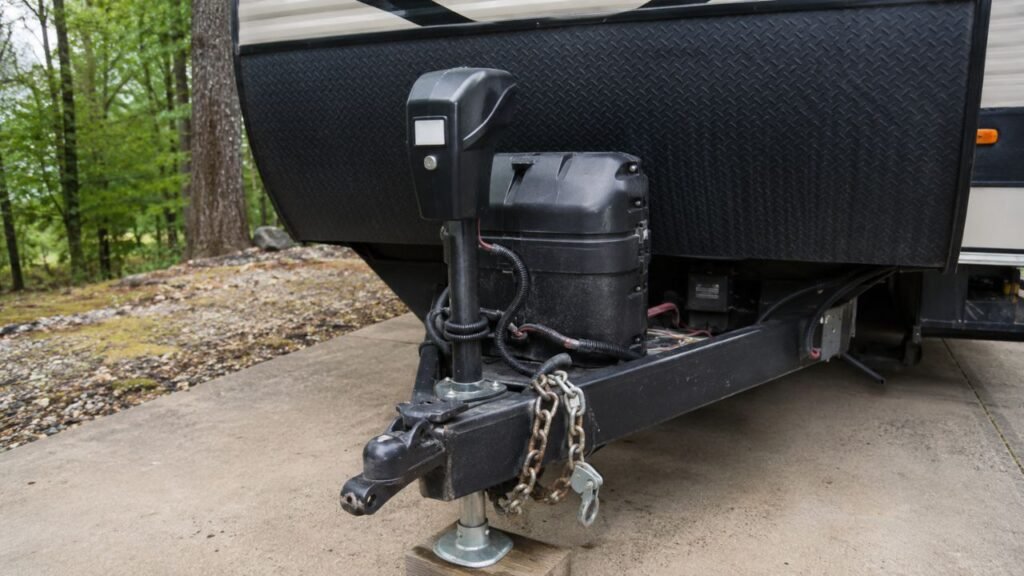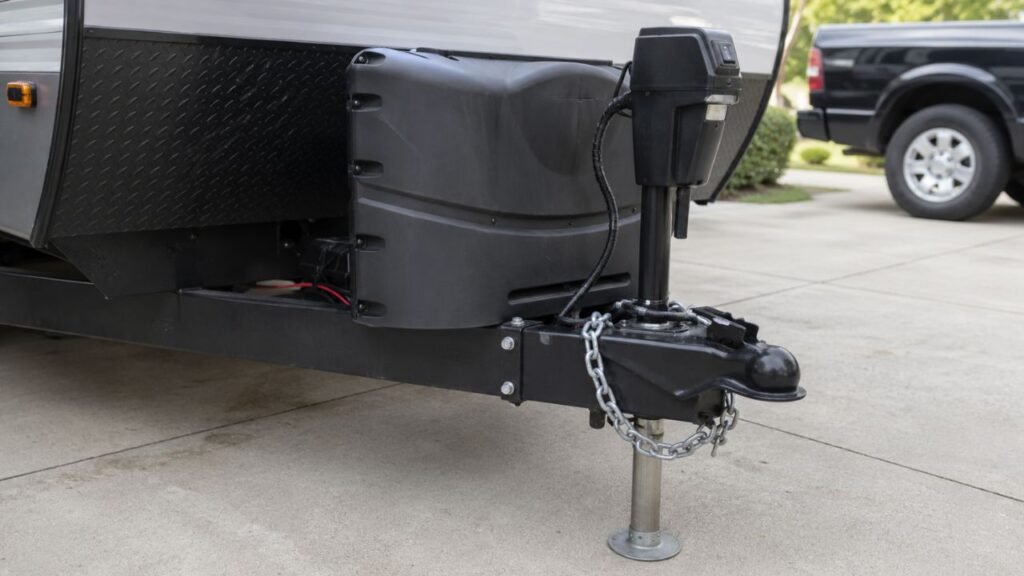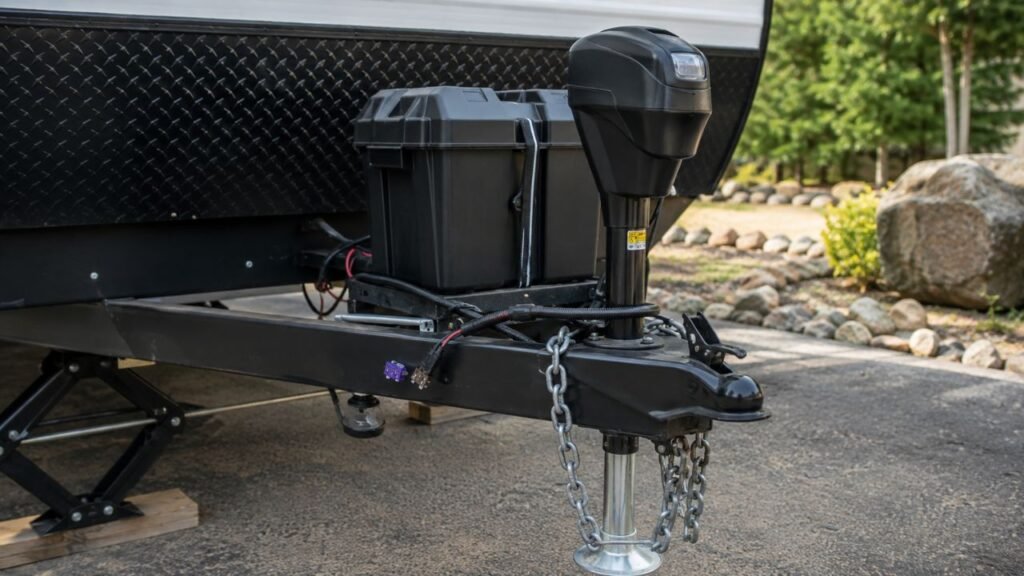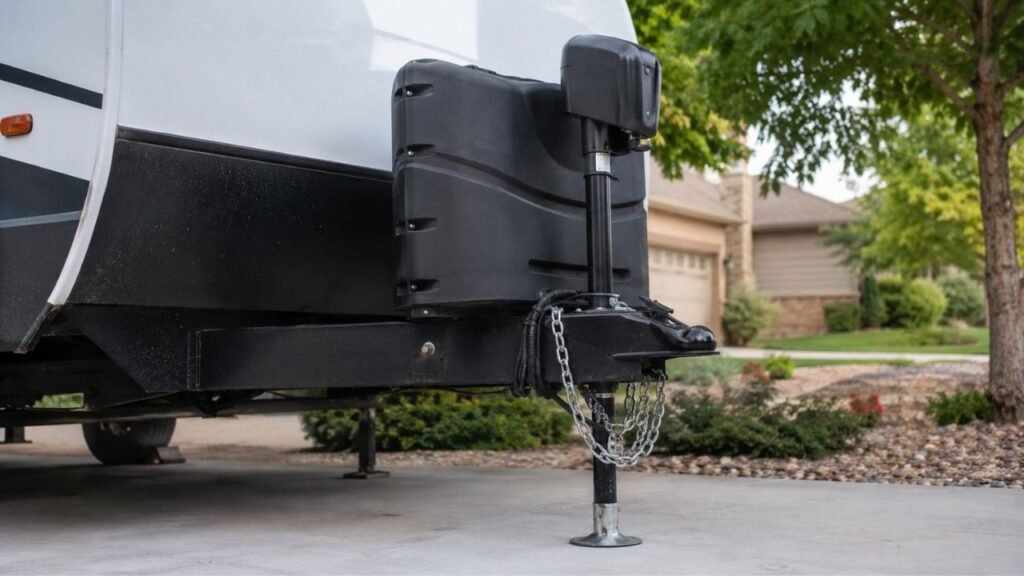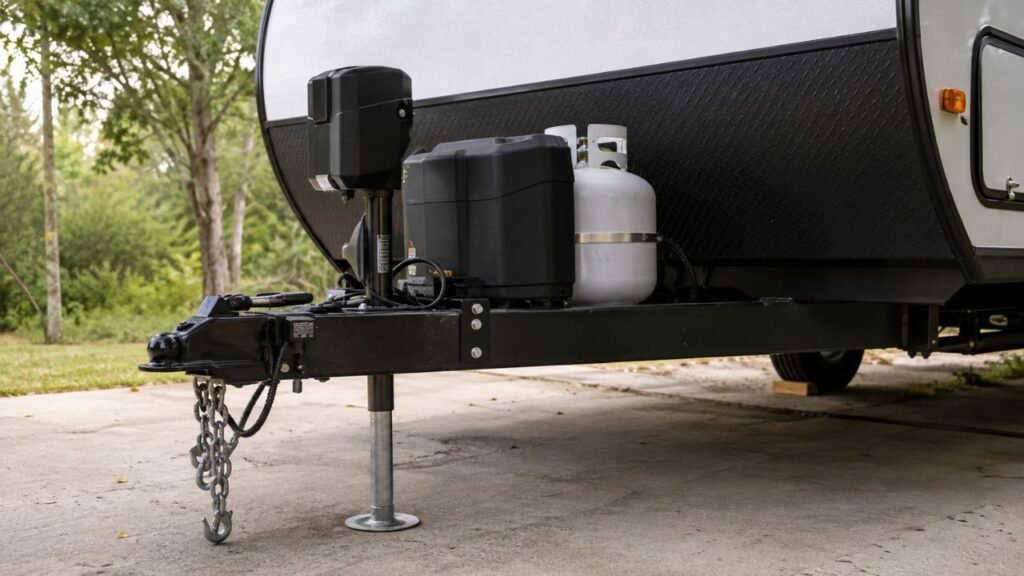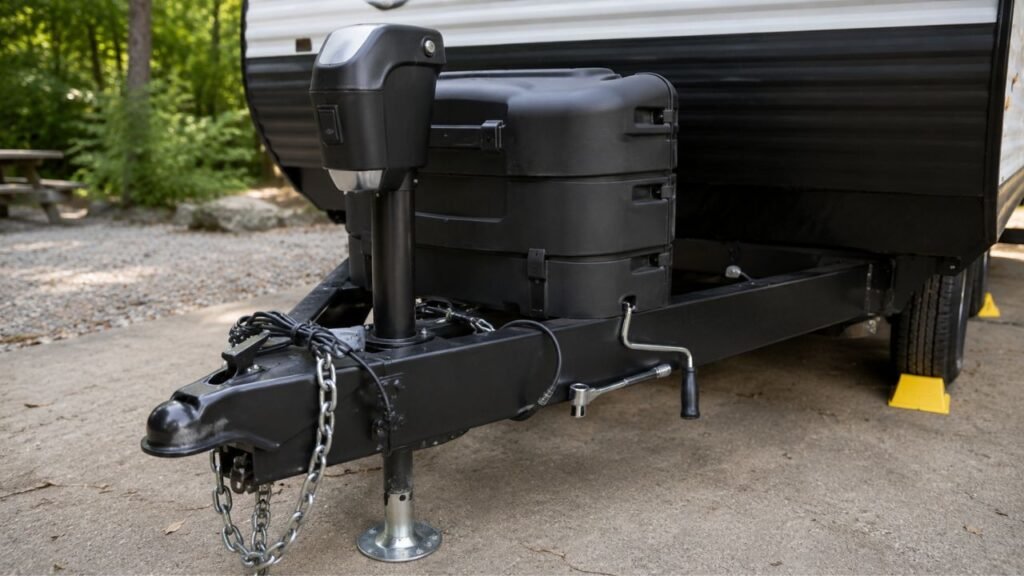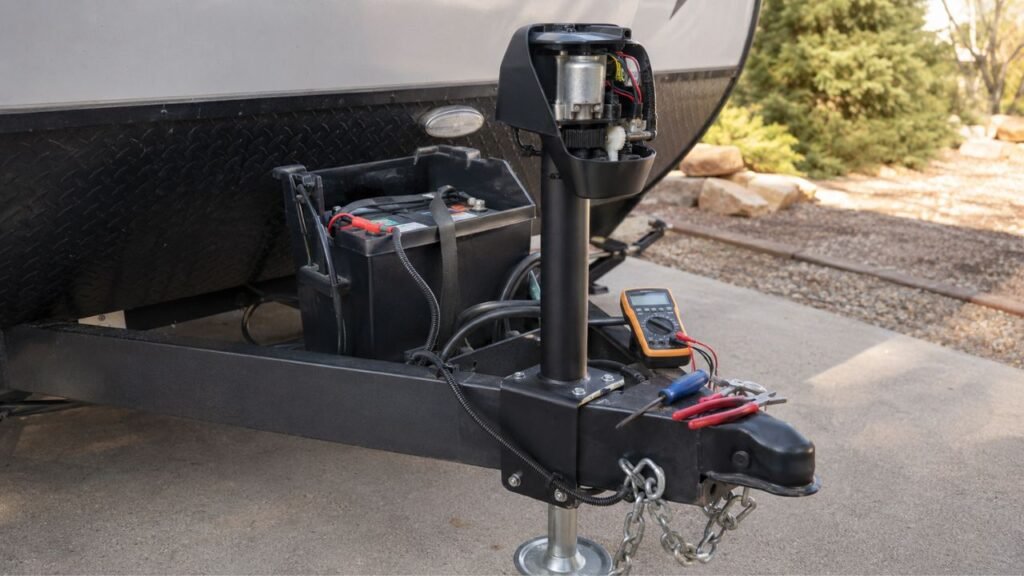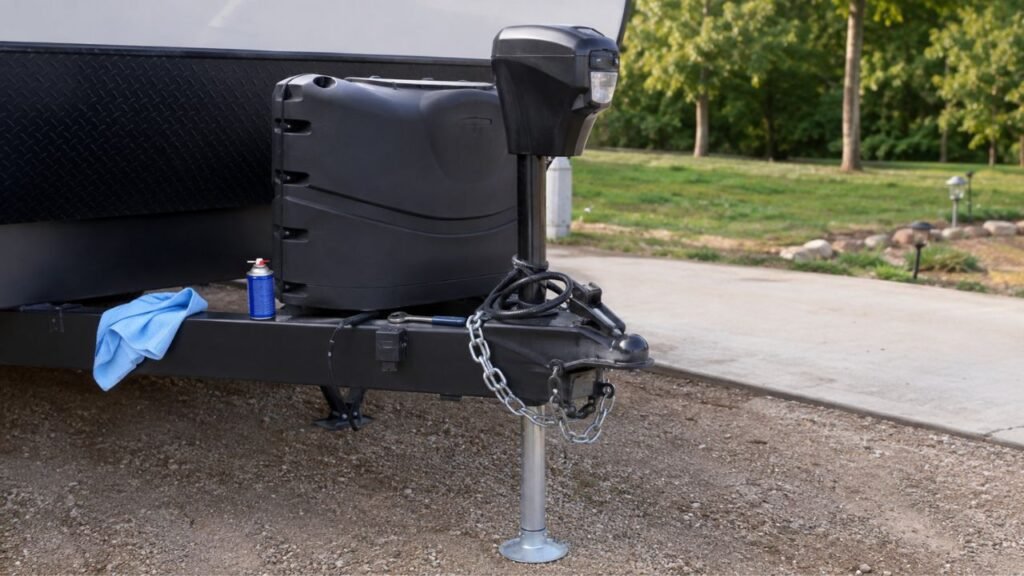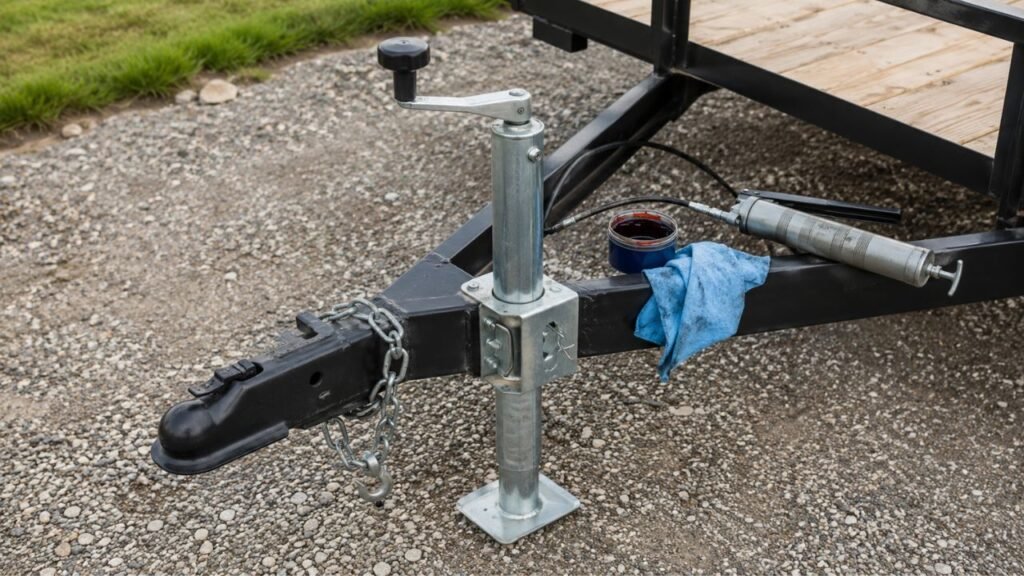
To lubricate a manual trailer jack, safely support the trailer tongue, clean away dirt and old grease, then apply the correct lubricant to the gears, screw mechanism, crank bushings, and other moving parts. After lubricating, crank the jack through its normal travel several times so the grease or oil spreads evenly.
The exact method depends on how your jack is built. I’ll walk you through the process, explain which lubricant works where, and show you what to check if the jack still feels stiff afterward.
Key Takeaways
- Support the trailer before servicing the jack.
- Clean old grease and dirt before adding fresh lubricant.
- Internal gears usually need grease rather than thin spray oil.
- Some bushings and pivots work better with lightweight machine oil.
- Jacks with grease fittings are easier to service without disassembly.
- Avoid putting thick grease on exposed surfaces that collect road grit.
- Cycle the jack after lubrication to spread the lubricant.
- Persistent binding may mean the jack has mechanical damage.
What Lubricant Should You Use on a Manual Trailer Jack?
Not every moving part on a manual trailer jack needs the same lubricant. Internal gears usually need heavier grease, while bushings, pivots, and exposed components may require something lighter.
| Jack Part | Suitable Lubricant | What I Recommend |
| Internal gears | Automotive or lithium-based grease | Apply a thin, even coating |
| Lead screw | Approved grease or oil | Follow manufacturer guidance |
| Crank bushings | Lightweight machine oil | A few drops are normally enough |
| Grease fitting | Compatible chassis or automotive grease | Use a grease gun slowly |
| Swivel pivot | Light machine oil | Clean dirt before lubricating |
| Drop-leg pin | Light oil or suitable grease | Keep exposed buildup minimal |
| Caster wheel axle | Grease or machine oil | Useful on boat trailer jacks |
| Exposed inner tube | Dry silicone when recommended | Avoid sticky grease buildup |
White lithium grease works well for many manual jack gears and screw mechanisms. Automotive grease or wheel-bearing grease may also work well when your jack manufacturer allows it.
What I would avoid is spreading thick grease over every visible surface.
Exposed grease attracts dust, sand, and road grime. Once that contamination sticks to the jack, it can increase wear rather than reduce it.
What Do You Need Before Lubricating the Jack?
You do not need specialized equipment for most manual trailer jack maintenance. Gather your supplies first so you can complete the job without repeatedly moving around an unsupported trailer.
- Wheel chocks
- Properly rated jack stands
- Work gloves
- Clean shop rags
- Nylon cleaning brush
- Small wire brush
- Mild degreaser
- White lithium or automotive grease
- Lightweight machine oil
- Grease gun, if your jack has a fitting
- Basic screwdriver or socket set
- Dry silicone lubricant, when recommended
You probably will not need everything here.
For a jack with an external grease fitting, the job may require only a rag, grease gun, and a few basic tools.
How Do You Lubricate a Manual Trailer Jack?
The actual lubrication process is fairly straightforward. The important part is supporting the trailer correctly and putting the right lubricant in the right places.
1. Park the Trailer on a Stable Surface
Start on firm, level ground.
Concrete or pavement is ideal because your supports will remain stable.
Avoid soft soil, loose gravel, or sloping ground whenever possible.
You do not want the trailer shifting while your hands are near the jack mechanism.
2. Chock the Trailer Wheels
Secure the wheels before working around the tongue.
Place sturdy wheel chocks against the trailer tires.
If possible, chock both sides of the tires so the trailer cannot roll forward or backward.
Do this even when the trailer remains connected to your tow vehicle.
3. Take the Tongue Weight Off the Jack
This step matters most if you plan to open or remove the jack.
Place properly rated supports beneath a suitable section of the trailer frame or tongue.
Slowly transfer the trailer’s weight onto those supports.
Give the trailer a careful stability check before continuing.
Never remove a jack while it is still holding the trailer tongue.
4. Find the Lubrication Points
Before taking anything apart, inspect the jack closely.
Manual trailer jacks use several different service designs.
Look for:
- A grease or zerk fitting
- A removable top cap
- A gear housing cover
- An exposed crank shaft
- Accessible bushings
- A lubrication hole
- A serviceable screw mechanism
If your jack has a grease fitting, routine servicing may require almost no disassembly.
If it does not have one, do not assume the entire jack must come apart.
Some jacks allow access through a small cover, while others have largely enclosed mechanisms.
5. Clean Away Dirt and Old Grease
I would not add fresh grease until the accessible areas are clean.
Old grease often contains:
- Road dust
- Sand
- Metal particles
- Surface rust
- Moisture
- Hardened lubricant
Use a clean rag first.
Then use a nylon brush to loosen stubborn grime.
A small wire brush can help on rusty exposed steel, but use it carefully.
You can also use a mild degreaser when the old grease has hardened.
Clean especially well around the grease fitting.
Otherwise, the grease gun can push dirt directly into the jack.
Let everything dry before adding new lubricant.
6. Lubricate the Internal Gears
The gears inside the upper housing transfer your crank movement into lifting force.
These gears need proper lubrication because they operate under considerable pressure.
If your jack has a grease fitting, wipe the fitting clean first.
Attach the grease gun firmly and add grease gradually.
Avoid pumping excessive amounts into the housing.
You want proper gear coverage, not a housing completely packed with grease.
If your jack uses a removable gear cover, open it carefully.
Before lubricating, look at the gears.
Watch for:
- Missing teeth
- Chips
- Heavy rust
- Metal shavings
- Excessive looseness
- Hardened grease
If everything looks healthy, spread fresh grease across the gear teeth.
Turn the crank slightly while you work.
This exposes different contact surfaces and helps distribute the grease.
7. Lubricate the Lead Screw
The lead screw is the threaded component responsible for raising and lowering the jack.
This is often where lubrication makes the biggest difference.
However, not every jack gives you direct access to the screw.
If yours does, remove old contaminated lubricant first.
Work a fresh layer of approved grease into the threads.
You want the thread surfaces covered without leaving large clumps.
Some jack designs use oil rather than thick grease in certain screw areas.
That is why checking the manufacturer’s maintenance guidance is worthwhile.
Also, avoid extending the jack aggressively just to expose more of the screw.
Never force the crank once the jack reaches its travel limit.
8. Lubricate the Crank Handle and Bushings
Do not forget the crank assembly itself.
Bushings around the crank shaft can become dry and stiff.
Apply a few drops of lightweight machine oil around accessible pivot and bushing areas.
Then rotate the crank several times.
This helps work the oil into the joint.
You do not need to soak the area.
Excess oil will simply collect more dirt.
9. Lubricate the Swivel Mechanism
If you have a swivel trailer jack, check the mounting pivot as well.
Mud, dust, and rust often collect around this area.
Clean the swivel bracket and pull pin thoroughly.
Apply a small amount of light lubricant to the moving surfaces.
Then rotate the jack between its towing and operating positions several times.
The jack should move smoothly and lock securely.
10. Lubricate the Drop-Leg Pin
Heavy-duty manual jacks often have adjustable drop legs.
These mechanisms live close to the road and collect plenty of debris.
Clean the pin and adjustment holes first.
Apply a light coating of lubricant afterward.
Operate the pin several times to distribute it.
Avoid covering the entire drop leg with thick grease.
That surface will quickly become covered with road grit.
11. Lubricate the Caster Wheel
If your manual jack has a caster wheel, give it some attention too.
Check whether the wheel rotates smoothly.
Clean dirt from the axle and swivel bearing.
Apply suitable oil or grease to the moving points.
Spin the wheel several times afterward.
This is particularly useful on boat trailer jacks that regularly encounter water.
12. Be Careful With the Exposed Inner Tube
You may be tempted to grease the entire shiny inner tube.
Usually, that is not the best approach.
A thick layer of grease on an exposed tube collects dirt quickly.
That dirt can then travel inside the jack when you retract it.
Some jack manufacturers recommend dry silicone lubricant for exposed sliding surfaces.
If that applies to your jack, spray a light coating and wipe away the excess.
13. Cycle the Jack Several Times
Once everything is lubricated, turn the crank slowly.
Raise and lower the jack through its normal working range.
Do this several times.
Cycling the jack helps spread lubricant across:
- Gear teeth
- Screw threads
- Bearings
- Bushings
- Sliding contact surfaces
You should notice the crank becoming smoother.
Do not force the jack against its fully extended or fully retracted stop.
14. Wipe Away Excess Lubricant
After cycling the jack, look for grease that has squeezed outward.
Wipe away unnecessary buildup.
Pay particular attention around:
- Gear covers
- Crank shafts
- Sliding tubes
- Grease fittings
- Pivot joints
A little lubricant where it belongs is helpful.
Large exposed blobs of grease only attract dirt.
15. Reinstall Covers and Hardware
Put everything back together carefully.
Replace any:
- Gear covers
- Top caps
- Grease fitting caps
- Retaining clips
- Handle bolts
- Mounting hardware
Make sure each part sits securely.
A missing or loose top cover can let water enter the jack.
Once water mixes with grease and dirt, corrosion can develop quickly.
16. Test the Jack Under Load
After reassembly, gradually return some trailer tongue weight to the jack.
Raise and lower it slowly.
The crank should feel smooth and consistent.
Pay attention to any unusual sounds.
Stop and inspect further if you hear:
- Grinding
- Repeated clicking
- Popping
- Gear skipping
- Metal scraping
Also stop if the jack repeatedly binds at the same height.
Those symptoms usually point to something beyond simple lubrication.
Do You Have to Remove a Trailer Jack to Lubricate It?
No, you usually do not need to remove a manual trailer jack for normal lubrication.
A jack with a grease fitting can often be serviced while completely installed.
Jacks with removable gear covers are also relatively easy to maintain in place.
Removal may become necessary when:
- You need full access to the lead screw.
- Old grease has hardened throughout the mechanism.
- Internal gears need replacement.
- Bearings or bushings need repair.
- Severe internal rust needs cleaning.
- The jack requires deeper disassembly.
If removal becomes necessary, support the trailer tongue first.
Never rely on the jack you are removing to hold the trailer.
How Does Lubrication Differ Between Manual Trailer Jack Types?
The main maintenance principles remain similar, but lubrication points change between jack styles. Knowing which style you have helps you avoid unnecessary disassembly.
Side-Wind Manual Trailer Jack
A side-wind jack has its crank extending horizontally from the upper housing.
The crank normally drives a set of internal gears.
Those gears usually benefit from automotive or lithium-based grease.
The crank shaft bushings may need lighter machine oil.
Some side-wind models also have grease fittings near the housing.
If yours does, routine maintenance becomes much easier.
Top-Wind Manual Trailer Jack
A top-wind jack has the crank mounted above the jack body.
Its internal arrangement can differ from a side-wind design.
Some models use grease inside their gear mechanism.
Others specify lightweight oil around particular screw or crank components.
Do not pour grease into random openings.
Use only the lubrication points intended for servicing.
Swivel Trailer Jack
A swivel jack has extra moving parts around its mounting bracket.
Besides the gears and screw, inspect:
- Swivel pivot
- Locking pin
- Pivot bushings
- Caster wheel
These exposed areas collect dirt easily.
Clean them before applying light lubricant.
Boat Trailer Jack
Boat trailer jacks need more frequent attention because water encourages corrosion.
Saltwater exposure is especially demanding.
After saltwater use, rinse away salt deposits with fresh water.
Let the jack dry before lubricating appropriate components.
Pay close attention to:
- Gear housing
- Screw mechanism
- Swivel pivot
- Caster axle
- Locking pin
Water-resistant grease can be useful when approved for your jack.
Heavy-Duty Drop-Leg Jack
Larger square jacks often use dedicated grease fittings.
Keep those fittings clean and service them regularly.
Also inspect the adjustable drop leg.
Mud and road debris frequently collect around its pin holes.
Clean these areas and apply only enough lubricant to maintain easy movement.
How Often Should You Lubricate a Manual Trailer Jack?
Checking your manual trailer jack once a year is a practical starting point. However, trailers used in harsh conditions often need attention much sooner.
Consider lubricating the jack earlier when:
- You frequently launch into saltwater.
- You drive on salted winter roads.
- The trailer regularly travels through mud.
- The jack stays outdoors all year.
- Cranking effort begins increasing.
- The trailer has been stored for months.
- Water entered through a damaged cap.
- Rust starts forming near moving components.
I recommend giving the jack a quick inspection whenever you perform routine trailer maintenance.
It takes only a few minutes and can prevent a seized jack later.
How Can You Tell When a Manual Trailer Jack Needs Lubrication?
A dry jack usually gives you several warning signs before it becomes completely stuck.
Look for:
- Increasing crank resistance
- Squeaking while raising the trailer
- Jerky movement
- Stiff crank handle movement
- Dry-looking gears or joints
- Rust around moving components
- A difficult swivel mechanism
- A caster wheel that barely rotates
- Long periods without maintenance
Lubrication often fixes mild stiffness and squeaking.
Grinding, gear skipping, or severe binding usually points to another problem.
What If the Trailer Jack Is Still Hard to Turn After Lubricating It?
If fresh lubrication does not improve the jack, do not keep adding more grease. Continued stiffness often means a mechanical part is damaged or badly worn.
Damaged Lead Screw Threads
The threaded screw can wear, bend, or become damaged.
You may feel resistance at the same point during every rotation.
Grease may reduce friction slightly, but it cannot repair damaged threads.
A badly damaged screw or lifting nut usually needs replacement.
Worn or Broken Gears
Worn gears often make clicking or skipping noises.
The crank may move while the jack barely moves.
You might also feel the handle suddenly jump under load.
Fresh grease cannot replace worn gear teeth.
Inspect or replace the gear set before using the jack heavily again.
Worn Bearings or Bushings
Bushings and bearings keep internal shafts aligned.
As they wear, components can shift under trailer tongue weight.
The jack may feel smooth when unloaded but stiff under load.
Lubrication might help temporarily.
Excessive movement usually means parts need replacement.
Bent Jack Tube
A bent inner or outer tube creates physical friction.
The jack often becomes stiff at the same height every time.
Inspect the tube for:
- Bends
- Dents
- Scraping marks
- Uneven gaps
Do not continue trusting a structurally damaged jack under heavy tongue weight.
Heavy Internal Corrosion
Rust can develop inside the jack without being obvious outside.
Moisture often enters through damaged covers or openings.
Severe corrosion can affect gears, bearings, and screw threads.
Light lubrication will not remove heavy rust.
You may need to disassemble or replace the jack.
Over-Extension Damage
Manual trailer jacks have fixed travel limits.
Forcing the crank once the jack reaches full extension can damage the internal screw or nut.
If the jack became difficult immediately after over-extension, inspect the internal lifting mechanism.
Do not keep forcing the crank.
Common Manual Trailer Jack Lubrication Mistakes
Most trailer jack lubrication problems come from using too much lubricant, using it in the wrong place, or skipping basic cleaning.
Avoid these mistakes:
- Working on a jack while it supports the trailer.
- Adding grease over dirty old lubricant.
- Assuming every jack uses white lithium grease everywhere.
- Pumping excessive grease into a grease fitting.
- Using penetrating spray as permanent lubrication.
- Smearing thick grease over exposed sliding tubes.
- Ignoring crank bushings and swivel pivots.
- Forcing the jack beyond its travel limits.
- Disassembling parts unnecessarily.
- Leaving large amounts of grease exposed.
- Ignoring missing protective caps.
- Continuing to operate a jack that grinds or skips.
The goal is not to put as much grease as possible into the jack.
The goal is clean, correct lubrication in the areas that actually need it.
Can You Use White Lithium Grease on a Manual Trailer Jack?
Yes, white lithium grease is a good choice for many manual trailer jack gears and threaded mechanisms.
It provides strong lubrication and stays in place better than thin oil.
It can also provide useful protection against moisture and corrosion.
However, white lithium grease is not automatically correct for every part.
Some crank bushings need lightweight oil.
Some exposed tubes may perform better with dry silicone lubricant.
Whenever your jack manufacturer specifies a particular lubricant, follow that recommendation first.
Final Words
A manual trailer jack usually needs only basic maintenance to keep working smoothly.
Support the trailer properly, clean away contaminated grease, then lubricate the correct moving parts.
Pay particular attention to the internal gears, screw mechanism, crank bushings, and pivots.
Once finished, cycle the jack several times and test it under normal tongue weight.
If it still feels rough, stiff, or noisy after lubrication, do not force it.
That usually means you are dealing with worn gears, damaged threads, corrosion, or a bent component rather than a simple lack of grease.
Related FAQs
What Is the Best Grease for a Manual Trailer Jack?
White lithium grease, automotive grease, and suitable wheel-bearing grease work well on many manual trailer jack gears and screw mechanisms. The best option is always the lubricant recommended for your specific jack.
Can I Use White Lithium Grease on a Trailer Jack?
Yes, white lithium grease works well on many internal gears and threaded components. However, lighter oil or dry silicone may be more appropriate for bushings, pivots, or exposed sliding surfaces.
Can I Use Wheel Bearing Grease on a Trailer Jack?
Yes, wheel-bearing grease can work well on many serviceable trailer jack gears and lead screws. Make sure it is compatible with the jack manufacturer’s lubrication requirements before using it.
Can I Use WD-40 to Lubricate a Trailer Jack?
WD-40 can help loosen rust and displace moisture, but it should not replace proper grease or machine oil for long-term lubrication. Clean the area first, then apply the correct lubricant afterward.
How Often Should I Grease My Manual Trailer Jack?
Annual lubrication is a reasonable starting point for many manual trailer jacks. Service it sooner if you regularly tow in salt, mud, rain, or other harsh conditions.
Do All Trailer Jacks Have Grease Fittings?
No. Some manual trailer jacks have grease fittings, while others use removable covers or enclosed mechanisms. Check your jack before attempting to add grease through any opening.
Can I Lubricate a Trailer Jack Without Removing It?
Yes, most routine trailer jack lubrication can be done while the jack remains mounted. Removal is normally needed only for deep cleaning, major repairs, or internal screw access.
Should I Grease the Inner Tube of a Trailer Jack?
Usually, you should avoid coating an exposed inner tube with heavy grease because it collects dirt. Some jack manufacturers recommend dry silicone lubricant for these sliding surfaces instead.
Why Is My Trailer Jack Still Hard to Crank After Greasing?
The jack may have damaged gears, worn screw threads, bad bushings, internal corrosion, or a bent tube. Lubrication reduces friction, but it cannot repair mechanical damage.
How Do You Lubricate a Boat Trailer Jack?
Clean away salt, water residue, and road grime first. Then lubricate the gears, screw, swivel pivot, locking pin, and caster axle using products recommended for the jack, preferably with good water resistance.

Ryan Mitchell writes for readers who prefer independent travel and practical outdoor motorhome living. His how-to guides and reviews focus on simplicity, durability, and real value. He brings a calm, hands-on perspective to every topic.