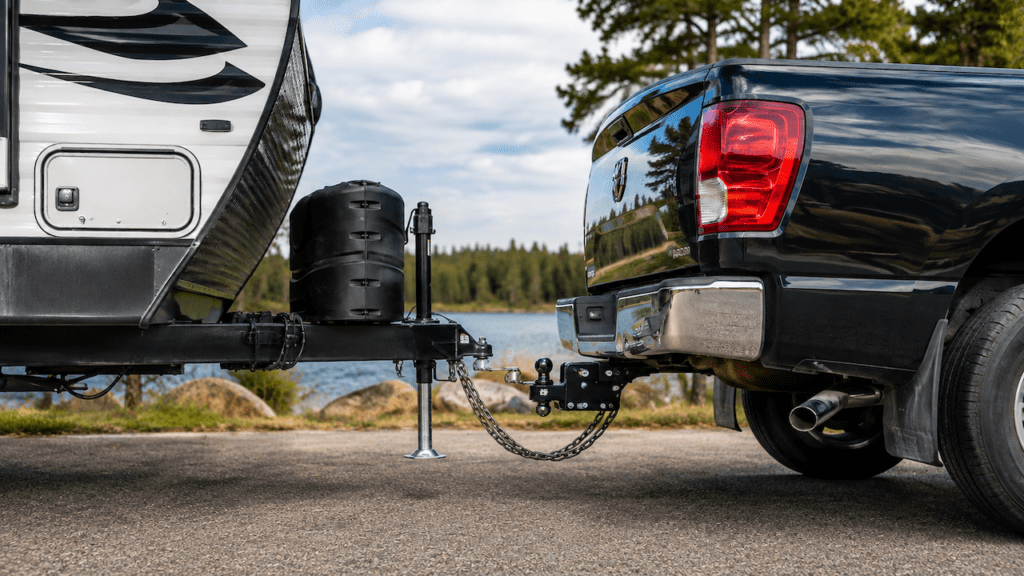
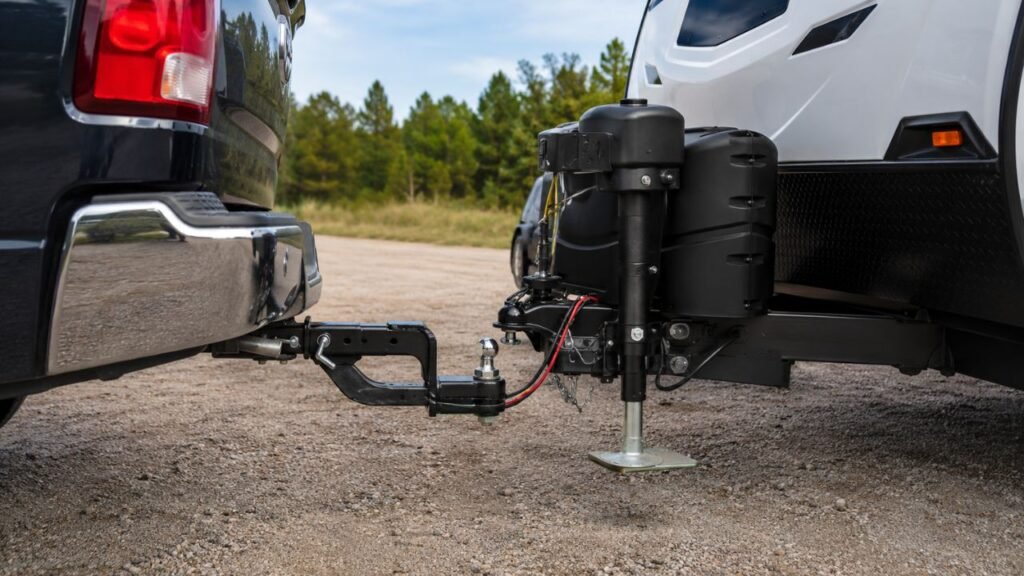
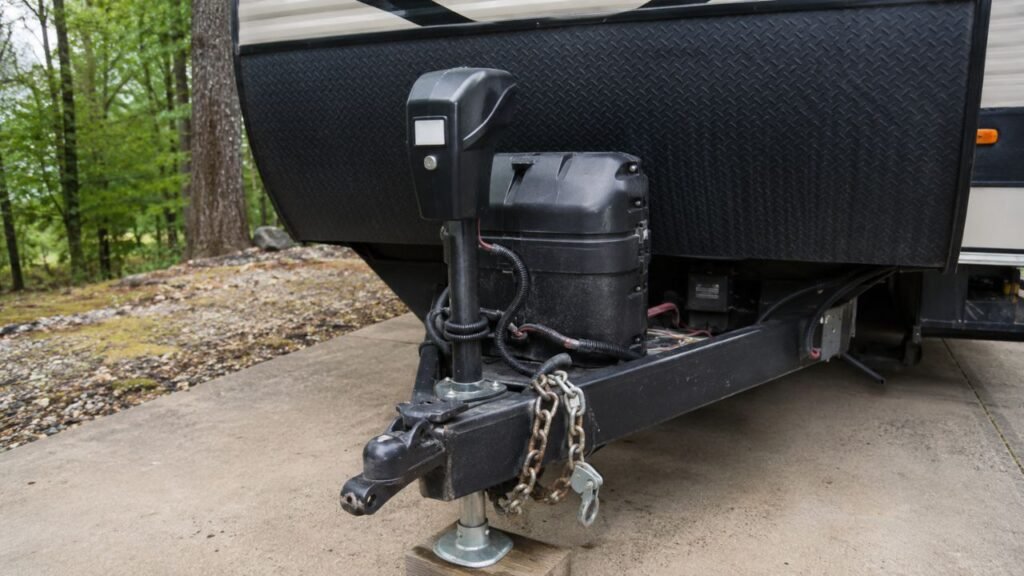
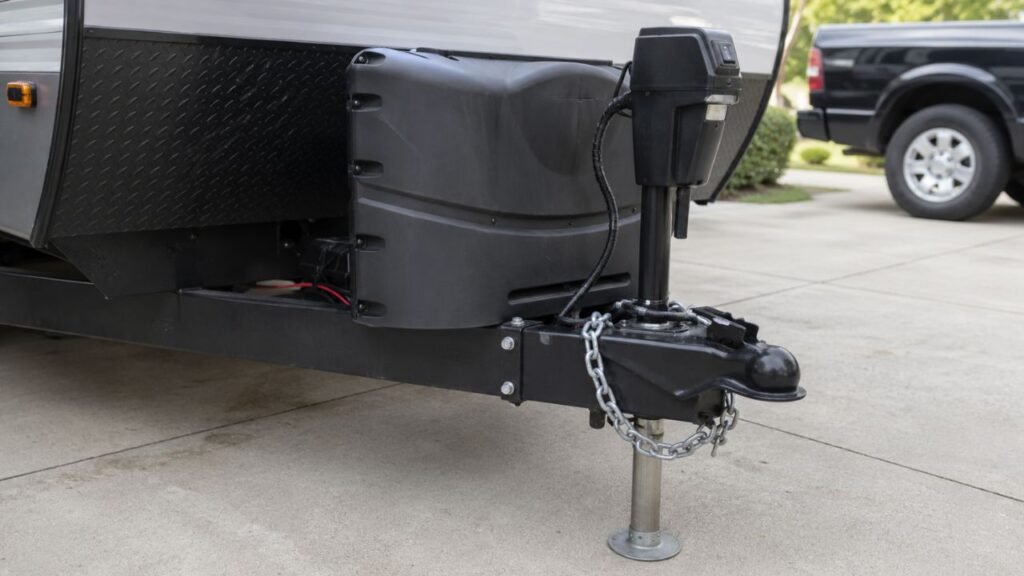
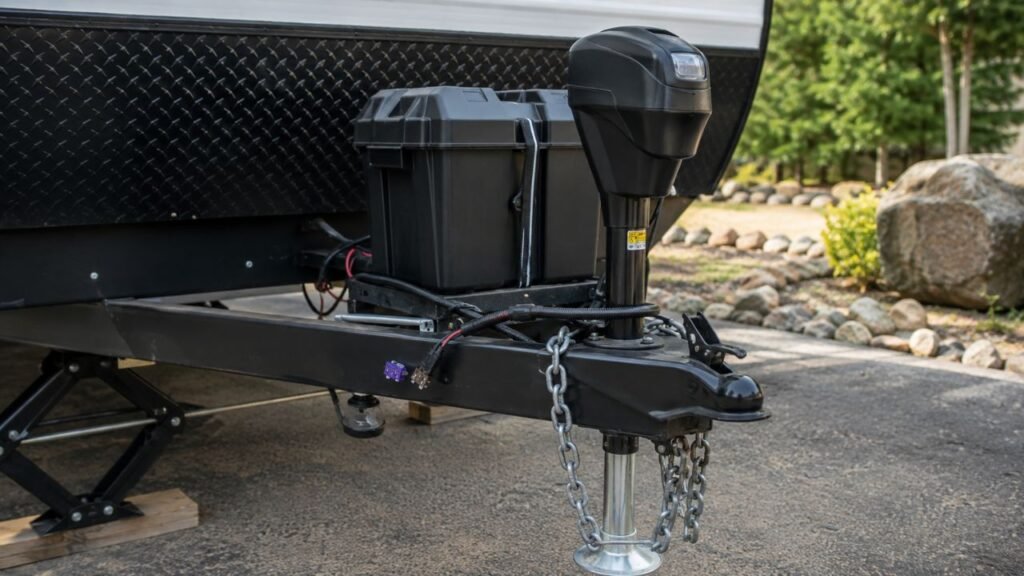
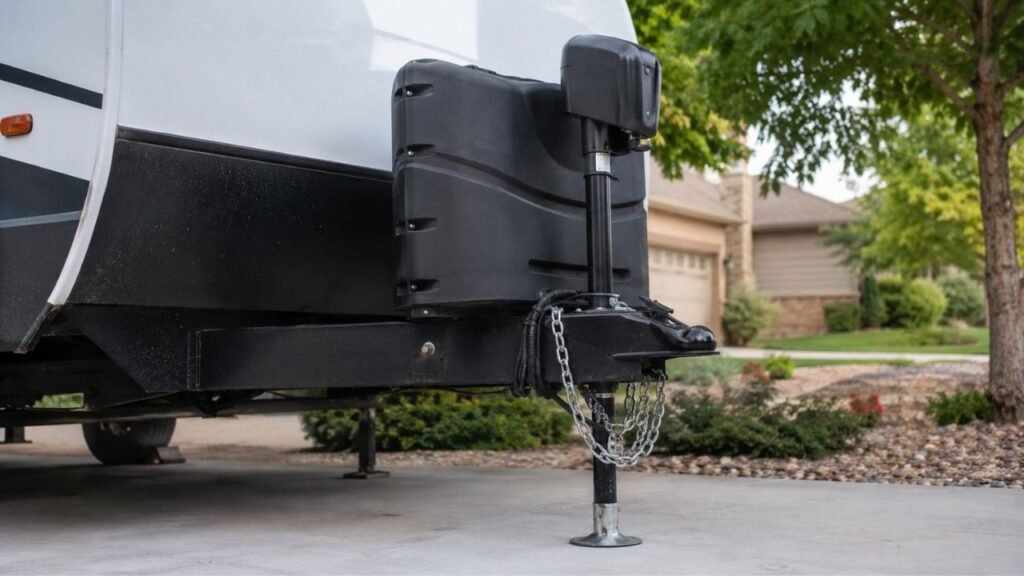
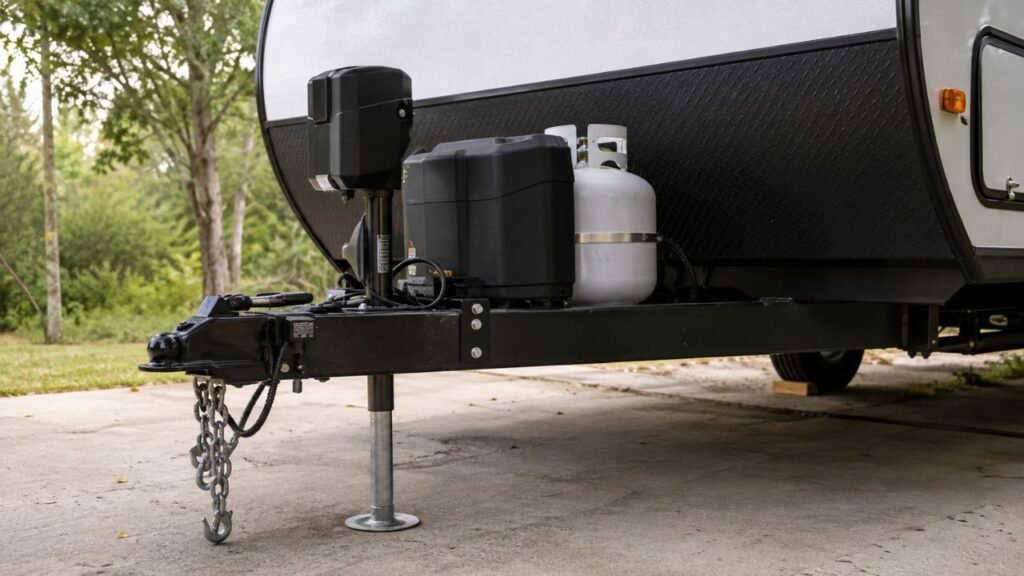
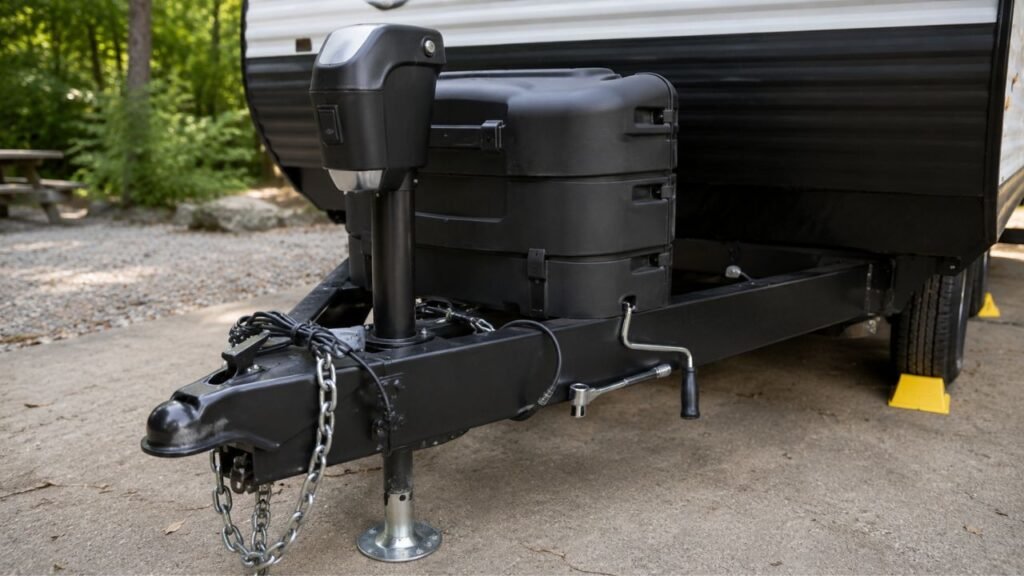
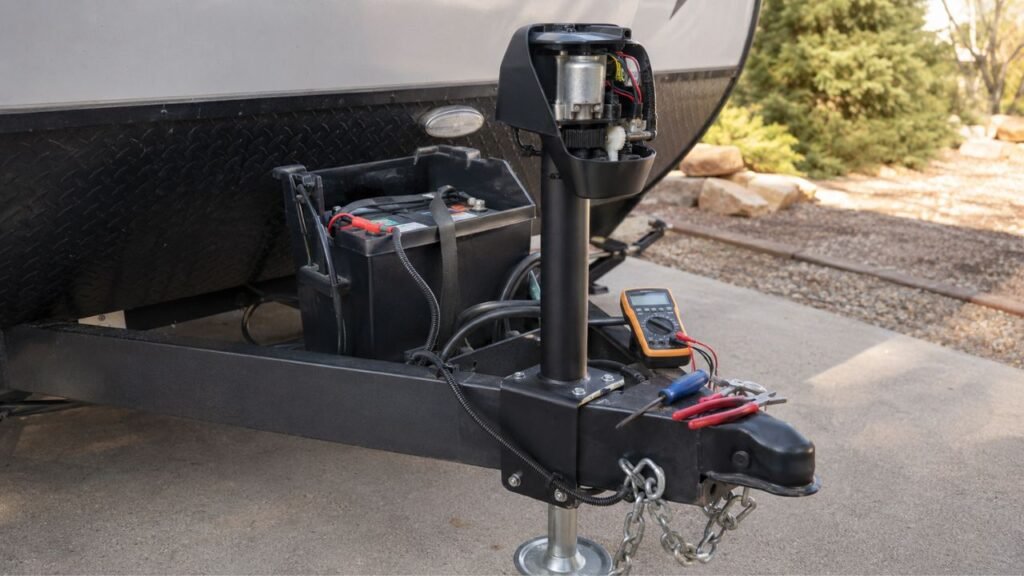
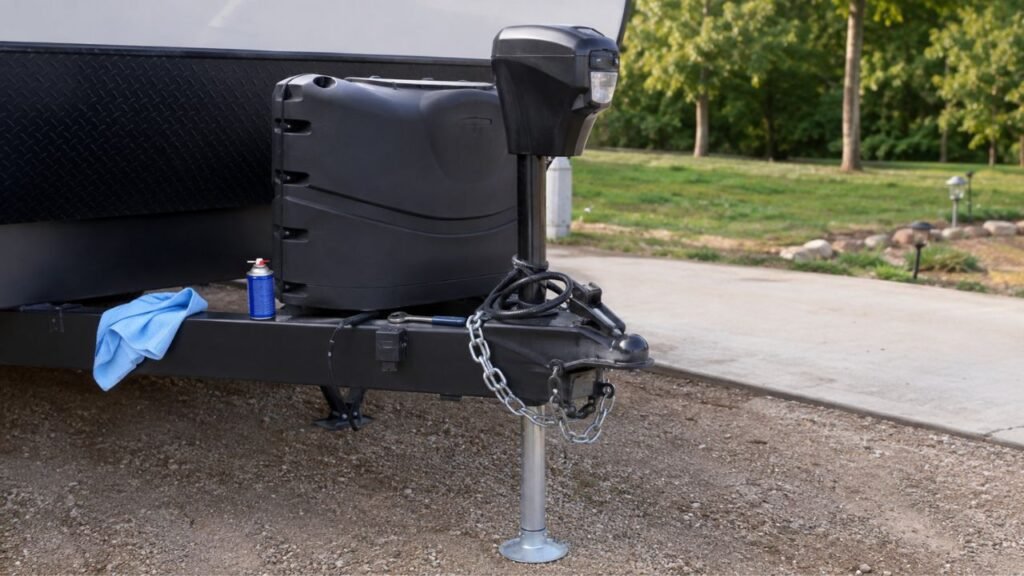
A trailer jack can get stuck in the up position when it retracts too tightly, the internal screw binds, rust or dried grease restricts movement, or a gear or drive component fails. On an electric jack, weak power, a poor ground, a bad switch, or motor trouble can also prevent the jack from lowering.
The good news is that many stuck jacks can be freed safely. I’ll walk you through the likely causes, quick diagnosis steps, safe ways to lower the jack, and signs that replacement makes more sense than repair.
Key Takeaways
- A fully retracted jack can bind against its upper travel limit.
- Relieve tongue weight before forcing or disassembling a stuck jack.
- Try the manual override to separate electrical and mechanical problems.
- A working jack light does not guarantee enough motor power.
- Rust, old grease, and dirt can make internal parts seize.
- Motor noise without jack movement can indicate damaged gears or pins.
- Stop turning if the manual override requires unusually high force.
- Repeated jamming often means worn or damaged internal components.
- Never work beneath a trailer supported only by a faulty jack.
Why Is My Trailer Jack Stuck in the Up Position?
A jack stuck fully retracted usually has either a mechanical bind or a power-related problem. Identifying which one you have makes troubleshooting much easier and helps prevent unnecessary damage.
The Jack Was Retracted Too Far
This is one of the first things I would suspect.
A trailer jack can sometimes be pulled tightly against its upper internal stop. When that happens, the screw mechanism may become wedged under pressure.
You may notice this after holding the retract button too long. It can also happen after repeatedly cranking a manual jack fully upward.
Some jacks have built-in travel protection, while others behave differently. So, you should not assume every model automatically stops before binding.
If the problem appeared immediately after fully retracting the jack, an upper-limit bind becomes especially likely.
Tongue Weight Is Binding the Screw
Trailer tongue weight puts considerable pressure through the jack mechanism.
Normally, the screw and nut handle that force without trouble. However, worn, dirty, or poorly lubricated components may bind under load.
The jack might work when unloaded but refuse to move under tongue weight.
This is why relieving pressure should happen before aggressive troubleshooting.
Sometimes a small reduction in load is enough to let the screw start turning again.
The Screw or Inner Tube Is Rusted
Rust can develop slowly inside a trailer jack.
Moisture enters around seals, openings, or exposed moving sections. Long-term outdoor storage can make the problem worse.
The inner tube may look fine externally while corrosion develops deeper inside.
Common signs include:
- Rough or jerky movement
- Grinding during operation
- Increasing crank resistance
- Orange or brown corrosion around the tube
- A jack that becomes harder to operate over time
Severe rust can eventually lock the screw mechanism completely.
Old Grease Has Become Dirty or Ineffective
Grease does not remain effective forever.
Dust, road grit, water, and tiny metal particles can contaminate old lubricant. The mixture becomes sticky instead of slippery.
You may then feel heavy resistance throughout the jack’s movement.
This is especially common on older trailers receiving little jack maintenance.
Fresh lubrication may help when the components are still structurally sound. However, lubrication cannot repair damaged threads or bent metal.
The Screw or Inner Tube Is Bent
A bent jack can sometimes retract but refuse to extend again.
Side loading is a common reason this happens.
The jack may have been pushed sideways while supporting the trailer. The trailer could also have shifted while the jack was extended.
Other causes include:
- Backing into an obstacle
- Dragging the jack foot
- Uneven ground
- Trailer movement while uncoupling
- Previous overload
- Impact damage
A bent screw or tube usually creates resistance at the same position repeatedly.
If you can clearly see bending, I would avoid trying to force it straight while installed.
A Gear, Pin, or Internal Drive Part Has Failed
The handle or motor does not directly move the jack leg.
Internal gears and drive components transfer that movement to the screw mechanism.
If one of those pieces breaks, you may hear activity without seeing movement.
Typical symptoms include:
- Motor runs but the leg stays still
- Handle turns unusually easily
- Clicking from inside the gear housing
- Grinding during operation
- Jack moves briefly and then stops
- Manual override spins without lowering the jack
A damaged gear tooth, drive pin, or coupling usually requires internal repair.
The Electric Jack Has a Power or Motor Problem
An electric trailer jack can appear mechanically stuck when electricity is actually the problem.
Possible causes include:
- Weak trailer battery
- Blown fuse
- Tripped circuit protection
- Loose power connection
- Corroded terminal
- Poor ground
- Damaged wiring
- Faulty up/down switch
- Failing motor
The symptoms can sometimes be misleading.
For example, the jack light may still work while the motor cannot draw enough current.
That is why electrical testing should not stop simply because the light comes on.
What Your Trailer Jack’s Symptoms Can Tell You
The jack’s behavior often gives you a useful clue. Use the following table before taking anything apart.
| What the Jack Does | Likely Problem | What I Would Check First |
| Completely silent with no light | Battery, fuse, wiring, power connection | Battery and fuse |
| Light works but jack will not move | Weak current, poor ground, switch, motor | Battery voltage and ground |
| Motor hums but jack stays up | Mechanical bind or overloaded drive | Relieve tongue load |
| Motor spins but leg does not move | Gear, pin, or drive failure | Internal drive mechanism |
| Manual crank works normally | Electrical problem more likely | Wiring, switch, ground, motor |
| Manual crank will not move | Mechanical jam more likely | Screw, gears, rust, upper stop |
| Crank moves slightly then locks | Bent part or severe binding | Stop forcing and inspect |
| Grinding comes from jack head | Gear or screw damage | Internal components |
| Fuse blows repeatedly | Motor overload or internal binding | Mechanical resistance and wiring |
| Jack works unloaded but not loaded | Weak power or worn mechanism | Battery, ground, load rating |
Treat this table as a starting point rather than a final diagnosis. Several failures can create similar symptoms.
What Should You Do Before Trying to Free a Stuck Trailer Jack?
Before touching the jack, make sure the trailer cannot move unexpectedly. A jammed jack is inconvenient, but an unsupported trailer can become dangerous quickly.
- Park on firm and reasonably level ground.
- Chock the trailer wheels securely.
- Keep your feet clear of the jack foot.
- Keep hands away from pinch points.
- Support the trailer tongue independently.
- Use properly rated lifting and support equipment.
- Couple to the tow vehicle when appropriate.
- Never rely entirely on the damaged jack.
- Disconnect jack power before opening electrical components.
- Follow the jack manufacturer’s lifting and servicing instructions.
- Never crawl beneath an unsupported trailer.
The biggest mistake here is trying to repair the jack while its full load remains on the damaged mechanism.
Remove that pressure first whenever possible.
How Do You Get a Trailer Jack Unstuck From the Up Position?
Start with the least aggressive solution first. You want to release the bind without turning a minor problem into stripped gears or damaged threads.
Step 1: Take Pressure Off the Stuck Jack
Start by supporting the trailer independently.
Depending on your situation, that may mean keeping the trailer securely hitched to your tow vehicle or carefully using properly rated lifting equipment.
The goal is simple.
You want to reduce the weight pressing through the stuck jack mechanism.
Once the load is relieved, try lowering the jack again.
Sometimes the jack begins moving immediately.
If it remains stuck, continue with the next step.
Step 2: Move the Jack Away From Its Upper Stop
If you suspect over-retraction, try moving the jack toward its extended position.
Use controlled force rather than sudden force.
On a manual jack, turn the crank toward the lowering direction.
On an electric jack, briefly operate the switch toward extension.
Do not assume a specific clockwise or counterclockwise direction applies to every model. Follow the directional markings or owner’s instructions for your jack.
A small amount of movement may be enough to release the upper bind.
Step 3: Use the Manual Override on an Electric Jack
Most electric tongue jacks include some form of emergency manual operation.
Look near the top of the jack housing.
There is often a removable plug or cover over the override point.
Then:
- Support the trailer securely.
- Turn off or disconnect jack power when required.
- Remove the manual override cover.
- Insert the supplied crank or correct socket.
- Turn slowly toward the lowering direction.
- Feel for normal or abnormal resistance.
- Stop if excessive force becomes necessary.
The manual override is also an excellent diagnostic tool.
If the jack moves manually, your problem may be electrical.
If the jack remains completely locked manually, mechanical binding becomes much more likely.
Step 4: Gently Work a Light Bind Free
Sometimes an internal part is simply stuck from pressure or minor corrosion.
You can try moving the manual crank slightly back and forth.
Do not make large or aggressive movements.
You can also apply a few light taps around the lower jack tube using a rubber mallet.
The key word here is light.
You are trying to release a minor bind, not reshape the jack.
Do not strike the motor housing, wiring, gears, or thin metal components.
If several gentle attempts change nothing, move on.
Step 5: Inspect for Rust, Dirt, and Dry Lubrication
Look carefully at the exposed portions of the jack.
Pay attention to:
- Surface rust
- Dirt around sliding sections
- Hardened grease
- Water marks
- Metal shavings
- Damaged seals
- Scratches indicating side contact
- Unusual discoloration
If your jack is serviceable, you may need to inspect further inside.
Older grease can sometimes look thick, gritty, or almost waxy.
That condition creates significant drag inside screw-driven mechanisms.
Step 6: Clean and Lubricate the Jack
Cleaning and lubrication can help if corrosion or dried grease caused the problem.
However, use the lubricant recommended for your particular jack.
Different manufacturers may specify different products for:
- Screw threads
- Gear assemblies
- Bushings
- Bearings
- Outer tubes
- Pivot areas
Remove contaminated grease and loose debris before applying fresh lubricant.
Adding new grease directly over dirt simply traps the contamination.
After servicing, operate the jack slowly through part of its travel.
Stop immediately if you hear grinding or feel severe binding.
Step 7: Inspect the Gears, Pins, Screw, and Nut
If the jack still refuses to move, internal inspection may be necessary.
Look for:
- Chipped gear teeth
- Broken gears
- Sheared drive pins
- Loose couplings
- Damaged screw threads
- Cracked lift nuts
- Bent screw shafts
- Excessive metal filings
- Disconnected drive components
Some trailer jacks have replaceable internal parts.
Others are more economical to replace as complete assemblies.
Do not reuse damaged load-bearing components simply because they still move.
What If the Manual Override Will Not Turn?
If your electric jack will not work electrically and the manual override refuses to turn, you are probably dealing with a mechanical problem.
The jack may be jammed against its upper stop. Internal rust, damaged threads, bent components, or broken gears can also lock the mechanism.
First, verify that trailer weight has been removed from the jack.
Then try gentle movement in both directions.
Do not attach a long breaker bar and start applying extreme force.
Excessive leverage can strip gears, break the override mechanism, or damage the internal screw.
An impact wrench can cause similar damage.
If the manual override remains solidly locked after the load is relieved, I would inspect or replace the jack rather than keep forcing it.
How Do You Troubleshoot an Electric Trailer Jack Stuck Up?
When the jack moves manually but not electrically, focus on the electrical system. Work from the easiest checks toward the more involved ones.
Check the Trailer Battery
Start with the battery.
A weak battery can sometimes operate lights while failing under motor load.
Check the battery’s charge and connections.
Look for:
- Loose terminals
- Corrosion
- Damaged cables
- Low voltage
- Weak battery performance under load
If the jack slows dramatically before stopping, low available power becomes especially suspicious.
Check the Fuse or Circuit Breaker
Find the fuse or protection device serving the jack.
Replace a blown fuse only with the correct rating.
Never install a larger fuse because the original keeps blowing.
A repeated blown fuse may indicate:
- Motor overload
- Shorted wiring
- Mechanical binding
- Internal motor failure
Replacing fuse after fuse without finding the cause can create additional damage.
Inspect the Ground Connection
A poor ground is a very common electrical issue.
Some electric tongue jacks use their mounting hardware as part of the grounding path.
Rust, paint, dirt, or loose mounting hardware can create resistance.
Inspect the contact surfaces.
Clean corrosion where appropriate and tighten connections securely.
A jack’s light can still operate even when the ground cannot support full motor current.
Check the Power Wire and Connections
Follow the jack’s positive power wire.
Look for:
- Loose connectors
- Frayed insulation
- Crushed wiring
- Corroded terminals
- Heat damage
- Poor crimp connections
Pay close attention to connections near the battery and jack head.
A connection can appear intact while becoming electrically weak internally.
Test the Up/Down Switch
A directional switch can sometimes fail in only one direction.
This creates an interesting symptom.
The jack may retract normally but refuse to extend.
If the jack moves through the manual override, internal binding becomes less likely.
At that point, the switch and electrical circuit deserve closer attention.
Determine Whether the Motor Is Driving the Jack
Listen carefully when you press the switch.
Different sounds suggest different problems.
Complete silence: Think power, fuse, ground, switch, or failed motor.
Single click: Think poor power delivery, relay, motor trouble, or mechanical lock.
Motor humming: Think low voltage or heavy mechanical resistance.
Motor spinning freely: Think disconnected or damaged internal drive parts.
Grinding: Stop immediately and inspect internal gears.
Sound is not a perfect diagnostic tool, but it can narrow the search considerably.
Can You Force a Trailer Jack Down?
You generally should not force a stuck trailer jack down.
There is a difference between gently releasing an upper-limit bind and applying enough force to overpower damaged components.
Stop when:
- The manual crank becomes extremely difficult
- Gears begin grinding
- The housing starts moving or twisting
- The inner tube looks bent
- Metal shavings appear
- The override starts slipping
- The jack moves unpredictably
If the jack needs extreme leverage to move, something is wrong.
Forcing it may turn a serviceable jack into one requiring complete replacement.
Should You Repair or Replace a Trailer Jack That Keeps Sticking?
Some failures are easy and inexpensive to repair. Others affect important load-bearing components, making replacement the safer option.
Repair may make sense when:
- The problem is a poor ground.
- A fuse or connection has failed.
- The directional switch is defective.
- Lubrication was neglected.
- Corrosion is minor.
- A serviceable gear or pin needs replacement.
- The screw and inner tube remain straight.
- Manufacturer replacement parts are available.
Replacement usually makes more sense when:
- The screw is badly damaged.
- The inner tube is bent.
- Structural rust is severe.
- The jack housing is cracked.
- Multiple gear components are worn.
- The jack repeatedly binds after servicing.
- The manual override is damaged.
- Replacement parts are unavailable.
- Repair costs approach the price of a new jack.
I would be especially cautious about repairing severely bent or structurally damaged jacks.
A tongue jack supports substantial trailer weight, so reliability matters.
How Do You Replace a Trailer Jack That Is Stuck Fully Retracted?
Replacing a failed jack is usually straightforward, but supporting the trailer correctly comes first. Never remove the mounting hardware while the failed jack is still supporting the tongue.
Support the Trailer Tongue Independently
Chock the wheels first.
Then place the trailer on properly rated support equipment or keep it securely coupled when appropriate.
Make sure the failed jack carries no trailer weight.
Disconnect Power on an Electric Jack
Disconnect the jack from its power source.
Follow the wire back to its connection point.
Avoid cutting wires unnecessarily if connectors can be removed normally.
Remove the Mounting Hardware
Most tongue jacks attach through a mounting plate.
Support the jack itself before removing the final bolts.
A heavy electric jack can drop unexpectedly once the hardware comes free.
Remove the Failed Jack
Lift or lower the old jack through the mounting opening.
Inspect the mounting plate before installing anything new.
Look for:
- Bent metal
- Cracks
- Enlarged bolt holes
- Severe rust
- Damaged wiring
Repair mounting problems before installing the replacement.
Install a Correctly Rated Replacement
Choose a jack with enough lifting capacity for your trailer.
Do not select jack capacity based only on total trailer weight.
The jack primarily handles tongue or pin load, depending on the application.
Make sure the replacement also fits your mounting style and available clearances.
Test the New Jack
Test the replacement before relying on it fully.
Operate it through part of its travel first.
Listen for unusual noises and verify smooth movement.
Then test under normal trailer tongue load.
How Can You Prevent a Trailer Jack From Getting Stuck Up Again?
Most trailer jacks give some warning before they become completely stuck. Regular inspection and simple maintenance can help you catch those problems early.
- Avoid repeatedly forcing the jack against its travel limit.
- Stop retracting once adequate road clearance is reached.
- Follow any travel markings on the jack.
- Keep the inner tube clean.
- Remove surface corrosion early.
- Lubricate according to manufacturer recommendations.
- Protect electric jack heads from unnecessary water exposure.
- Check battery terminals periodically.
- Keep jack ground connections clean.
- Inspect wiring for corrosion and abrasion.
- Pay attention when the motor sounds different.
- Investigate increasing manual crank resistance early.
- Avoid side-loading the jack.
- Keep the trailer stable while hitching and unhitching.
- Inspect the jack after any impact.
One habit makes a particularly big difference.
Do not automatically hold the retract button until the jack cannot move anymore.
Retract only as far as your jack and trailer setup require.
Final Words
A trailer jack stuck in the up position is usually caused by binding, corrosion, damaged internal parts, or an electrical failure. The safest troubleshooting method is to remove the load first and then determine whether the problem is mechanical or electrical.
If the jack lowers through its manual override, start checking power, ground, wiring, switches, and the motor. If manual operation is also locked, focus on the screw, gears, corrosion, bent components, and possible end-of-travel binding.
Most importantly, do not rely on excessive force. A jack that keeps binding after proper cleaning and servicing is telling you something. Replacing a badly worn jack is often safer than repeatedly trying to free it.
Related FAQs
Why Won’t My Trailer Jack Go Down?
A trailer jack may not go down because it is bound at its upper travel limit, carrying too much pressure, internally rusted, poorly lubricated, bent, or suffering from damaged gears. Electric models can also stop lowering because of weak power, a bad ground, wiring trouble, switch failure, or motor problems.
Can a Trailer Jack Get Stuck From Being Retracted Too Far?
Yes, some trailer jacks can bind when retracted tightly against their upper travel limit. Relieving trailer weight and gently operating the jack toward extension may release the pressure, but you should stop if unusually high force is required.
Why Does My Electric Trailer Jack Have Power but Not Move?
A working light only shows that some electricity reaches the jack. The motor requires much more current, so a weak battery, poor ground, corroded connection, damaged switch, motor problem, or internal mechanical bind can still prevent movement.
Why Does My Trailer Jack Motor Run but the Jack Not Move?
If the motor runs while the jack leg stays still, an internal gear, pin, coupling, screw component, or drive connection may be damaged. Stop operating the motor repeatedly because continued spinning can damage additional internal parts.
Why Won’t My Trailer Jack Turn Manually?
A manual jack or electric jack override may refuse to turn because the screw is tightly bound, rusted, bent, damaged, or wedged against its travel limit. Remove the trailer load first and avoid using excessive leverage if the crank stays locked.
Can I Use WD-40 on a Stuck Trailer Jack?
WD-40 or another penetrating product may help loosen minor surface corrosion in some situations, but it should not automatically replace the grease or oil recommended for your jack’s screw, gears, and bearings. Always follow the manufacturer’s lubrication instructions for long-term maintenance.
Should I Grease My Trailer Jack?
Many trailer jacks require periodic lubrication, but the correct lubricant depends on the design. Some components need grease while others may require lightweight oil, so check the manufacturer’s maintenance instructions before applying lubricant.
Can I Drive With a Broken Trailer Tongue Jack?
You should only tow if the damaged jack can be fully and securely stowed without contacting the road or moving during travel. If the jack hangs down, is structurally loose, or cannot remain safely secured, repair or replace it before towing.
How Do I Know if My Trailer Jack Is Bad?
A trailer jack may need repair or replacement when it repeatedly jams, grinds, slips, develops excessive crank resistance, has a bent tube, shows damaged screw threads, runs without moving the leg, or continues failing after electrical power and grounding have been verified.

Ryan Mitchell writes for readers who prefer independent travel and practical outdoor motorhome living. His how-to guides and reviews focus on simplicity, durability, and real value. He brings a calm, hands-on perspective to every topic.