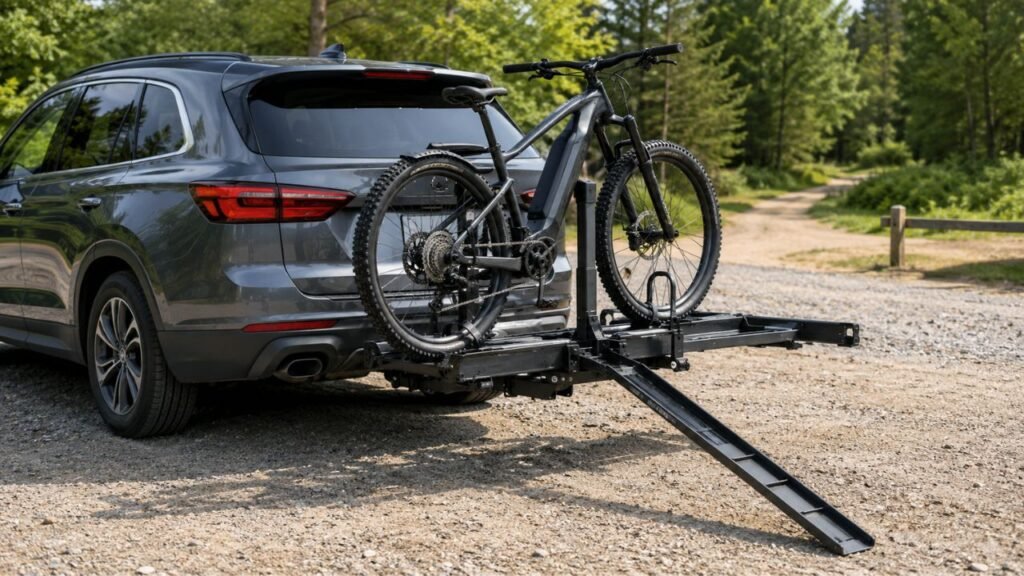
A lift-assist rack is generally easier to load than an e-bike rack with a ramp because the lifting mechanism raises much of the bike’s weight for you. A ramp still makes loading far easier than manually lifting an e-bike, but you must push, balance, and control the bike as it moves uphill.
That does not automatically make lift-assist the better choice for everyone. I’ll compare actual loading effort, ramp angle, vehicle height, bike weight, solo use, rack weight, compatibility, and everyday convenience so you can choose the system that fits you.
Key Takeaways
- Lift-assist racks usually require the least physical effort.
- Ramp racks remove most lifting but still require pushing.
- A steep ramp can make a heavy e-bike surprisingly difficult to control.
- Taller SUVs and pickups can make ramp loading harder.
- Lift-assist systems are generally heavier and more complex.
- Ramp racks are often simpler to install, remove, and maintain.
- Bike weight, wheelbase, tires, and hitch capacity still matter.
- The easiest rack to load may not be the easiest rack to own.
E-Bike Rack Ramp vs Lift-Assist Rack: Quick Comparison
Both systems solve the same basic problem differently. A ramp replaces lifting with rolling, while lift assist reduces how much physical work you perform during the entire loading process.
| Factor | Ramp E-Bike Rack | Lift-Assist E-Bike Rack |
| Physical lifting | Very little | Very little to almost none |
| Pushing effort | Moderate | Very low |
| Balance required | Moderate | Usually lower |
| Heavy e-bike loading | Good | Excellent |
| Solo loading | Good | Excellent |
| High SUV or truck | Can become harder | Usually easier |
| Uneven ground | Can affect ramp stability | Depends on rack design |
| Rack complexity | Low to moderate | Moderate to high |
| Electrical requirement | Usually none | Some models require power |
| Rack weight | Usually lighter | Often heavier |
| Maintenance | Generally simple | More moving components |
| Purchase cost | Usually lower | Usually higher |
| Best for | Most everyday riders | Maximum loading assistance |
If your main concern is minimum physical effort, lift assist has the advantage. If you simply want to avoid lifting a heavy e-bike from the ground, a ramp may already solve the problem.
What Is an E-Bike Rack With a Loading Ramp?
An e-bike rack with a ramp allows you to roll your bike from the ground onto the rack tray instead of lifting the bike vertically.
The ramp connects to or extends from the rack platform. You line up the bike’s tires with the ramp and slowly roll it upward until the wheels reach their trays.
Some racks keep the ramp attached to the carrier. Others use a removable ramp that stores separately or clips onto the rack.
The biggest advantage is simple. You avoid trying to lift a 50-, 60-, or 70-pound e-bike several feet off the ground.
However, the bike does not become weightless.
You still need enough strength and control to push it uphill. You also need to keep the handlebars steady while preventing the bike from tipping sideways or rolling backward.
That difference becomes important with heavier e-bikes.
What Is a Lift-Assist E-Bike Rack?
A lift-assist rack lowers the bike platform closer to the ground and then helps raise the loaded bike into its transport position.
Some systems use powered lifting mechanisms. Other designs may use mechanical assistance depending on the rack.
The important distinction is that the system does more than provide a path for the wheels. It actually reduces how much of the bike’s weight you must move upward yourself.
You typically position the bike on a lowered platform, secure it, and activate or release the lifting system. The platform then rises toward normal hitch height.
That is why lift assist is particularly useful for riders transporting very heavy e-bikes regularly.
Ramp vs Lift-Assist: Which Actually Requires Less Effort?
A ramp and a lift-assist rack can both eliminate traditional bike lifting, but they do not reduce physical effort equally. Several smaller factors determine how easy each one feels in real use.
Lifting Effort
Lift assist wins when we look only at vertical lifting.
With a properly designed lift-assist rack, you usually position the bicycle on a low platform rather than raising the bike to normal rack height yourself.
A ramp also removes most vertical lifting. The wheels remain on a surface while the bike moves upward.
However, you still provide the force needed to move it.
Pushing Effort
This is where ramp racks require noticeably more work.
Imagine pushing a 65-pound e-bike up a short hill. You are not lifting the full 65 pounds, but gravity still works against you.
The steeper the ramp becomes, the harder that push feels.
A lighter e-bike may roll up easily. A heavy fat-tire bike with accessories can feel very different.
Lift assist largely removes this uphill pushing requirement.
Balance and Side-to-Side Control
Weight is only one part of loading difficulty.
You must also prevent the bike from tipping left or right.
Heavy e-bikes can have tall handlebars, long frames, wide tires, or rear-mounted equipment. All of these features can make the bike awkward to balance.
With a ramp, you normally walk beside the bike while steering it upward.
A lift-assist platform usually lets you position the bike while everything remains closer to ground level.
That can make securing and balancing the bike feel much easier.
Ramp Angle and Vehicle Hitch Height
Ramp angle can completely change the loading experience.
A rack mounted behind a lower crossover may sit relatively close to the ground. The same style of rack behind a tall pickup can sit considerably higher.
Higher rack height creates a steeper climb unless the ramp becomes longer.
That means someone who easily loads a bike onto a crossover may struggle with the same bike behind a lifted truck.
Lift-assist systems have an advantage when they lower the actual platform closer to ground level.
Loading When You’re Tired
This is easy to overlook when shopping.
You may test a rack at home while rested. Real-world loading often happens after several hours of riding.
Your arms may be tired. Your grip may be weaker. Your legs may already feel worn out.
A loading method that seemed manageable in your driveway can feel very different after a long trail ride.
Frequent riders should consider that repeated effort, not just whether they can load the bike once.
Unloading Effort Matters Too
A ramp makes unloading easier than lifting, but gravity now works in the opposite direction.
A heavy e-bike can start rolling downhill faster than expected.
You must control its speed while keeping it centered on the ramp.
A lowering lift-assist platform can make unloading more controlled because the system brings the bike down before you remove it.
Why Ramp Length Can Make a Big Difference
Not all e-bike rack ramps provide the same loading experience. Ramp length strongly affects how steeply the bike must climb.
Short Ramp vs Long Ramp
A short ramp reaches the rack quickly, creating a steeper angle.
That compact design saves storage space but requires more pushing effort.
A longer ramp spreads the same height difference across more distance. The resulting incline feels shallower and easier to climb.
For a heavy e-bike, those extra inches of ramp can make a meaningful difference.
Why SUV and Truck Owners Should Pay Extra Attention
SUVs and pickups often place the receiver higher above the road.
That increased height can make a short loading ramp surprisingly steep.
Before choosing a ramp rack, think about the actual distance from the ground to the rack tray on your vehicle.
Do not judge ramp convenience from product photos alone.
Ground Space Is the Trade-Off
Longer ramps need more room behind the vehicle.
That may not matter in your driveway.
It can matter in a crowded trailhead, tight garage, busy campground, or narrow parking space.
A ramp that requires several feet of clear space can become inconvenient when another vehicle is parked close behind you.
How Easy Is It to Load an E-Bike With a Ramp?
Ramp loading is straightforward once you develop a routine. The goal is to keep the bike centered and controlled throughout the climb.
- Park on firm, reasonably level ground.
- Install or extend the loading ramp securely.
- Align the front wheel with the ramp.
- Stand beside the bike with both hands controlling it.
- Roll the bike slowly upward.
- Keep both tires centered on the ramp.
- Stop if the bike begins leaning heavily.
- Guide the wheels into their rack trays.
- Secure the bike using the rack’s required straps or arms.
- Stow the ramp properly before driving.
If your e-bike has walk assist, it may reduce pushing effort.
However, use it only when you can maintain complete control. Walk assist can move the bike faster than expected on a narrow ramp.
How Easy Is It to Load an E-Bike With Lift Assist?
A lift-assist system removes more physical work from the process. Exact steps vary between racks, but the basic sequence is similar.
- Lower the rack platform toward the ground.
- Position the e-bike on the wheel tray.
- Keep the bike upright while securing it.
- Attach the required wheel straps or retaining arms.
- Check that nothing blocks the moving platform.
- Activate or release the lifting mechanism.
- Allow the platform to rise into transport position.
- Lock or latch the rack as required.
- Recheck every bike attachment before driving.
Lift assist helps move the bikes, but it does not replace proper securing.
You still need to follow the rack manufacturer’s loading sequence carefully.
When Does a Ramp Become Hard to Use?
Ramp racks work very well for many riders. Problems usually appear when bike weight, rider strength, vehicle height, or ground conditions increase the difficulty.
Very Heavy E-Bikes
The heavier your bike becomes, the harder it is to push uphill.
A 45-pound e-bike can feel quite manageable.
A 70-pound bike with fat tires and accessories requires noticeably more control.
Removing a detachable battery may help, but the remaining bike must still stay within the rack’s per-bike weight rating.
High Hitch Receivers
A higher receiver places the rack farther from the ground.
That increases the ramp angle unless the manufacturer compensates with a longer ramp.
Tall trucks deserve extra attention here.
Short Loading Ramps
A compact ramp saves storage space but can create a steep climb.
If you already struggle to push your bike uphill, a short ramp may not provide enough assistance.
Loose Gravel, Grass, Mud, or Uneven Ground
The bottom of the ramp needs stable support.
Soft soil can allow it to sink. Gravel can shift underneath it.
Uneven terrain may also change the ramp angle or make the bike harder to balance.
Firm pavement generally provides the easiest loading conditions.
Limited Hand, Arm, or Balance Strength
You may have enough strength to push the bike but still struggle to control its sideways movement.
This is especially important with tall or top-heavy e-bikes.
If maintaining balance is the difficult part, lift assist may provide more benefit than a ramp.
When Does Lift Assist Make the Biggest Difference?
Lift assist becomes more valuable as bike weight, loading frequency, or physical effort increases.
Loading Heavy E-Bikes Frequently
Occasional ramp loading may feel perfectly manageable.
Doing it several times every week is different.
Even moderate physical effort becomes more noticeable when repeated regularly.
Loading Two E-Bikes
The first bike may be easy enough to handle.
Then you have to repeat the entire process.
For couples or families regularly carrying two heavy e-bikes, reducing the effort of each loading cycle can be worthwhile.
Loading Alone
Solo loading means you cannot ask someone else to steady the bike.
Lift assist can reduce the amount of time you spend holding a heavy bike at an awkward angle.
Riders Who Want to Minimize Strain
You do not need a medical condition to prefer easier loading.
Some riders simply want to avoid wrestling with a heavy bicycle every time they travel.
Lift assist is particularly appealing when reducing lifting and pushing is the highest priority.
Higher Vehicles
A ramp must bridge the height between the ground and rack.
A lift mechanism can lower the actual platform instead.
That can make the difference especially noticeable behind taller vehicles.
Ramp Rack vs Lift-Assist Rack for Different Riders
The better choice depends heavily on your bike, vehicle, strength, and how often you travel. This table gives you a practical starting point.
| Situation | Better Fit | Why |
| Lightweight e-bike | Ramp | Little extra assistance may be needed |
| 60- to 70-pound e-bike | Depends | Strength and ramp angle matter |
| Very heavy e-bike | Lift assist | Less pushing required |
| Two heavy e-bikes | Lift assist | Reduces repeated physical effort |
| Occasional transportation | Ramp | Simpler and often sufficient |
| Frequent transportation | Lift assist | Easier repeated loading |
| Rider prefers simple equipment | Ramp | Fewer moving components |
| Minimum physical effort matters | Lift assist | System moves more weight |
| Rack removed frequently | Ramp may help | Often lighter overall |
| Tall SUV or pickup | Lift assist often helps | Avoids steep ramp angles |
| No suitable vehicle electrical connection | Ramp | Most need no power |
| Tighter budget | Ramp | Usually simpler and less costly |
Your answer may still change after checking rack compatibility. Ease of loading means little if the rack cannot safely carry your exact bike.
Don’t Forget the Weight of the Rack Itself
A lift-assist system can make the bike easier to load while making the rack harder to handle.
That distinction matters.
Powered or mechanically assisted racks need additional hardware. Motors, lifting mechanisms, hinges, reinforced frames, and other components can increase rack weight.
If you plan to leave the rack installed most of the season, that may not bother you.
If you remove the rack after every ride, carrying a heavy rack into your garage could become the most difficult part of ownership.
Ramp racks are often simpler in this regard.
So remember one important rule:
The easiest rack to load is not always the easiest rack to own.
Vehicle and Hitch Compatibility Can Decide the Winner
Loading convenience comes second to compatibility. Before choosing either style, make sure your vehicle and hitch can safely support the complete setup.
Hitch Receiver Size
Heavy e-bike racks commonly use hitch-mounted platform designs.
Check the exact receiver size required by the rack.
Do not assume an adapter automatically makes an incompatible rack suitable.
Tongue Weight Capacity
Your hitch must support more than just the bikes.
Add together:
rack weight + bike one + bike two + attached accessories
Then compare that figure with both the vehicle and hitch limits.
Use the lower applicable capacity.
A rack that technically supports two 70-pound bikes may still be unsuitable if your vehicle cannot support the complete tongue weight.
Electrical Connection
Most basic ramp racks need no electrical power.
Some powered lift-assist systems do.
Depending on the model, you may need a specific trailer-style electrical connector.
Check this before buying rather than assuming every vehicle can power the rack.
Ground Clearance
Large racks extend behind the vehicle.
Driveway entrances, steep transitions, and deep dips can reduce clearance.
A low platform can be convenient while parked but vulnerable on certain roads.
Rear Hatch and Tailgate Access
Think about how often you use your cargo area.
A rack may tilt or swing away, but access varies considerably by design.
This becomes even more important once heavy bikes are loaded.
Your E-Bike Must Fit the Rack Too
A loading ramp or powered platform does not guarantee compatibility. Your bicycle still has to fit the rack safely.
Per-Bike Weight Capacity
Check the maximum weight allowed for each individual bike.
Do not rely only on the rack’s total capacity.
A rack rated for 140 pounds total does not automatically mean one tray can carry a 90-pound bike.
Wheelbase
Long-wheelbase e-bikes can extend beyond standard wheel trays.
Cargo e-bikes deserve special attention.
Measure your bike and compare it with the rack manufacturer’s maximum wheelbase.
Tire Width
Fat-tire e-bikes may require wider trays or longer straps.
Do not force an oversized tire into hardware designed for narrower wheels.
Fenders
Some rack designs hold the bike by contacting the tires.
Full fenders can interfere with certain wheel hooks or retaining arms.
Check where the rack contacts the bike before choosing it.
Step-Through Frames
Many modern racks work well with step-through e-bikes.
However, systems that require frame contact may need additional consideration.
Look carefully at how the rack secures the bicycle rather than assuming every platform rack works the same way.
Does Removing the E-Bike Battery Make Loading Easier?
Yes. Removing a detachable e-bike battery can make ramp loading and bike handling easier because you reduce the bike’s overall weight.
That can be especially helpful when balancing the bike on a narrow ramp.
Battery removal may also change the bike’s center of gravity.
However, follow your e-bike manufacturer’s recommendations for removing and transporting the battery.
Also remember that battery removal does not solve every compatibility problem.
The remaining bicycle still needs to fit within the rack’s weight, wheelbase, and tire limits.
Ramp Rack vs Lift Assist: Ownership Trade-Offs Beyond Loading
Loading difficulty matters, but you will interact with the rack in many other ways. Consider the entire ownership experience.
- Purchase price: Ramp systems are usually simpler.
- Rack weight: Lift-assist systems may weigh more.
- Installation: Heavier racks can be difficult to mount alone.
- Removal: Consider whether you’ll remove the rack frequently.
- Electrical components: Powered systems may require wiring.
- Moving parts: More mechanisms can mean more maintenance.
- Ramp storage: Removable ramps need a convenient storage location.
- Garage storage: Large racks can occupy substantial space.
- Repairability: Check replacement-part availability.
- Weather exposure: Moving components remain exposed outdoors.
- Hatch access: Make sure normal vehicle use remains practical.
- Lighting: Large racks may block taillights on some vehicles.
- License plate visibility: Confirm local requirements.
- Long-term maintenance: Follow lubrication and inspection recommendations.
These factors may change which rack feels easier after several months of ownership.
How to Decide Based on Your Own Loading Ability
You can learn a lot before purchasing anything. Try evaluating how you currently handle your e-bike.
- Can you comfortably keep the bike upright?
- Can you walk beside it without fighting its weight?
- Can you push it up a moderate slope?
- Can you stop it from rolling backward?
- Can you control it if the handlebars turn suddenly?
- Will you normally load without another person?
- Will you load after long or tiring rides?
- Are you transporting one bike or two?
- How high does your vehicle’s hitch sit?
- Will you remove the rack after every trip?
- Do you have enough space behind the vehicle for a long ramp?
If several of these tasks already feel difficult, lift assist may offer a meaningful improvement.
If they feel easy, a ramp may provide all the help you actually need.
Which Is Safer: A Ramp or Lift-Assist Rack?
Neither design is automatically safer in every situation. Safety depends on proper setup, bike control, weight limits, ground conditions, and following the manufacturer’s instructions.
Ramp-Loading Risks
A ramp can introduce several loading hazards.
The bike may roll backward if you stop pushing.
A narrow ramp also requires careful wheel alignment.
Other concerns include the ramp slipping, the bike leaning sideways, or your fingers getting caught near trays and clamps.
Loading on stable ground reduces many of these problems.
Lift-Assist Risks
Lift-assist systems introduce moving components.
Keep hands, clothing, straps, and bicycle parts clear of pinch points.
Do not activate the lift until the bicycle is positioned and secured as required.
Powered systems should also be inspected regularly for damage or unusual movement.
The Safest System Is the One You Can Control Properly
Do not choose a rack because it looks easy in a demonstration video.
Choose a loading system you can operate calmly and consistently.
If you have to fight the bike every time, the system is not making transportation easier.
Mistakes That Can Make Either Rack Harder to Use
Even a well-designed rack can become frustrating when important details are overlooked.
- Buying based only on total rack capacity.
- Ignoring the per-bike weight limit.
- Forgetting the rack’s own weight.
- Choosing a ramp that feels too steep.
- Ignoring the vehicle’s hitch height.
- Loading on loose or uneven ground.
- Using a ramp without securing it correctly.
- Standing directly where the bike could fall.
- Using walk assist without good control.
- Forgetting wheelbase limitations.
- Ignoring fat-tire compatibility.
- Overlooking fender interference.
- Exceeding hitch tongue-weight capacity.
- Assuming every 2-inch receiver has equal strength.
- Forgetting electrical requirements for powered racks.
Taking a few measurements before buying can prevent most of these problems.
Is a Lift-Assist Rack Worth Paying More For?
A lift-assist rack can be worth the additional cost when heavy-bike loading is something you do frequently.
The value is easiest to understand if loading currently feels like work.
If you regularly transport two heavy e-bikes, load alone, or dislike pushing bikes up ramps, powered or mechanical assistance can improve every trip.
However, occasional riders may not need that complexity.
If you can easily balance and push your bike, a well-designed ramp provides most of the practical benefit without adding another powered system to maintain.
Ramp or Lift Assist: Which Should You Choose?
There is no universal winner for every rider. Match the loading system to the type of effort you actually want to eliminate.
Choose a Ramp Rack If…
- You can comfortably push your e-bike uphill.
- You have good control over the bike’s balance.
- You transport bikes only occasionally.
- You prefer fewer moving components.
- Rack weight matters to you.
- You remove the rack frequently.
- You do not want vehicle electrical requirements.
- You want easier loading without paying for powered assistance.
For many riders, this is the sensible middle ground between lifting a bike manually and using a powered carrier.
Choose a Lift-Assist Rack If…
- Your e-bike is particularly heavy.
- You transport two heavy bikes regularly.
- You normally load without help.
- You want to minimize pushing and lifting.
- Ramp loading already feels difficult.
- Your vehicle sits high off the ground.
- You expect to load after tiring rides.
- Your hitch and vehicle support the rack.
- Your vehicle has any required electrical connection.
The additional assistance matters most when loading effort is already one of your biggest frustrations.
Neither Option Is Right Until Compatibility Is Confirmed
Before choosing either system, verify your bike weight, hitch capacity, receiver size, tire width, wheelbase, and rack contact points.
A convenient loading system still needs to transport your e-bike safely.
Final Verdict
A lift-assist rack makes loading easier overall because it removes more of the physical work. You position the bike lower, secure it, and let the mechanism handle much of the upward movement.
A ramp is still a major improvement over lifting a heavy e-bike onto a traditional rack. For many riders, it provides enough assistance while keeping the rack simpler, lighter, and easier to manage.
If you carry one moderately heavy e-bike and can comfortably push and balance it, I would lean toward a good ramp system.
If you regularly carry very heavy bikes, transport two bikes, load alone, or simply want the lowest-effort option, lift assist has the clear advantage.
The best choice is not just about how heavy your e-bike is. Think about how often you load it, how high your vehicle sits, how tired you’ll be after riding, and whether you want to handle a heavier rack between trips.
Related FAQs
Is an E-Bike Rack With a Ramp Easier to Load?
Yes. A ramp allows you to roll the bike onto the rack instead of lifting its full weight. You still need to push and balance the bike during loading.
Can One Person Load a Heavy E-Bike Using a Ramp?
Yes, many people can load a heavy e-bike alone with a ramp. Difficulty depends on bike weight, ramp angle, vehicle height, rider strength, and balance.
Can You Load a 70-Pound E-Bike Onto a Bike Rack?
Yes, provided the rack’s individual bike capacity supports at least that weight and the complete rack-and-bike combination remains within your hitch and vehicle limits.
Does Ramp Length Matter for an E-Bike Rack?
Yes. A longer ramp generally creates a shallower incline, which can make a heavy e-bike easier to push and control during loading.
Is a Longer E-Bike Loading Ramp Better?
A longer ramp is usually easier for heavy bikes or higher vehicles, although it requires more clear space behind the vehicle during loading.
Can I Use Walk Mode to Push My E-Bike Up a Rack Ramp?
You may be able to use walk assist if your e-bike manufacturer permits it. Keep the speed low and maintain complete control while the bike stays centered.
Should I Remove the E-Bike Battery Before Loading It?
Removing a detachable battery can reduce bike weight and make handling easier. Follow your bike manufacturer’s instructions for battery removal, storage, and transportation.
Do Lift-Assist Bike Racks Need Electricity?
Not every assisted design operates the same way, but some powered lift-assist racks require a vehicle electrical connection to raise and lower the platform.
Do All Lift-Assist E-Bike Racks Require a 7-Pin Connector?
No. Electrical requirements depend on the rack design. Check the specific rack’s instructions before assuming your vehicle already has the required connection.
Are Lift-Assist E-Bike Racks Heavier?
They often are because the rack may contain motors, lifting mechanisms, stronger frames, or additional hardware. Always check rack weight if you plan to remove it frequently.
Which Is Easier for Loading Two E-Bikes?
Lift assist usually requires less physical effort when loading two heavy e-bikes. A ramp can still work very well when both bikes are manageable for you.
Are E-Bike Rack Ramps Safe on SUVs and Pickup Trucks?
They can be safe when correctly installed and used within manufacturer limits. Higher vehicles may create steeper ramp angles, so ramp length becomes especially important.
Can a Ramp Be Too Steep for a Heavy E-Bike?
Yes. A steep ramp increases the pushing force required and can make the bike harder to balance or stop if it begins rolling backward.
What Happens If a Powered Bike Rack Stops Working?
The correct procedure depends on the rack. Some systems provide manual procedures or service options. Check the manufacturer’s instructions before operating a powered rack.
Is a Ramp or Lift-Assist Rack Better for a Fat-Tire E-Bike?
Either can work if the rack supports the bike’s weight, tire width, and wheelbase. Loading assistance alone does not guarantee fat-tire compatibility.

Ryan Mitchell writes for readers who prefer independent travel and practical outdoor motorhome living. His how-to guides and reviews focus on simplicity, durability, and real value. He brings a calm, hands-on perspective to every topic.