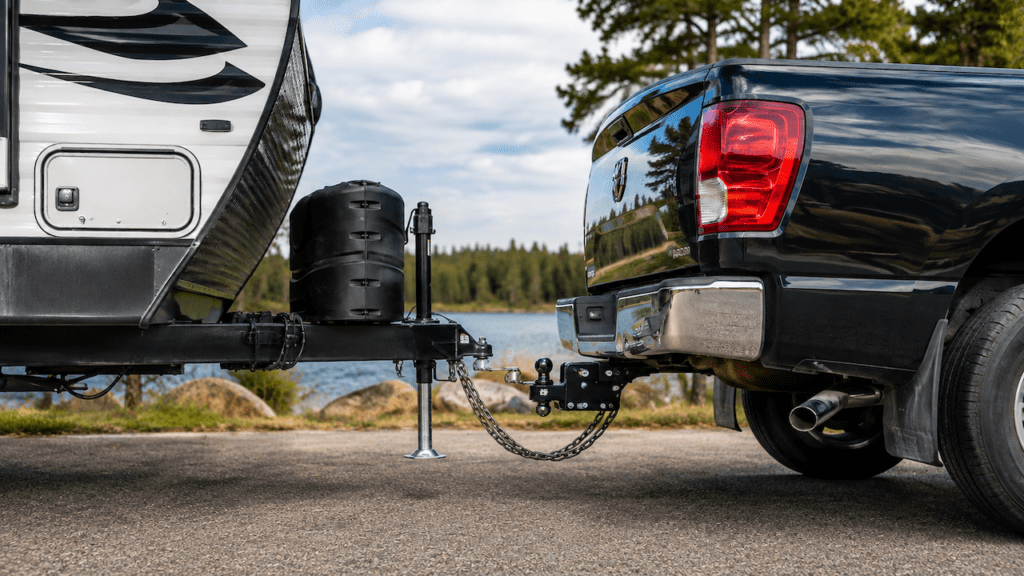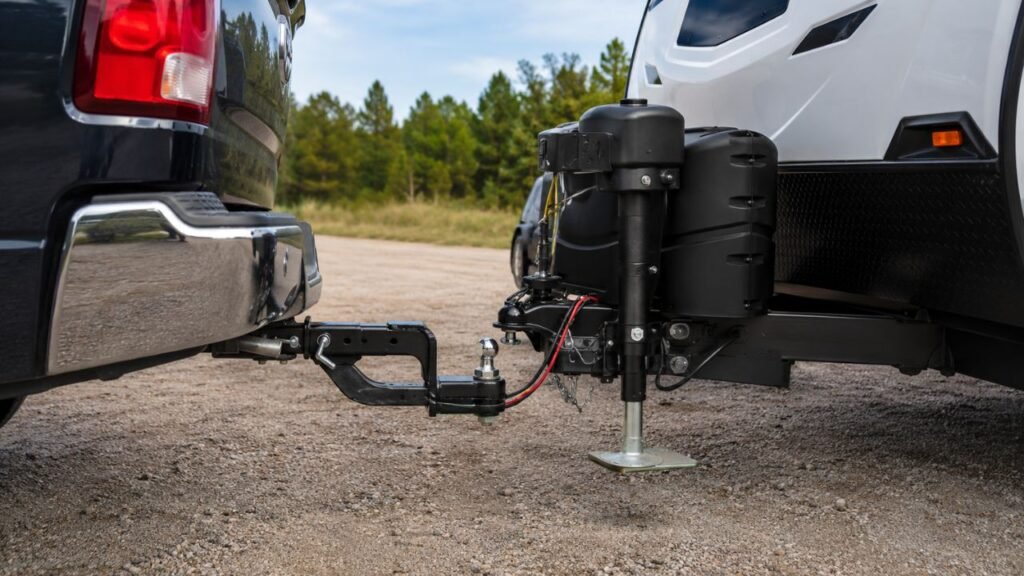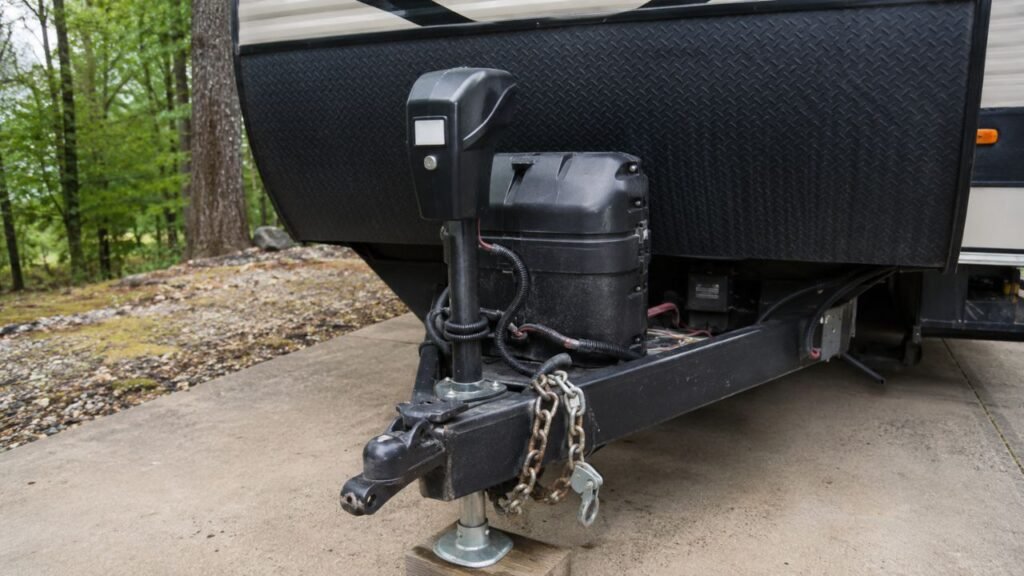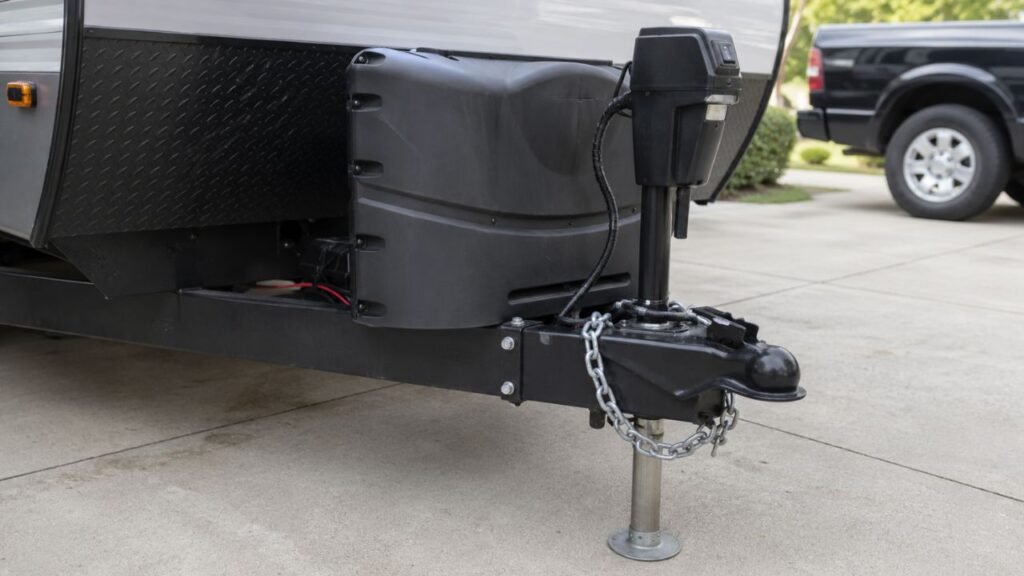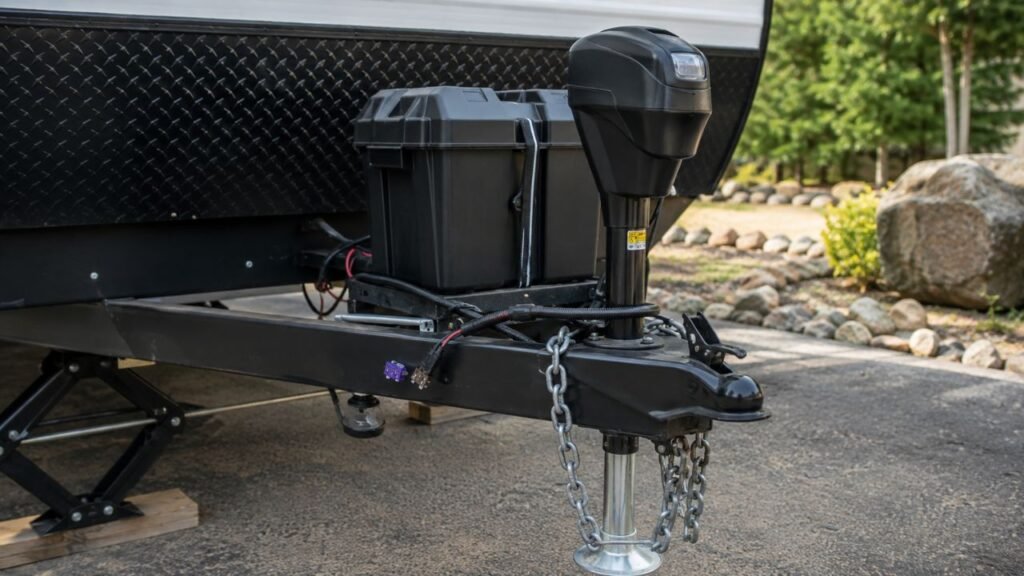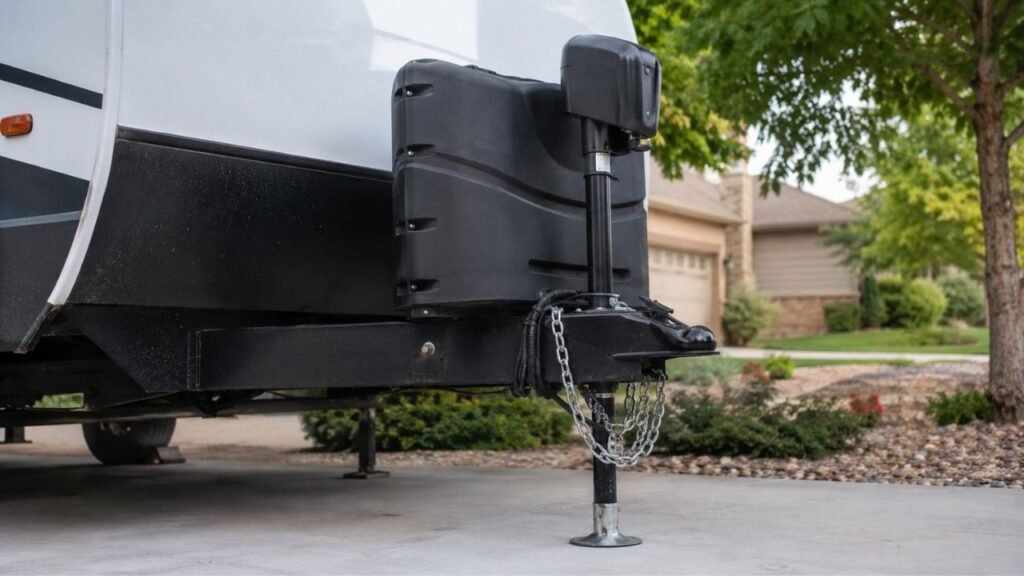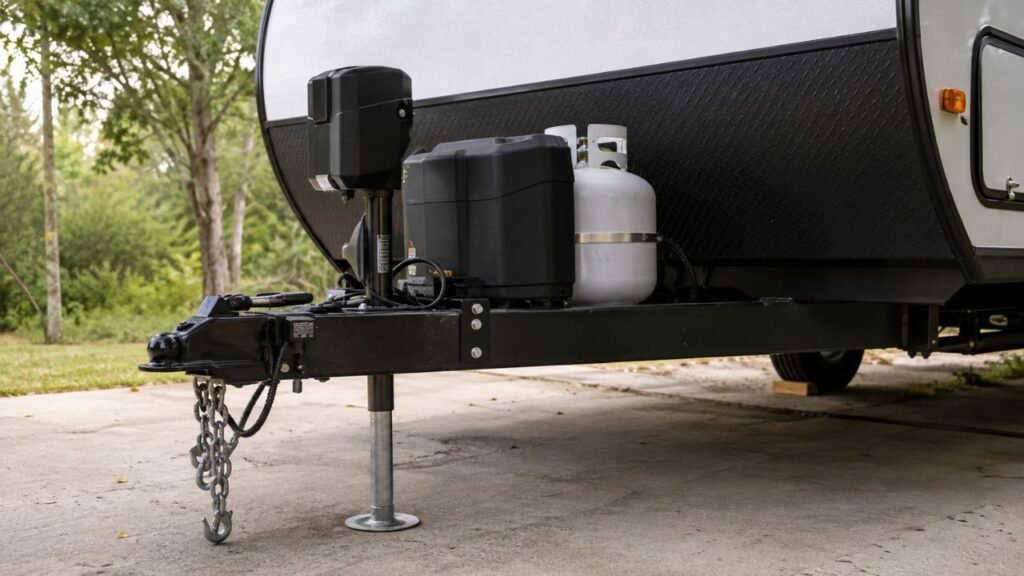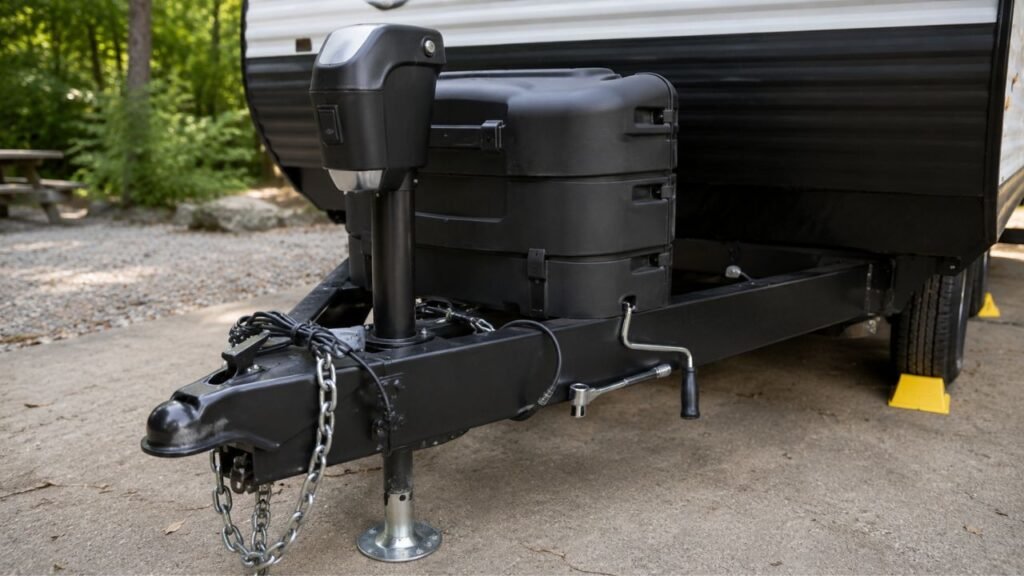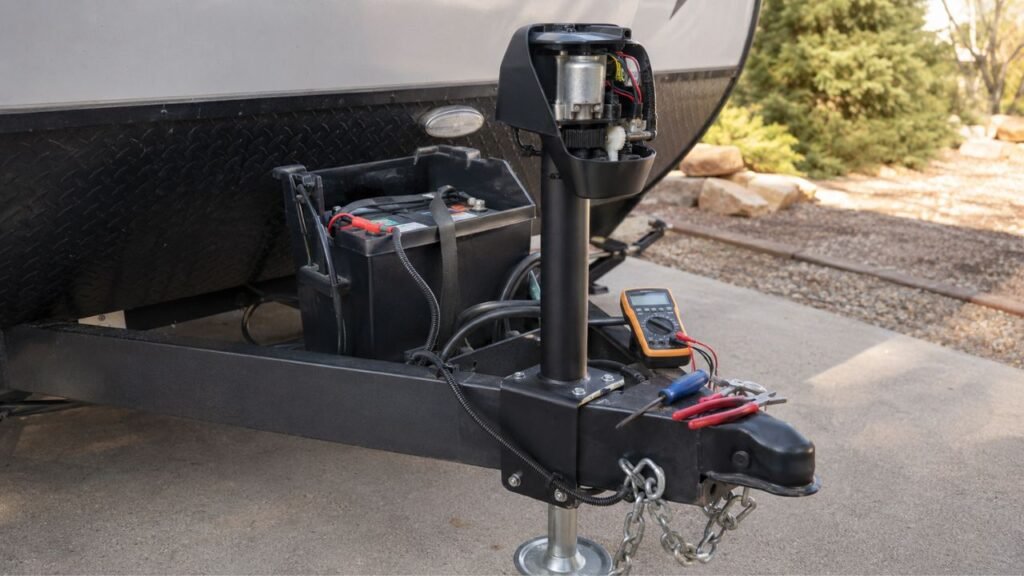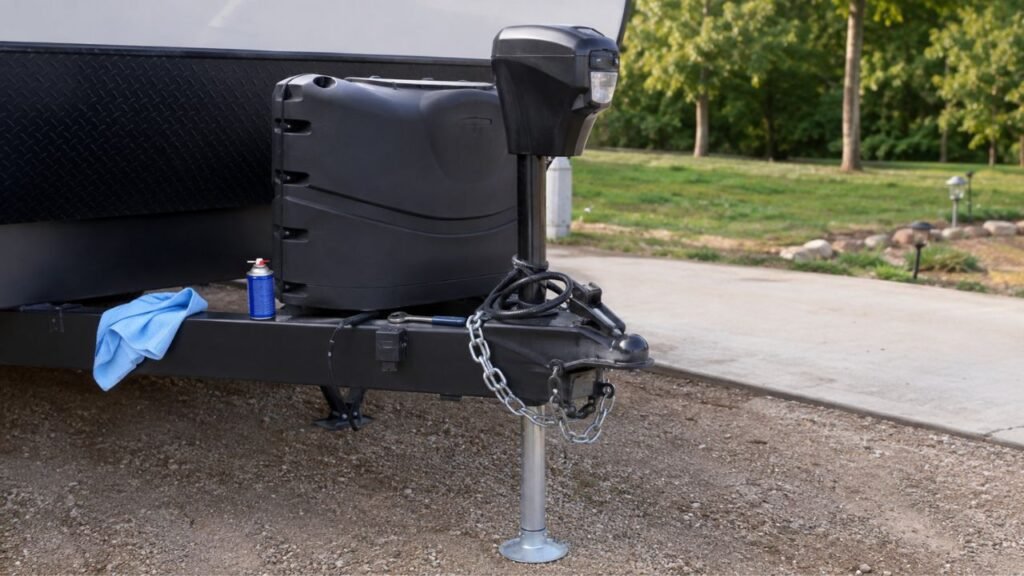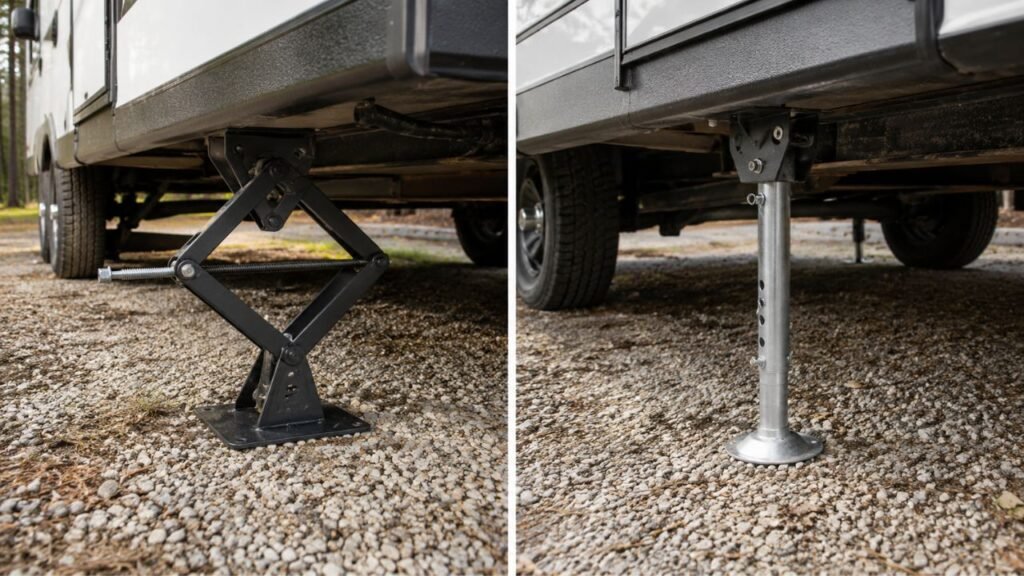
Scissor stabilizer jacks use folding X-shaped arms moved by a threaded screw. Telescoping stabilizer jacks use sliding or drop-down legs that extend toward the ground. Scissor jacks usually offer precise adjustment and higher-capacity options. Telescoping jacks usually deploy faster and require less cranking.
Both designs can reduce trailer movement when they are used correctly. However, their strength, setup speed, extension, maintenance, and mounting requirements differ. I’ll walk you through those differences so you can decide which design fits your RV better.
Key Takeaways
- Scissor stabilizer jacks use an X-shaped, screw-driven lifting mechanism.
- Telescoping stabilizers use sliding, drop-down, or swing-down support legs.
- Telescoping jacks usually reach the ground faster during campsite setup.
- Scissor jacks usually provide more gradual and precise final adjustment.
- Capacity ratings vary widely between brands and individual jack models.
- Stabilizer jacks should not automatically be used for leveling or lifting.
- Shorter stabilizer extension usually produces a firmer, steadier setup.
- Your RV frame and mounting arrangement may limit replacement options.
Scissor vs Telescoping Stabilizer Jacks: Quick Comparison
Both systems perform the same basic job: reducing movement inside a parked RV. Their mechanical designs, however, accomplish that job in very different ways.
| Feature | Scissor Stabilizer Jacks | Telescoping Stabilizer Jacks |
| Basic design | Folding X-shaped arms | Sliding or drop-down leg |
| Adjustment | Threaded screw | Drop leg plus final adjustment |
| Setup speed | Moderate | Usually faster |
| Fine adjustment | Excellent | Good |
| Capacity options | Often higher | Varies widely |
| Manual effort | More cranking | Usually less cranking |
| Extended shape | Wide folding mechanism | Straight or angled leg |
| Storage | Folds underneath trailer | Retracts or swings upward |
| Uneven ground | Good with proper setup | Good within extension range |
| Maintenance | Screw and pivot lubrication | Tubes, pins, pivots, screw |
| Common use | Travel trailers and campers | Campers, trailers, cargo trailers |
| Main advantage | Strength and fine control | Quick deployment |
| Main drawback | Slower operation | Long extension may increase movement |
The table gives you the basic picture. Now let’s look at what those differences mean during actual campsite use.
How Does a Scissor Stabilizer Jack Work?
A scissor stabilizer looks complicated, but its operation is fairly simple. The folding metal arms open and close as one central screw turns.
X-Shaped Scissor Mechanism
A scissor jack uses two sets of linked metal arms. Those arms cross each other and form an X shape.
When you rotate the drive screw, the arms move together horizontally. That movement forces the jack foot downward toward the ground.
Turning the screw in the opposite direction folds everything back together. The jack then sits compactly beneath the trailer.
This design creates a wide mechanical structure between the frame and ground. That is one reason scissor stabilizers are common on travel trailers.
Threaded Screw Provides Fine Adjustment
One advantage of the screw mechanism is precise adjustment.
Each small turn changes the stabilizer height slightly. That makes it easy to bring the foot into firm ground contact.
You can stop when the stabilizer becomes snug against the campsite surface. You do not need to force the trailer upward.
That controlled adjustment is useful when all four corners need similar pressure.
How the Jack Folds for Travel
When fully retracted, the arms fold almost flat underneath the RV.
That keeps most of the assembly away from the ground. However, you still need enough clearance beneath the trailer.
A damaged or partially retracted jack can hang dangerously low while towing. Always confirm every stabilizer is completely raised before leaving camp.
How Does a Telescoping Stabilizer Jack Work?
Telescoping stabilizers skip much of the repetitive cranking required by scissor jacks. They normally extend most of their length using a sliding or drop-down section.
The Sliding or Drop-Leg Section
A telescoping stabilizer usually contains an inner tube inside an outer tube.
You release the locking mechanism and extend the inner section downward. The leg can quickly move close to the ground.
That handles most of the required travel immediately.
Instead of cranking through several inches, you only make smaller final adjustments.
Pin, Lever, or Release Mechanism
Different models use different locking systems.
Some have removable pins that pass through adjustment holes. Others use spring-loaded pins, levers, or release handles.
Swing-down versions may first pivot away from the trailer frame. The telescoping section then extends toward the ground.
Always confirm the locking mechanism is fully engaged before applying pressure.
Final Screw Adjustment
Many telescoping stabilizers still have a small screw adjustment.
The telescoping leg handles the large distance quickly. The screw then provides the final contact pressure.
This combination makes setup noticeably faster in many situations.
You extend, lock, snug the jack, and move to the next corner.
Swing-Down vs Fixed Telescoping Designs
Not every telescoping stabilizer looks exactly the same.
Some mount permanently in a downward-facing position. Others swing upward against the frame while traveling.
Certain lightweight trailer stabilizers use a simple drop-leg design. Heavier RV systems may use more substantial telescoping frames.
Because designs vary, do not assume two telescoping jacks share identical capacities.
Scissor vs Telescoping Jacks: Which Provides Better Stability?
Both designs can stabilize an RV effectively when installed and adjusted correctly. Stability depends on more than the jack style alone.
Vertical Movement
Scissor and telescoping stabilizers both reduce vertical frame movement.
When someone walks inside your RV, weight shifts through the floor. That movement can flex the suspension, tires, frame, and stabilizers.
Firm ground contact helps limit that motion.
Scissor jacks often feel solid because their folding structure creates broad support. A well-designed telescoping jack can also provide excellent vertical support.
Side-to-Side Movement
This is where things become more complicated.
Neither stabilizer design completely removes lateral movement by itself.
Your trailer tires can flex sideways. Suspension components can move slightly. The frame can also twist under changing loads.
A long, fully extended stabilizer may allow more noticeable movement. That applies to both designs, although the movement can feel different.
If side-to-side motion remains annoying, additional approved stabilizer bracing may help.
Fore-and-Aft Movement
Walking inside your RV can also create front-to-back movement.
Stabilizer jacks reduce some of this motion. However, they cannot completely immobilize the suspension and tires.
Proper wheel chocks are therefore important.
On tandem-axle trailers, movement between the tires can also contribute to rocking.
Why Jack Extension Matters
This is one of the biggest factors affecting stability.
A stabilizer usually feels firmer when it is not excessively extended. Longer extension gives the structure more opportunity to flex.
You can often reduce extension by placing proper stabilizer pads underneath.
The goal is not to build an unsafe tower. Use stable pads designed for the load and surface.
A shorter, properly supported stabilizer often feels much more solid.
Which Type Is Stronger?
Scissor stabilizers are commonly available with higher advertised capacity ratings. However, the actual rating depends entirely on the specific product.
Scissor Jack Load Capacity
Scissor jacks use a substantial mechanical framework and threaded drive screw.
Many RV versions are designed to handle considerable static stabilization loads. Heavy-duty models may have much higher ratings than lightweight alternatives.
However, a large capacity number does not change the intended purpose.
A stabilizer can have a high rating while still being unsuitable for lifting.
Telescoping Jack Load Capacity
Telescoping stabilizers cover a much broader range of designs.
A lightweight swing-down trailer stabilizer may support relatively modest loads. A heavier RV telescoping system may support substantially more.
This makes broad comparisons difficult.
Always compare the actual manufacturer rating for each jack you are considering.
Static Capacity vs Lifting Capacity
This distinction matters more than many RV owners realize.
A static or support capacity describes the load a jack can support. It does not necessarily mean the jack can safely lift that weight.
A lifting capacity specifically describes an approved lifting function.
Many stabilizers are designed only to support movement after leveling.
Never assume a 5,000-pound stabilizer can lift 5,000 pounds. Check the manual and product instructions before applying lifting force.
Can You Use Either Stabilizer Jack to Level or Lift an RV?
Normally, stabilizer jacks should stabilize an already leveled RV rather than lift or level it. Use leveling blocks, tongue jacks, landing gear, or an approved leveling system for actual leveling.
This point causes plenty of confusion because some products carry large weight ratings.
You may think a strong scissor jack can lift a low corner. Mechanically, it might start moving the frame upward.
That does not mean the frame or jack is designed for that load.
You could bend the stabilizer, twist its mounting bracket, or stress the RV frame.
The safer sequence is simple.
Level the RV first. Chock the wheels. Then lower the stabilizers until they make firm contact.
If your particular manufacturer specifically approves another procedure, follow that procedure instead.
Which Stabilizer Jack Is Faster to Set Up?
Setup speed is one area where telescoping stabilizers usually have an advantage. They can cover most of their travel without turning a long screw.
Scissor Jack Setup
A scissor jack must open from its folded position.
That requires multiple rotations of the drive screw.
A hand crank works reliably but can become tiring. Many RV owners use a cordless drill with the appropriate socket.
That can make deployment considerably faster.
Still, the mechanism needs to move through most of its range mechanically.
Telescoping Jack Setup
Telescoping stabilizers can skip much of that process.
You release the leg and extend it close to the ground. Then you lock the leg into position.
Only a small amount of final adjustment remains.
If you move campsites frequently, this difference can become noticeable.
Be Careful With Impact Drivers
Power tools make stabilizer setup easier, but excessive torque can damage components.
An impact driver can rapidly overload a screw, gearbox, pin, or mounting bracket.
If your manufacturer allows power operation, use a drill with controlled torque.
Slow down as the stabilizer reaches the ground.
You only need firm contact. Hammering the jack tight does not improve stability.
Which Works Better on Uneven Campsites?
Both designs can handle uneven campsites when they have enough adjustment range. The important part is keeping the trailer level before stabilization begins.
Scissor Jacks on Uneven Ground
Scissor jacks often provide a generous vertical adjustment range.
That helps when one corner sits noticeably higher than another.
The threaded screw also gives you excellent final control.
However, avoid extending the jack unnecessarily far when a stable pad could reduce the distance.
Telescoping Jacks on Uneven Ground
Telescoping jacks adapt quickly to different frame-to-ground distances.
You can drop each leg independently until it approaches the surface.
That makes campsite setup efficient when the ground height changes between corners.
Again, stay within the manufacturer’s approved extension range.
Why Stabilizer Blocks Can Help Both Designs
Stabilizer pads reduce the empty space beneath the jack.
That means the jack does not need to extend as far.
A larger pad can also spread the load across soft ground.
This helps prevent the foot from sinking overnight.
However, stabilizer pads do not replace proper tire leveling blocks. They serve different purposes.
Ground Clearance and Storage While Towing
Your stabilizers spend more time retracted than deployed. Their travel position therefore matters almost as much as campsite performance.
Retracted Height of Scissor Jacks
Scissor jacks fold into a fairly compact shape.
Even so, the bottom of the mechanism may remain below the trailer frame.
That can matter on low-clearance travel trailers.
Check clearance around curbs, steep driveways, campsite entrances, and uneven roads.
A bent stabilizer often starts with an unnoticed ground strike.
How Telescoping Jacks Store
Telescoping designs use several storage arrangements.
Some retract vertically toward the frame. Others swing horizontally into a travel position.
Swing-up designs can offer useful clearance when properly folded.
However, the locking mechanism must hold the jack securely during travel.
Which Has Better Road Clearance?
There is no universal winner.
Ground clearance depends on the actual mounting position and retracted dimensions.
Check:
- Distance from the lowest jack point to the ground
- Rear departure angle
- Suspension travel
- Mounting location
- Tire clearance
- Frame clearance
- Storage position
Do not choose a jack based only on its extended height.
Installation Differences
Replacing stabilizers is not always a simple bolt-on swap. The trailer frame and existing mounting points determine what will actually fit.
Installing Scissor Stabilizer Jacks
Scissor jacks commonly attach directly beneath the RV frame.
Some models bolt into existing brackets. Others require different mounting hardware.
Before installing one, check the mounting surface carefully.
The jack needs enough space to open without contacting plumbing, wiring, tanks, or suspension parts.
You also need easy access to the drive screw.
Installing Telescoping Stabilizer Jacks
Telescoping jacks may require different brackets or mounting geometry.
Swing-down versions need enough room to pivot safely.
Drop-leg systems need unobstructed space beneath the extension path.
The release pin or handle should also remain accessible.
Poor placement can make a convenient jack frustrating to use.
Can You Replace One Type With the Other?
Sometimes you can, but do not assume direct compatibility.
Compare:
- Frame construction
- Mounting-hole spacing
- Available mounting surface
- Ground-to-frame height
- Required extension
- Retracted dimensions
- Suspension clearance
- Plumbing and wiring locations
- Manufacturer recommendations
A stabilizer upgrade should not weaken or unnecessarily modify the RV frame.
If structural drilling or welding is required, professional installation is worth considering.
Which Type Requires More Maintenance?
Neither design requires complicated maintenance. Still, both work better when you keep moving parts clean and protected.
Scissor Jack Maintenance
Scissor jacks have several exposed moving components.
Pay attention to:
- Threaded drive screw
- Pivot bolts
- Folding joints
- Mounting hardware
- Foot plate
- Corrosion
- Bent arms
Clean dirt from the screw before adding the recommended lubricant.
A dirty screw coated with heavy grease can collect grit quickly.
Telescoping Jack Maintenance
Telescoping stabilizers depend on smooth sliding surfaces and working locks.
Inspect:
- Inner tube
- Outer tube
- Locking pin
- Release lever
- Pivot point
- Final adjustment screw
- Mounting hardware
Rust on the inner tube can make extension difficult.
Do not force a stuck leg with excessive leverage. Clean and inspect it first.
Which Is Easier to Repair?
Both manual designs are mechanically straightforward.
Scissor jacks have more pivoting links and a long screw mechanism.
Telescoping jacks rely heavily on straight tubes and locking components.
Minor issues are often easy to identify visually.
A bent structural component, however, usually deserves replacement rather than straightening.
Common Problems With Each Stabilizer Design
Knowing the typical problems helps you catch damage before your next trip. Most failures begin with corrosion, overloading, impact, or excessive extension.
Common Scissor Jack Problems
- The drive screw becomes difficult to turn.
- Folding arms bend from excessive side loading.
- Pivot joints become loose after repeated use.
- Dirt and corrosion make the jack bind.
- Excessive extension creates noticeable trailer movement.
- The jack foot sinks into soft soil.
- Mounting bolts loosen underneath the trailer.
- The mechanism becomes damaged after a ground strike.
Common Telescoping Jack Problems
- The inner tube becomes difficult to slide.
- Locking pins become rusty or difficult to remove.
- Release levers bind after exposure to dirt.
- Tubes bend under excessive lateral force.
- The foot sinks into soft ground.
- Corrosion prevents smooth extension.
- Pivoting models develop movement at their brackets.
- The jack fails to lock completely before loading.
If any stabilizer looks bent, cracked, or badly corroded, replace it.
Scissor vs Telescoping Stabilizers for Different RVs
There is no single stabilizer design that fits every trailer. Trailer weight, frame height, mounting space, and factory design all matter.
Travel Trailers
Scissor stabilizers are extremely common on travel trailers.
Their long extension range and simple operation suit many frame layouts.
Telescoping stabilizers can also work very well when the trailer supports their mounting design.
If your existing system performs correctly, changing styles may offer little benefit.
Lightweight Campers and Cargo Trailers
Telescoping and swing-down stabilizers are common on smaller trailers.
Their simple construction and quick deployment work well for frequent stops.
Some lightweight campers also use compact scissor jacks.
The correct choice depends more on capacity and frame design than trailer category.
Fifth Wheels
Fifth wheels already use landing gear at the front.
Rear stabilizers can help reduce frame movement after the trailer is leveled.
Depending on the RV design, either scissor or telescoping rear stabilizers may work.
Follow the RV manufacturer’s mounting and stabilization recommendations.
High-Clearance Trailers
High-clearance trailers require more stabilizer reach.
That makes extension range especially important.
A long telescoping drop leg may reach the ground quickly.
A tall scissor jack may also provide enough range.
Whichever design you use, avoid unnecessarily long unsupported extension.
Scissor or Telescoping Stabilizer Jacks: Which Should You Choose?
Neither jack wins every comparison. So you need to choose based on how you actually camp and what your trailer supports.
Choose scissor stabilizer jacks if you:
- Want precise screw adjustment.
- Prefer a common travel-trailer stabilizer design.
- Need higher-capacity model options.
- Want a broad range of replacement choices.
- Do not mind slightly more setup time.
- Want straightforward mechanical operation.
Choose telescoping stabilizer jacks if you:
- Want faster campsite setup.
- Prefer less full-range cranking.
- Have compatible factory mounting points.
- Want quick height adjustment.
- Own a lightweight trailer suited to the design.
- Frequently move between campsites.
There is also nothing wrong with keeping your existing stabilizers.
If they are straight, safe, properly rated, and sufficiently stable, replacement may not improve much.
How to Get More Stability From Either Jack Type
Changing stabilizer styles is not always necessary. A few setup improvements can often reduce trailer movement significantly.
- Level the RV before lowering your stabilizers.
- Chock the wheels before final stabilization.
- Keep stabilizer extension reasonably short.
- Use sturdy pads on soft or uneven surfaces.
- Avoid tall or unstable stacks beneath jack feet.
- Lower each stabilizer until it becomes firmly snug.
- Do not aggressively lift the RV frame.
- Recheck stabilizers after soft ground settles.
- Inspect mounting bolts throughout the camping season.
- Check for bent arms, tubes, feet, or brackets.
- Consider approved cross-bracing for persistent lateral movement.
If your RV still shakes, the stabilizers may not be the problem.
Tire flex, suspension movement, frame flex, and wheel movement can all contribute.
Final Verdict
Scissor stabilizer jacks usually make more sense when you want precise adjustment, widely available replacement options, and higher-capacity models. Telescoping stabilizer jacks are appealing when fast deployment and reduced cranking matter more.
Neither design is automatically more stable on every RV.
The final result depends on jack extension, mounting location, frame stiffness, ground conditions, wheel movement, and proper setup.
Most importantly, compare the exact manufacturer’s specifications before replacing anything. Do not judge a stabilizer only by its advertised capacity.
If your existing system works safely and keeps the RV steady, you probably do not need to change it. Good setup often matters more than switching between these two designs.
Related FAQs
Are Scissor Jacks More Stable Than Telescoping Stabilizer Jacks?
Scissor jacks can feel very solid because their folding structure creates broad mechanical support. However, a properly sized telescoping stabilizer can work equally well. Extension length, mounting position, frame flex, and ground conditions often influence stability more than jack style.
Are Telescoping Stabilizer Jacks Strong Enough for Travel Trailers?
Yes, many telescoping stabilizers can safely support travel trailers when properly rated. Always check the individual jack’s capacity and intended application because ratings vary greatly between lightweight and heavy-duty telescoping designs.
Can Scissor Stabilizer Jacks Level a Travel Trailer?
Usually, scissor stabilizers should support an already leveled trailer rather than perform the leveling itself. Level side-to-side with proper leveling methods and front-to-back with the tongue jack before lowering the stabilizers.
Can You Lift an RV With Scissor Stabilizer Jacks?
Do not lift an RV with a scissor stabilizer unless the manufacturer specifically approves that use. A high static capacity does not automatically mean the jack, mounting bracket, or RV frame is designed for lifting.
Can You Use a Drill on Scissor Stabilizer Jacks?
You can use a cordless drill on many scissor stabilizers when the manufacturer permits it. Use controlled speed and torque, and stop once the foot becomes firmly snug. Avoid hammering the mechanism tight with a powerful impact driver.
Do Telescoping Stabilizer Jacks Need Blocks Under Them?
They do not always need blocks, but proper stabilizer pads can reduce excessive extension and prevent the foot from sinking into soft ground. Use stable pads rather than tall, loosely stacked materials.
Why Does My RV Still Shake With Four Stabilizer Jacks Down?
Your RV can still shake because the tires, suspension, frame, and wheel assemblies continue moving slightly. Excessively extended stabilizers can also flex. Proper wheel chocking, shorter jack extension, firm pads, and approved bracing may improve stability.
Should Stabilizer Jacks Be Fully Extended?
Avoid fully extending stabilizer jacks unless the campsite requires it and the manufacturer allows it. Keeping the extension shorter usually creates a firmer setup and reduces leverage on the jack and mounting brackets.
Can I Replace Telescoping Stabilizers With Scissor Jacks?
You may be able to replace telescoping stabilizers with scissor jacks if the frame, mounting surface, clearance, and capacity requirements are compatible. Confirm mounting specifications before drilling, welding, or changing the original stabilizer arrangement.
How Tight Should RV Stabilizer Jacks Be?
Stabilizer jacks should make firm contact with the ground without aggressively lifting the trailer. Lower each jack until it becomes snug and removes movement, then stop before placing unnecessary force on the frame.

Ryan Mitchell writes for readers who prefer independent travel and practical outdoor motorhome living. His how-to guides and reviews focus on simplicity, durability, and real value. He brings a calm, hands-on perspective to every topic.